Clear Sky Science · en
A multi-scenario evaluation of adaptive Fuzzy Logic Algorithms for intelligent traffic signal management in Urban intersections
Why smarter traffic lights matter
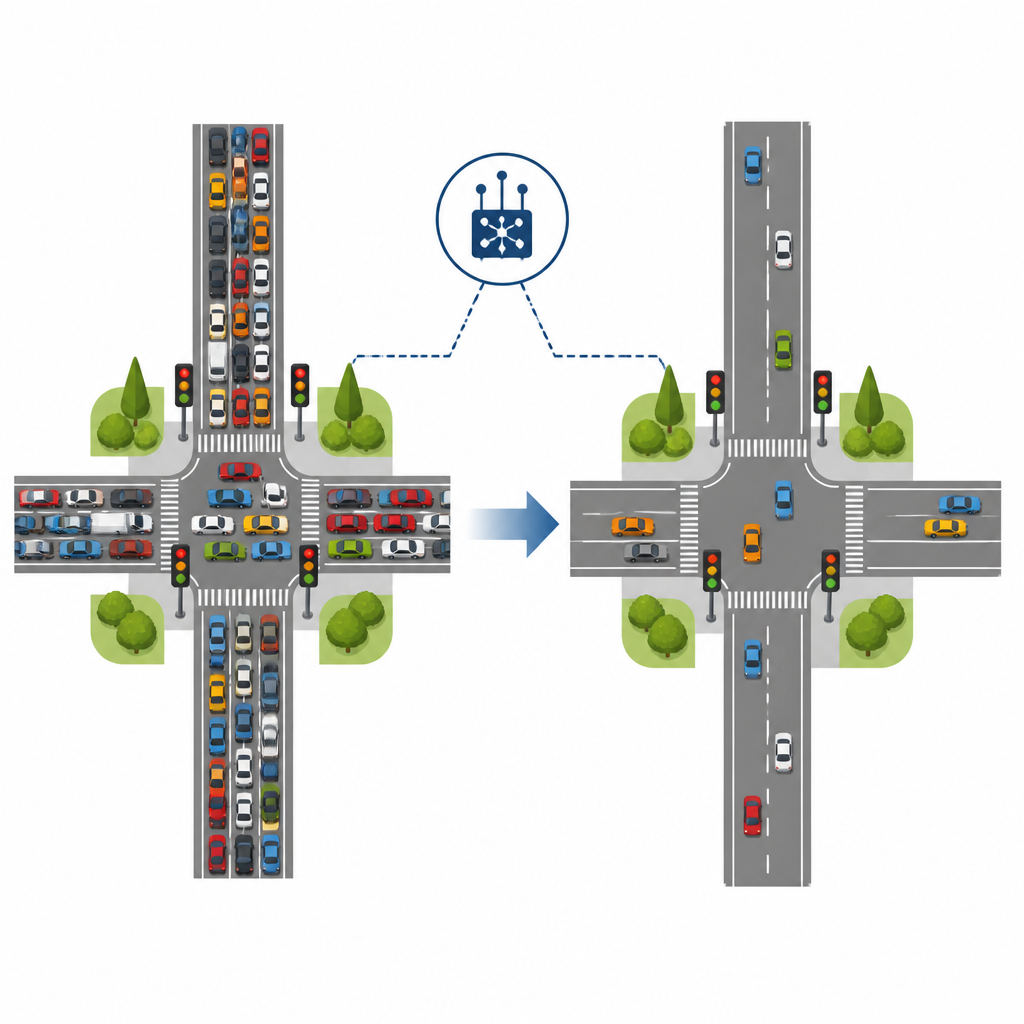
Anyone who has sat at a red light with no cars coming the other way has felt how wasteful rigid signals can be. This study looks at how smarter traffic lights, guided by advanced decision rules, can cut queues, shorten delays, and reduce fuel waste at busy crossroads. By testing new control methods in many different traffic situations, the researchers show how intersections can react in real time instead of following a fixed script.
The problem with rigid signal timings
Most city intersections still run on fixed schedules that repeat the same pattern over and over. These plans are simple to set and maintain, but they cannot keep up when traffic is uneven, suddenly increases, or shifts direction. The result is familiar: long queues, wasted time, extra fuel burned, and more exhaust in the air. Even more advanced systems that adjust timings along a corridor often react slowly and focus on one main goal, such as delay, without balancing other concerns like emissions. The authors argue that crossroads in fast-growing cities need controllers that can cope with randomness, imbalance between directions, and incomplete information.
Two ways to let signals “reason” about traffic
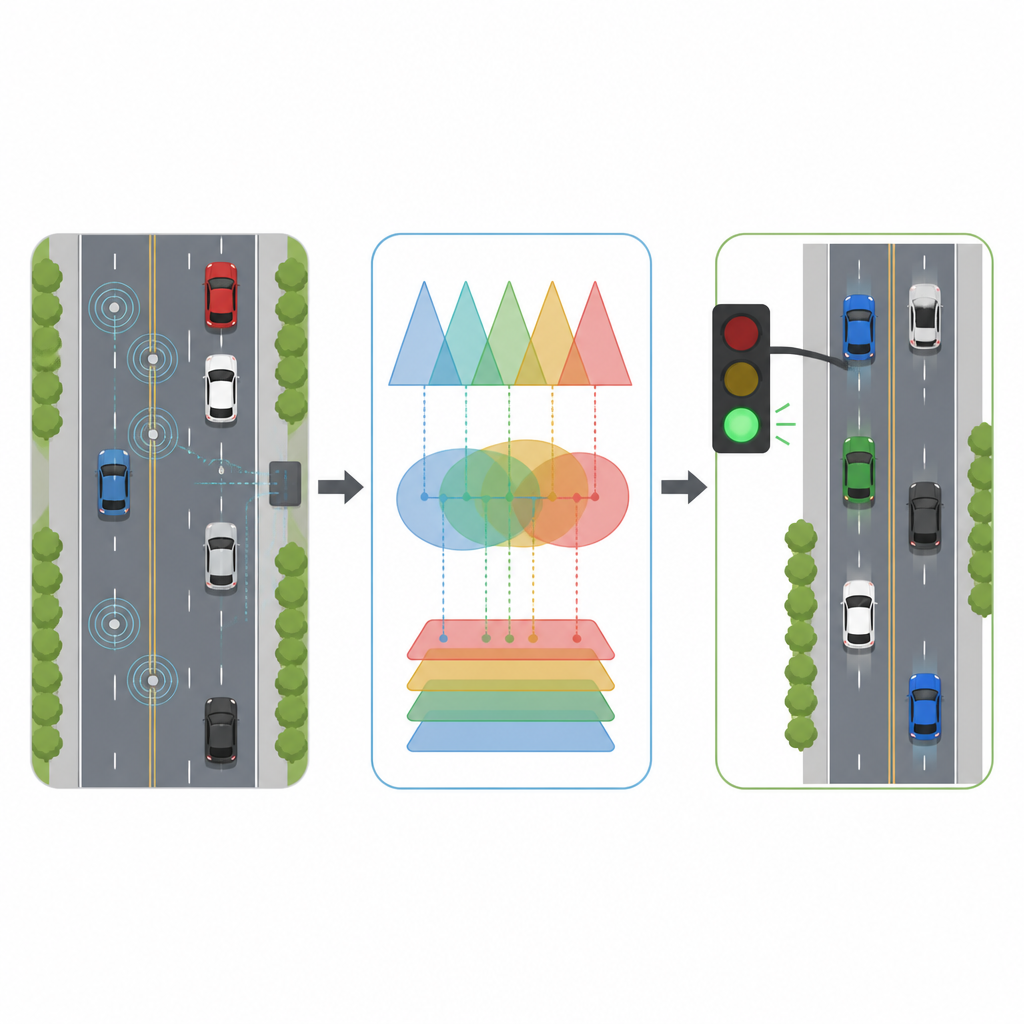
The study tests two families of fuzzy logic controllers. Fuzzy logic is a way for machines to reason with shades of gray rather than strict yes or no rules, which is useful when traffic data is noisy and conditions change quickly. The first method, called MIFLA, allows the controller to weigh not only how strongly a rule seems true or false, but also how unsure it is, which encourages cautious changes instead of abrupt swings. The second, called MIT2FL, goes further by treating key inputs like queue length and road capacity as ranges instead of single numbers. This lets the controller directly represent uncertainty and still settle on a sensible green time using a structured calculation.
Putting smart signals to the test
To compare these approaches fairly, the team built a detailed four-way intersection in the SUMO traffic simulator and fed it nine different demand patterns. These ranged from light to very heavy flows, and from evenly balanced to strongly skewed toward certain directions, mimicking rush-hour peaks. Inductive loops in the virtual roads measured queues, and the controllers repeatedly adjusted green times in response. A traditional fixed-time method known as Modified Webster served as the baseline. For each scenario, the researchers tracked average queue length, waiting time, and extra travel time beyond free-flow conditions, repeating runs until the patterns were stable.
How much better can intersections perform
Across all nine scenarios, both fuzzy controllers beat the fixed-time plan, often by a large margin. Under light and medium demand, they cut average queues by roughly one-quarter to one-half and slashed waiting times, sometimes by more than 70 percent. Under these easier conditions, the two fuzzy approaches performed similarly, showing that even modest uncertainty handling helps. Under heavy and unbalanced flows, however, MIT2FL pulled ahead. Its interval-based reasoning produced smoother, faster reductions in queues, less variation from cycle to cycle, and lower remaining congestion than MIFLA. Importantly, these gains came with only a few thousandths of a second of computing time per decision, well within what real hardware at an intersection can handle.
What this means for everyday travel
For everyday drivers, the message is that traffic lights do not have to be dumb timers. By using decision rules that accept uncertainty instead of ignoring it, intersections can adapt to changing volumes and uneven flows, shortening queues and delays while limiting fuel waste and emissions. The study shows that more advanced fuzzy logic, as in the MIT2FL controller, offers the strongest benefits when traffic is heavy and lopsided, which are exactly the moments people feel congestion most. Though tested in simulation at a single crossroads, this work lays out a reproducible way to design and compare smart controllers, pointing toward future city networks where lights cooperate to keep people and goods moving more smoothly.
Citation: Shaheen, S., Qadri, S.S.S.M., Riaz, M.B. et al. A multi-scenario evaluation of adaptive Fuzzy Logic Algorithms for intelligent traffic signal management in Urban intersections. Sci Rep 16, 15273 (2026). https://doi.org/10.1038/s41598-026-44017-2
Keywords: adaptive traffic signals, fuzzy logic control, urban intersections, traffic simulation, smart cities