Clear Sky Science · en
Frugivore richness poorly predicts seed dispersal effectiveness under climate change
Why the Fate of Forests Depends on Hungry Animals
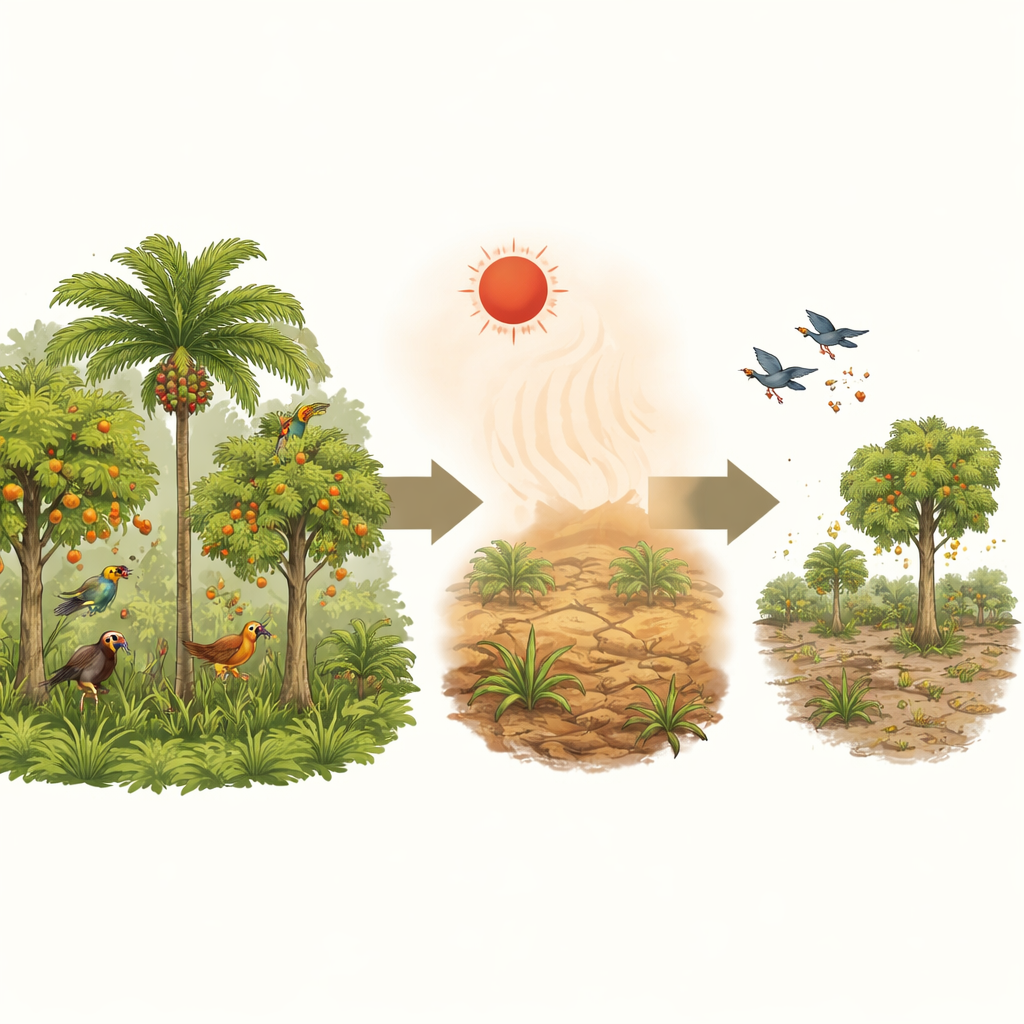
Tropical forests do not regenerate by magic: they rely on fruit‑eating animals that swallow or carry seeds and drop them in new places. As the climate warms and becomes drier, many of these animals are changing where they can live. This study asks a deceptively simple question with big implications for forest health: is just counting how many fruit‑eating species are present enough to know whether trees will still get their seeds dispersed, or does it matter which particular animals remain?
How Fruit Eaters Keep Forests Alive
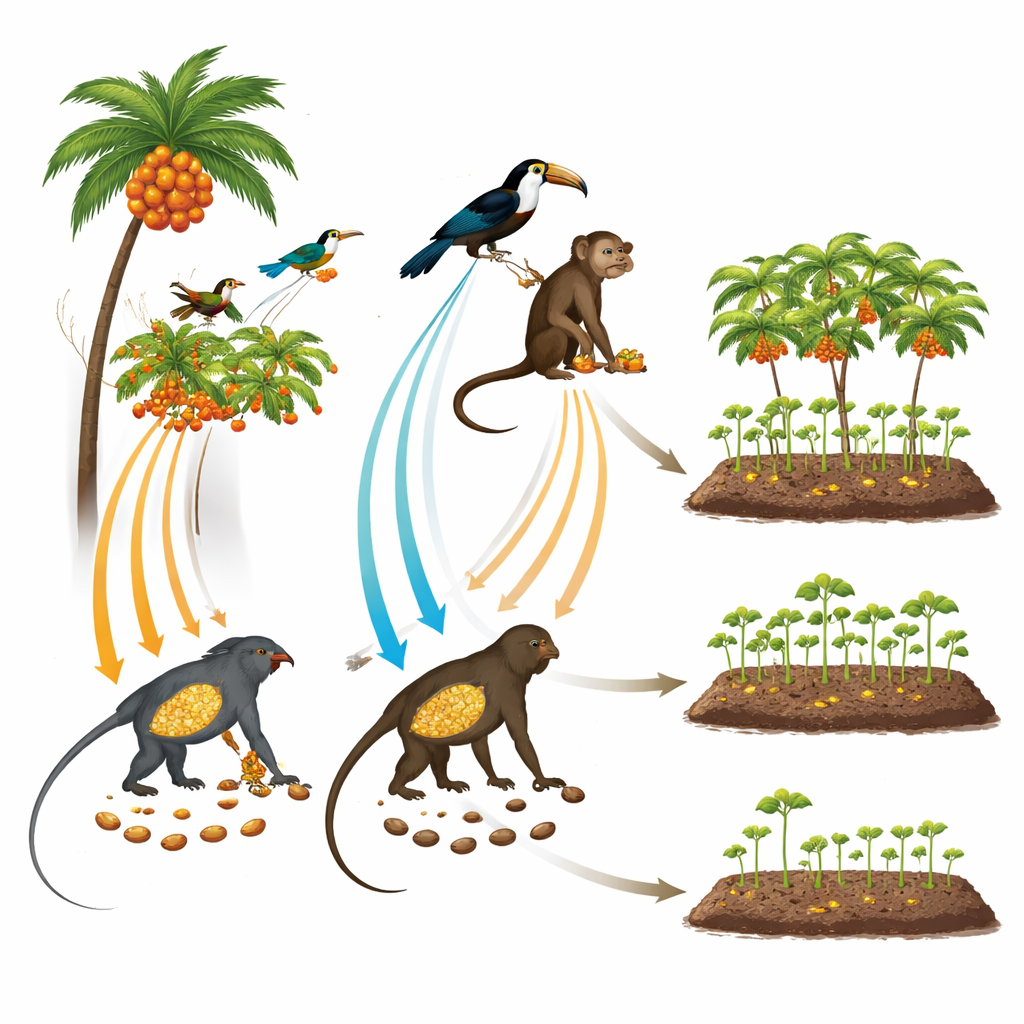
In Brazil’s Atlantic Forest, up to nine out of ten woody plant species depend on vertebrates such as birds and primates to spread their seeds. When these frugivores eat fruit, they transport seeds away from parent trees, helping seedlings escape pests, competition, and unfavorable conditions. Some animals swallow huge numbers of seeds but do little to improve their chances of sprouting; others may move fewer seeds but greatly boost germination as the seeds pass through their guts. The authors capture both sides of this process in a measure called “seed dispersal effectiveness,” which combines how many seeds each animal moves and how many of those seeds actually germinate.
Two Key Trees and Their Animal Partners
The research focuses on two keystone tree species in semideciduous Atlantic Forest fragments: the silver cecropia, a small tree with many tiny seeds, and the jussara palm, a tall palm with larger single‑seeded fruits. Both fruit during the dry season, when food is scarce, making them crucial resources for wildlife. Through 350 hours of watching fruiting trees, plus feeding trials and germination experiments, the team identified 23 frugivore species that disperse their seeds. They found that only a handful of animals dominate the job. For silver cecropia, a marmoset and a few small birds move most seeds; for jussara palm, thrushes and some larger birds provide especially powerful boosts to seed germination. This uneven sharing of work means that the loss of a single key species can have outsized consequences.
Climate Change Scrambles Who Lives Where
Using climate projections for mid‑century under moderate and business‑as‑usual greenhouse gas scenarios, the authors mapped how the ranges of the two trees and all their seed dispersers are likely to shift. Both trees are expected to lose 14–34% of their suitable habitat in the region by 2070, while their frugivore partners also suffer substantial range contractions. On average, each tree currently co‑occurs with about eight or nine disperser species per location, a number projected to fall by one to two species as the climate warms and dries. Areas where plants and animals still overlap also shrink, meaning fewer places where mutualistic interactions can happen at all.
Counting Species Misses the Real Story
Crucially, the researchers went beyond simply overlaying plant and animal ranges. They combined each species’ measured seed dispersal effectiveness with its projected distribution, building maps of how many seeds are likely to be dispersed and how many will germinate under future climates. These function‑based maps reveal sharper declines than richness alone suggests: silver cecropia could see roughly 37% fewer seeds dispersed and germinated, while jussara palm could lose about 30% of dispersed seeds and more than a fifth of germination success. Across about 60% of the trees’ projected ranges, the number of disperser species either overestimates or underestimates how well seeds are actually being moved and sprouting. For silver cecropia, species counts sometimes track function reasonably well, because many animals contribute more evenly. For jussara palm, however, seed dispersal is heavily concentrated in a few climate‑resilient birds, so richness is a poor guide to functional outcomes.
What This Means for Forest Futures
The study shows that in a warming, increasingly fragmented Atlantic Forest, simply knowing that “some” frugivores are present is not enough to gauge whether key trees will keep recruiting new generations. Because seed dispersal work is highly skewed toward a small group of star performers, climate‑driven losses or shifts in those species can undermine forest regeneration even where overall animal diversity appears intact. To anticipate and manage climate risks to tropical forests, conservation planners need to look beyond species counts and explicitly consider how much each animal contributes to ecosystem functions such as seed removal and germination. In other words, saving forest resilience will depend not just on how many fruit eaters remain, but on whether the right ones do.
Citation: Rigacci, E.D.B., Silva, W.R., Boom, M.P. et al. Frugivore richness poorly predicts seed dispersal effectiveness under climate change. Sci Rep 16, 13775 (2026). https://doi.org/10.1038/s41598-026-43964-0
Keywords: seed dispersal, frugivores, climate change, Atlantic Forest, ecosystem function