Clear Sky Science · en
Systematic performance evaluation and application validation of an end-to-end NGS workstation
Why faster gene tests matter
From cancer care to tracking new infectious outbreaks, modern medicine increasingly depends on reading DNA quickly and accurately. Yet the behind‑the‑scenes lab work that prepares DNA for sequencing is still often done by hand, taking many hours and leaving room for human error. This paper describes and rigorously tests a fully automated workstation designed to handle that entire preparation process, aiming to make high‑quality genetic testing faster, more consistent, and easier to scale.
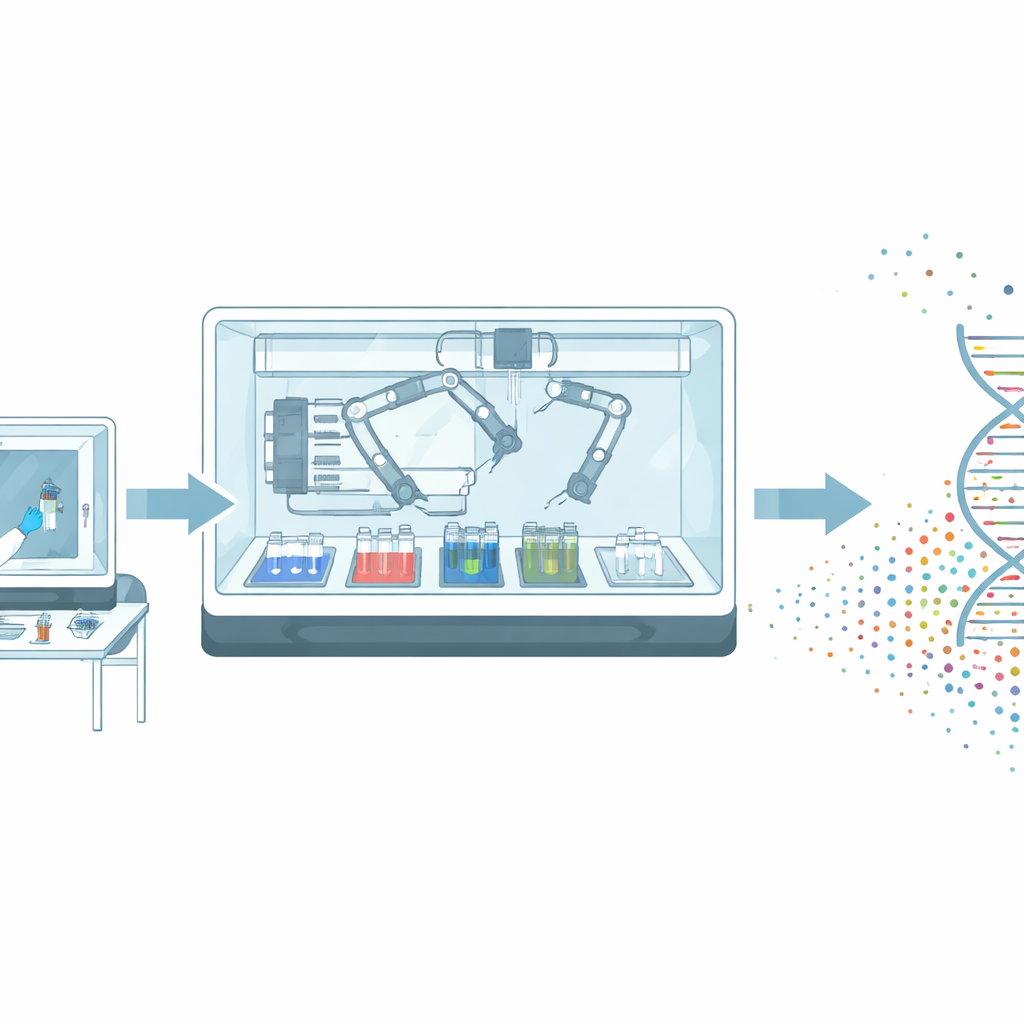
A robot to prepare DNA for reading
The researchers introduce a family of machines called NadAuto workstations that perform the key steps needed before DNA can be sequenced. Instead of technicians moving tiny liquid samples between tubes and devices, the system uses robotic arms, precise liquid dispensers, and tightly controlled heating and cooling blocks inside an enclosed, air‑filtered cabinet. Reagents are supplied in sealed plates with single‑use portions, which simplifies setup and reduces handling mistakes. A touchscreen and software interface let users design and simulate workflows, while electronic logs track every run for quality and regulatory needs.
Making sure samples stay separate
One fear with high‑throughput genetic testing is that traces of DNA from one sample might contaminate another, creating false results. To probe this, the team ran a series of “checkerboard” tests where wells containing human DNA alternated with wells containing only clean water, or with bacterial DNA, across the same plate. Even after deliberately disturbing the system during a critical amplification step, they found that wells meant to be negative showed only background‑level signals. When they sequenced mixed plates of human and bacterial DNA, almost every read mapped back to the correct species, with the worst‑case cross‑contamination at just three in a million reads—evidence that the automated setup keeps samples effectively isolated.
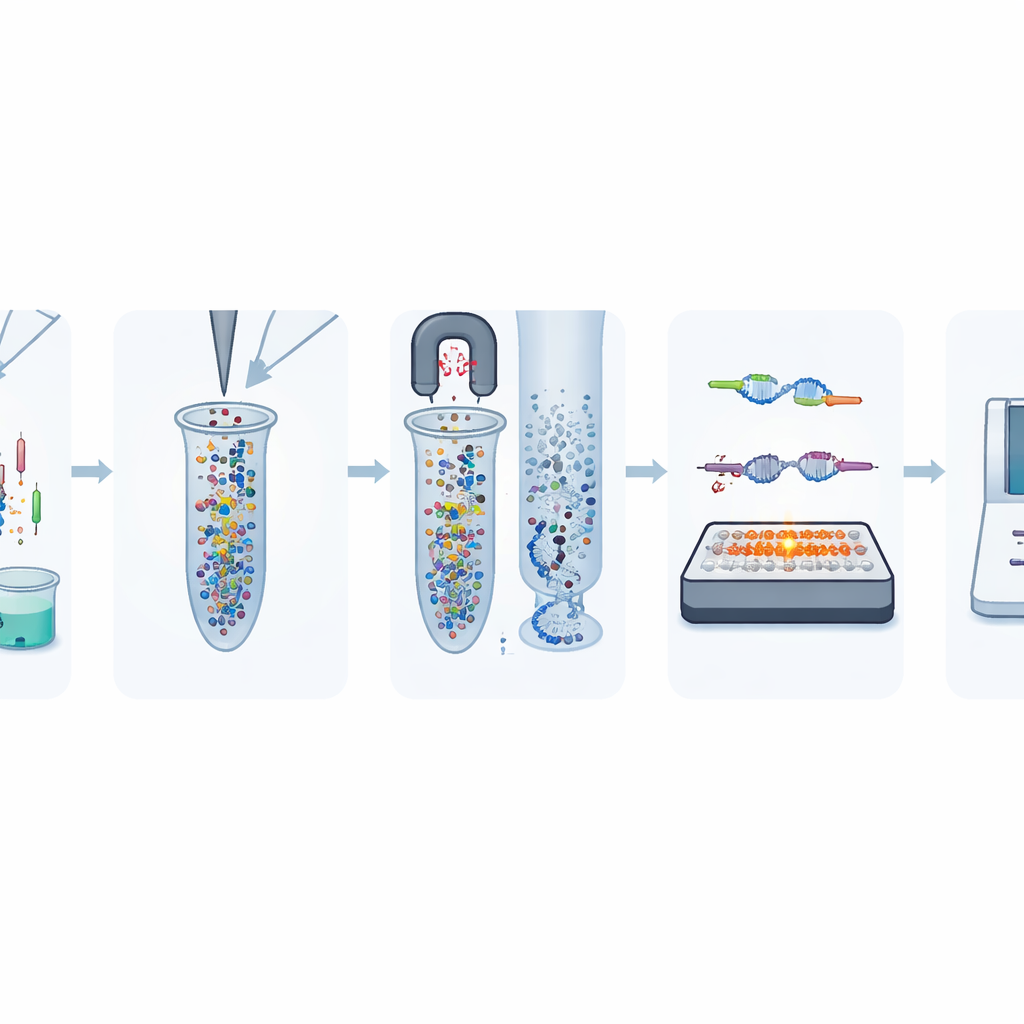
Consistent output at different workloads
The authors then asked whether the robot could produce DNA “libraries” — the prepared DNA fragments ready for sequencing — as reliably as a skilled human. Using standard human DNA samples, they compared multiple runs at different throughputs, from small batches of 8 or 16 samples to large batches of 24 or 48. Across these conditions, library yields were high and tightly clustered, with batch‑to‑batch variation generally under 8 percent, lower than typical manual workflows. The sizes of the DNA fragments fell squarely within the range required by common sequencing machines, with no excess of very short or very long pieces that could reduce data quality.
Putting targeted gene panels to the test
Beyond basic preparation, many clinical and research tests focus on specific sets of genes, such as cancer‑related regions in the genome. The workstation was evaluated with such targeted panels using a capture step that fishes out chosen DNA regions. In both high‑throughput and mid‑throughput modes, the resulting sequence data showed high overall quality, strong alignment to the human reference genome, and even coverage of the targeted genes, including regions that are harder to capture because of unusual base composition. Importantly, the system reduced the proportion of duplicate reads compared with manual methods, indicating more diverse and information‑rich libraries.
Do the automated results match human work?
To see if these technical gains translate into real‑world answers, the team compared the robot’s performance with manual preparation on reference DNA samples containing known cancer‑related mutations and gene copy changes. Both approaches correctly detected all expected single‑letter mutations and small insertions or deletions, with mutation frequencies closely matching each other and the reference values, even for rare variants present at about one percent. Measurements of gene amplifications, such as extra copies of MET and ERBB2, also agreed closely between manual and automated runs, with differences of only a few percent and no impact on interpretation.
What this means for future testing
Overall, the study shows that a fully automated workstation can cut total processing time roughly in half while maintaining, and in some respects improving, the quality and reliability of DNA sequencing preparations. For clinicians and public health teams, this means genetic tests that are faster, less prone to human variability, and easier to standardize across different labs. While further work is needed on more challenging sample types, such as degraded tumor tissues, the results suggest that end‑to‑end automation is ready to support the growing demand for precise, large‑scale genomic analysis.
Citation: Xie, W., Yang, C. & Ren, S. Systematic performance evaluation and application validation of an end-to-end NGS workstation. Sci Rep 16, 13115 (2026). https://doi.org/10.1038/s41598-026-43941-7
Keywords: automated DNA sequencing, NGS library preparation, genomic diagnostics, clinical genomics workflow, laboratory automation