Clear Sky Science · en
High refractive index microlenses patterned onto micro-LED arrays using electrohydrodynamic inkjet printing
Brighter Tiny Screens for Everyday Tech
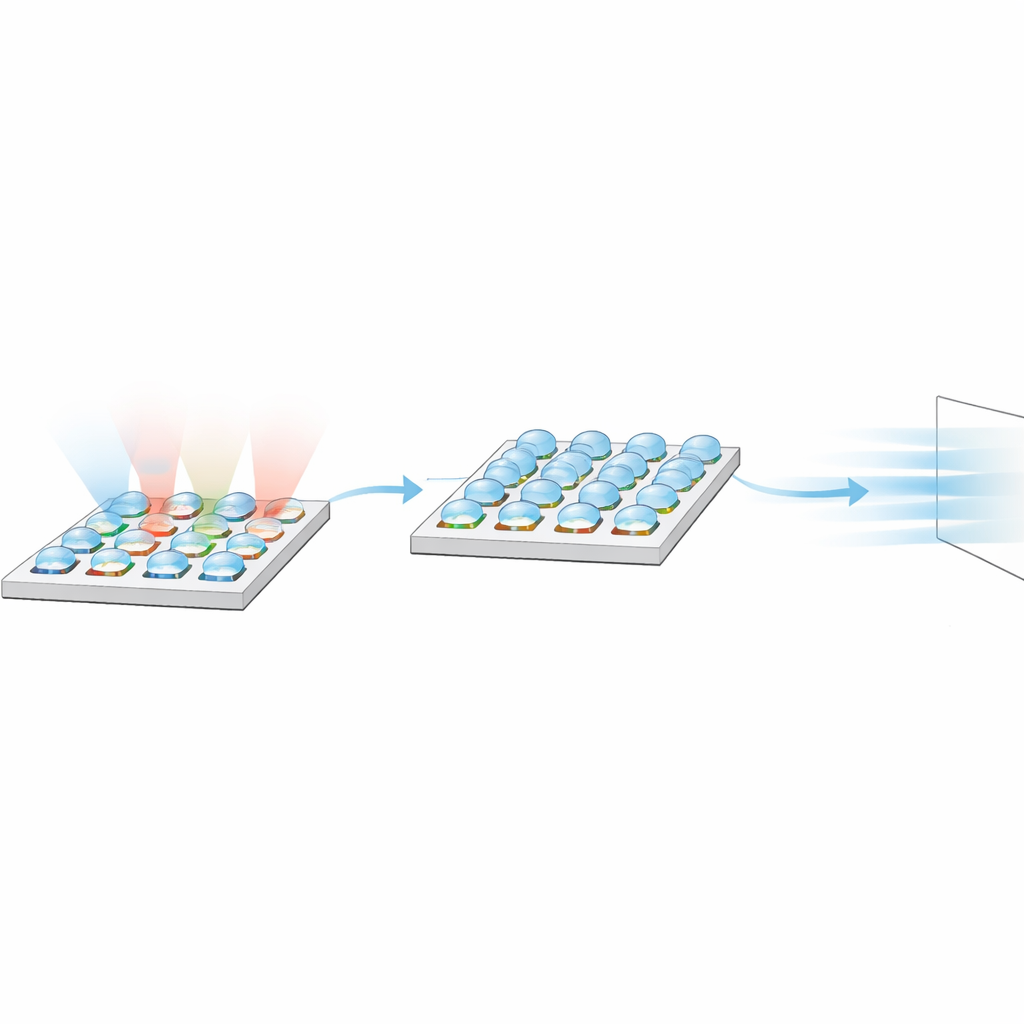
From smart glasses to car headlights, many emerging gadgets rely on micro-sized light-emitting diodes, or micro-LEDs, to produce crisp, bright images. Yet a lot of the light these tiny pixels create never reaches your eyes or the road; it spreads out in all directions and even spills into neighboring pixels, blurring the picture. This study explores a simple way to place miniature lenses directly on top of each micro-LED pixel so more light is aimed where it is useful, paving the way for sharper, more efficient displays and projectors.
Why Tiny Lenses Matter
Micro-LEDs are considered a leading candidate for next-generation displays because they can be extremely bright, power-efficient, and long-lasting. However, each pixel behaves like a bare light bulb, shining almost equally in many directions. In applications such as augmented reality glasses or miniature projectors, only a narrow cone of that light can be captured by the optics and sent to the viewer. Light that shoots off at steep angles is effectively wasted, and it can also cause "crosstalk," where light from one pixel leaks into its neighbors and softens image contrast. Engineers have tried complex structures such as patterned surfaces or tiny optical cavities to rein in the light, but these can be difficult or expensive to manufacture over large areas.
A New Way to Shape Light
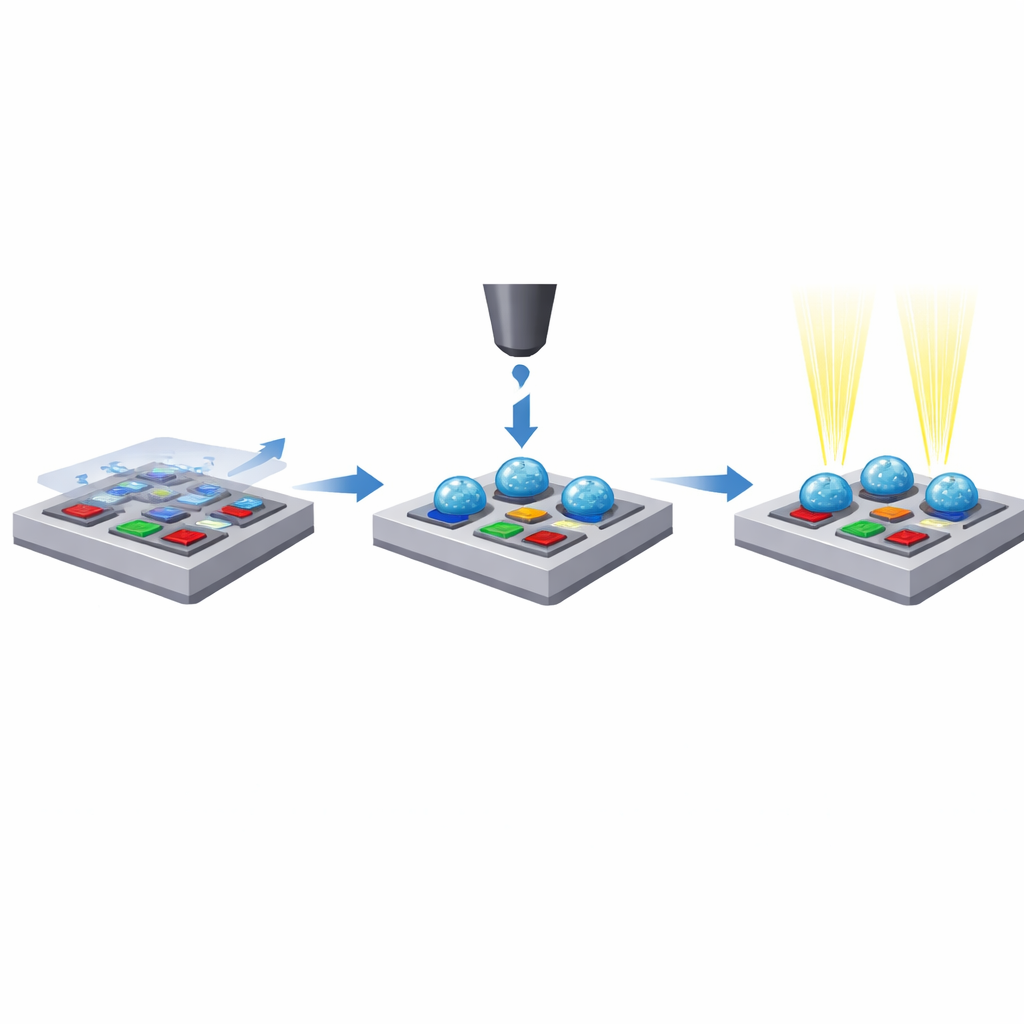
The authors focus on a more straightforward idea: covering each micro-LED with a matching tiny lens so that the outgoing light is gently steered into a tighter beam. To work well, these microlenses need two key properties: they must be tall enough and made from a material that bends light strongly. Traditional methods—like melting patterned photoresist, pressing molds into soft plastic, or using standard inkjet printing—either cannot easily make tall lenses or are limited to plastics that do not bend light very strongly. In contrast, the team turns to electrohydrodynamic inkjet printing, which uses electric forces rather than just fluid flow to eject extremely fine droplets. This lets them print a thicker, higher-index optical resin directly onto fully made micro-LED chips, precisely one droplet per pixel.
Making the Surface Lens-Friendly
Simply printing droplets is not enough: the way a droplet spreads out or piles up depends strongly on how the underlying surface interacts with liquids. To get steeper, more dome-shaped lenses, the researchers first coat the micro-LED surface with a thin hydrophobic (water-repelling) layer. This treatment makes droplets of the lens resin bead up more, increasing the lens “sag” height and concentrating its focusing power. Measurements of how water and resin droplets sit on the surface show that the contact angle increases after treatment, confirming a stronger beading effect. When the same resin is printed on treated versus untreated chips, the resulting lenses nearly double in height, shrink slightly in diameter, and gain a higher effective light-gathering ability. Confocal 3D scans and electron microscope images reveal well-formed domes that closely match the size and spacing of the micro-LED pixels.
Sharper Beams and Less Pixel Leakage
To see whether these neatly printed microlenses actually improve performance, the team measures how bright the micro-LED array appears at different angles. With lenses in place, the brightness within a central viewing cone of about plus or minus 30 degrees—the range typically used in augmented reality optics—rises by about 16 percent. At the same time, light that would otherwise fly off at wider angles beyond about 60 degrees is reduced by around 12 percent. This means more of the generated light is directed into useful directions and less is wasted or causes glare. Simulations based on detailed 3D scans of the lenses confirm the basic trend and suggest that by slightly enlarging each lens and inserting a thin spacer layer between the LEDs and the lenses, the collimation and efficiency could be pushed even further. A key benefit is that pixel crosstalk drops dramatically, from roughly two-thirds of the light leaking into neighboring regions to about one quarter.
What This Means for Future Devices
For a general reader, the take-home message is that a carefully engineered layer of tiny lenses, printed directly onto micro-LED chips, can make miniature displays and projectors significantly brighter and clearer without needing more power. By combining a high light-bending material, a surface treatment that helps droplets form tall domes, and a printing method suited to thick, precise droplets, the researchers show a practical and scalable path to better light control. As these techniques mature, we can expect sharper visuals in compact devices such as AR glasses, head-up displays, and digital headlights, all benefiting from more of the light being steered exactly where it is needed.
Citation: Dai, G., Chen, K., Meng, X. et al. High refractive index microlenses patterned onto micro-LED arrays using electrohydrodynamic inkjet printing. Sci Rep 16, 14272 (2026). https://doi.org/10.1038/s41598-026-43929-3
Keywords: micro-LED displays, microlens arrays, inkjet printing, light collimation, augmented reality