Clear Sky Science · en
Efficacy of IBA (indole-3-butyric acid) and kinetin for the success of T-budding in citrus
Helping Citrus Trees Get a Better Start
Citrus fruits like mandarins and lemons are household staples, but the trees that produce them are surprisingly delicate when young. Growers often rely on a technique called budding, where a single bud from a desirable variety is inserted onto a hardy root system. This paper explores how tiny doses of plant hormones can dramatically increase the success and strength of these young budded citrus plants, making orchards more reliable and productive for farmers and, ultimately, for consumers.
Why Budding Matters for Citrus Farms
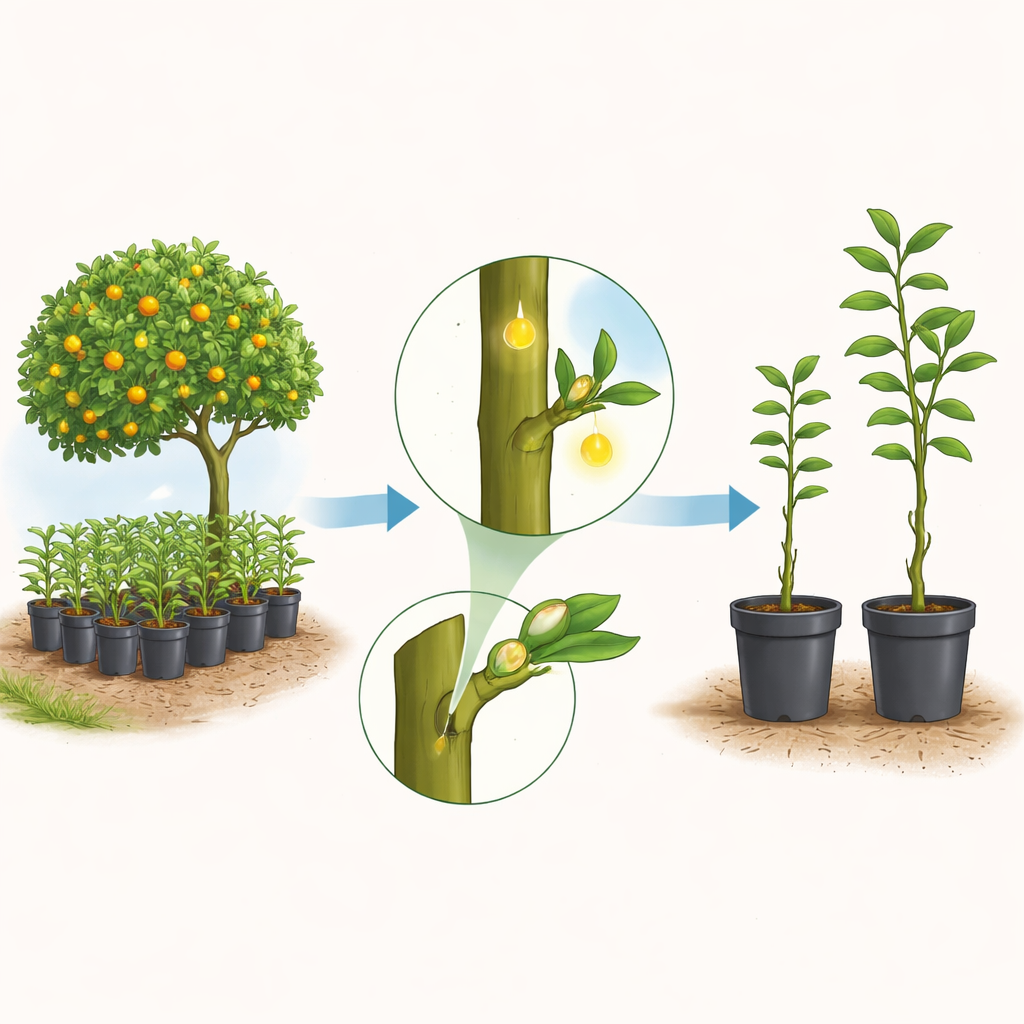
Most commercial citrus trees are not grown from seed. Instead, growers combine two plants: a tough rootstock that handles soil and climate stresses, and a scion that produces tasty, market-quality fruit. In this study, the scion came from ‘kinnow’ mandarin, a popular hybrid, and the rootstock from rough lemon, known for its vigor. The researchers focused on T-budding, where a T-shaped slit is made in the rootstock’s bark and a single bud from the scion is slipped in. Although this method usually works, its success can drop in less-than-ideal field conditions, threatening nursery output and orchard establishment.
The Role of Plant Signals in a Clean Union
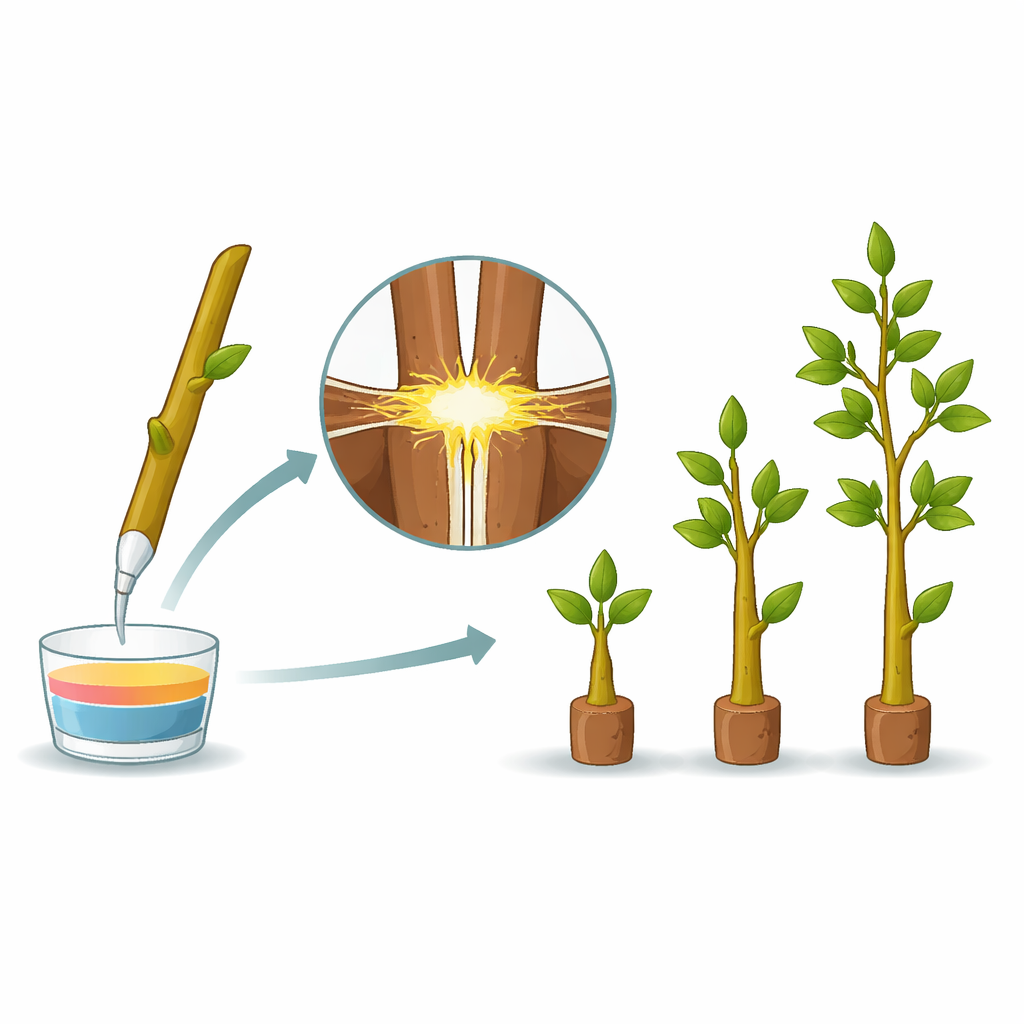
When a scion bud is joined to a rootstock, the two pieces of plant tissue must heal, knit together, and reconnect their water and nutrient pipelines. This process is guided by internal plant signals, especially two hormones: auxins and cytokinins. Auxins encourage the formation of callus tissue and new conductive strands that physically join the scion and rootstock, while cytokinins help dormant buds wake up and start growing shoots and leaves. If these hormone levels are unbalanced, the graft may heal poorly, sprout late, or die. The team therefore tested whether dipping scion shoots in solutions of the synthetic auxin IBA (indole-3-butyric acid) and the cytokinin kinetin, before taking buds from them, could tip the balance in favor of a strong union and rapid growth.
Testing Hormone Dips in the Nursery
In a field nursery in northern India, the researchers set up six treatment combinations using three levels of IBA (0, 30, and 60 milligrams per liter) and two levels of kinetin (0 and 5 milligrams per liter). Scion shoots were briefly dipped in these solutions; buds were then taken and T-budded onto rough lemon rootstocks. After the buds sprouted, the same hormone mixtures were sprayed on the young plants at set intervals. Over six months, the team tracked how long it took for buds to sprout, what fraction of them sprouted, how many survived, how thick the scion and rootstock stems became, how tall the plants grew, and how many shoots and leaves developed, using standard statistical tools to separate real effects from chance.
Stronger Starts with the Right Hormone Mix
The results were striking. Buds that received both IBA and kinetin, especially 30–60 milligrams per liter of IBA combined with 5 milligrams per liter of kinetin, sprouted several days earlier and in much higher numbers than untreated buds. Survival of budded plants climbed to about 98 percent under the best treatments. These hormone-boosted plants developed thicker scion and rootstock stems and a better balance between them, an indicator of a strong, well-matched union. They also produced more shoots and leaves and grew taller over time. Statistical analyses showed that shorter sprouting time and higher sprouting percentage were strongly linked to better survival, and that most growth traits moved together in a positive way when hormones were applied.
What This Means for Citrus Growers
For non-specialists, the take-home message is simple: giving citrus buds a brief dip in carefully chosen plant hormones before budding can greatly improve the odds that each tiny bud becomes a healthy, productive tree. By nudging the plant’s own healing and growth signals, the treatment speeds up bud awakening, strengthens the connection between scion and rootstock, and supports vigorous early growth. While the study was limited to one season and focused on visible traits, it points to a practical, low-dose technique that nurseries can adopt to produce more reliable citrus seedlings and, with further research, to fine-tuned recipes for other fruit crops as well.
Citation: Gehlot, N., Thakur, D., Singh, S.K. et al. Efficacy of IBA (indole-3-butyric acid) and kinetin for the success of T-budding in citrus. Sci Rep 16, 13689 (2026). https://doi.org/10.1038/s41598-026-43912-y
Keywords: citrus budding, plant hormones, auxin cytokinin, graft success, horticultural propagation