Clear Sky Science · en
Performance comparison of coupled-resonator optical waveguide Mach–Zehnder modulators with III–V SIS structures
Faster chip conversations with light
Modern artificial intelligence and high-performance computing chips must trade enormous amounts of data every second, pushing metal wires to their limits in speed and power use. This study explores a new way for chips to talk using light, in a device that is tiny, energy-efficient, and fast enough to keep up with future data demands. By carefully shaping how light moves through a special optical circuit, the authors design a modulator that can rival today’s best tiny devices while staying stable and easier to use in real systems. 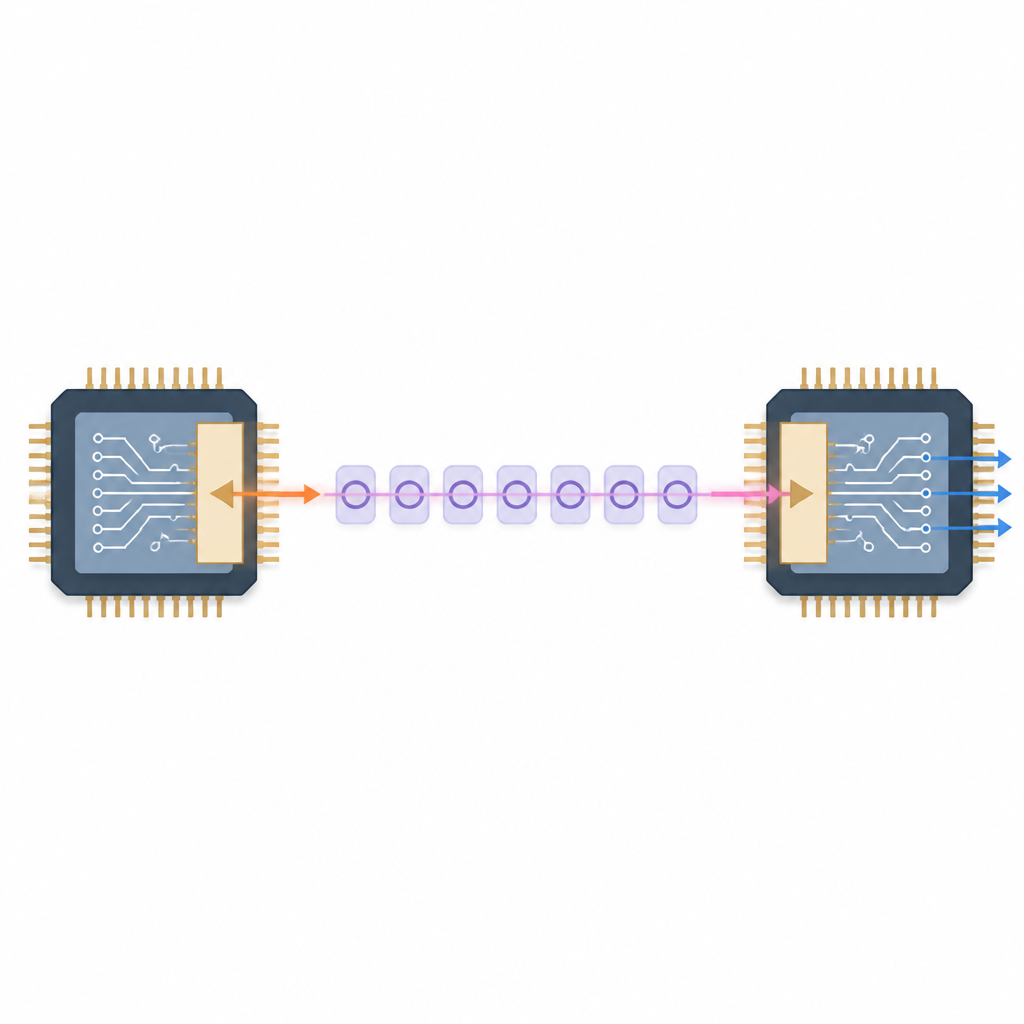
Why moving away from copper matters
As data rates climb toward trillions of bits per second, copper interconnects inside and between chips waste power and struggle to carry signals cleanly. Silicon photonics, which routes information using light on a chip, offers a path forward, but the key building block is the optical modulator that turns electrical signals into optical ones. Common designs either use long structures that are easy to operate but bulky and power-hungry, or ultra-compact ring-shaped devices that are efficient yet very sensitive to temperature and wavelength drift. Engineers are looking for designs that combine small size, high speed, low power, and forgiving operating conditions in a single platform.
Slowing light for compact, stable devices
The authors focus on a family of devices that slow light down inside the chip so that light interacts more strongly with the material in a short distance. They use a structure called a coupled-resonator optical waveguide, a chain of tiny resonant sections formed by phase-shifted Bragg gratings in a waveguide. This chain produces a “pass band” where light can travel with nearly constant delay and strong phase response, giving the benefits of slow light without severe signal distortion. By choosing the grating period and size, they can tune a tradeoff between bandwidth and how strongly light is slowed, letting them keep the device length to under 100 micrometers while still supporting tens to over one hundred gigahertz of usable bandwidth.
New material stack for stronger control of light
The central idea of the work is to replace the usual silicon p–n junction with a vertical semiconductor–insulator–semiconductor capacitor that operates by piling up charge rather than removing it. On top of the silicon waveguide, the team considers either a layer of silicon or a layer of a III–V compound called InGaAsP, separated by a thin oxide. When voltage is applied, electrons and holes accumulate at the oxide interfaces, changing the refractive index seen by the slow light in the resonator chain. InGaAsP has lighter charge carriers and stronger optical response than silicon, which means a larger index change for the same voltage and, importantly, lower added absorption loss. Simulations show that with InGaAsP the phase shift builds up about seven times more effectively at 1 volt than in conventional silicon depletion devices, while resistance stays low enough to preserve a wide electrical bandwidth.
Balancing loss, speed, and drive voltage
The authors systematically vary oxide thickness, doping level, and resonator design to see how these knobs affect loss, speed, and efficiency. Thinner oxide and higher doping boost the index change but also raise free-carrier absorption and resistance, so there is a sweet spot where the device modulates strongly without excessive penalties. With realistic parameters, the InGaAsP-based modulator reaches an electro-optic bandwidth of about 110 gigahertz at a modest group index, and maintains low transmitter penalty at data rates around 40 gigahertz, outperforming both crystalline and polycrystalline silicon versions. Large-signal time-domain simulations of eye diagrams show that the InGaAsP design can sustain clean on–off keying up to 120 gigabits per second, where silicon-based counterparts have partially or fully closed eyes. 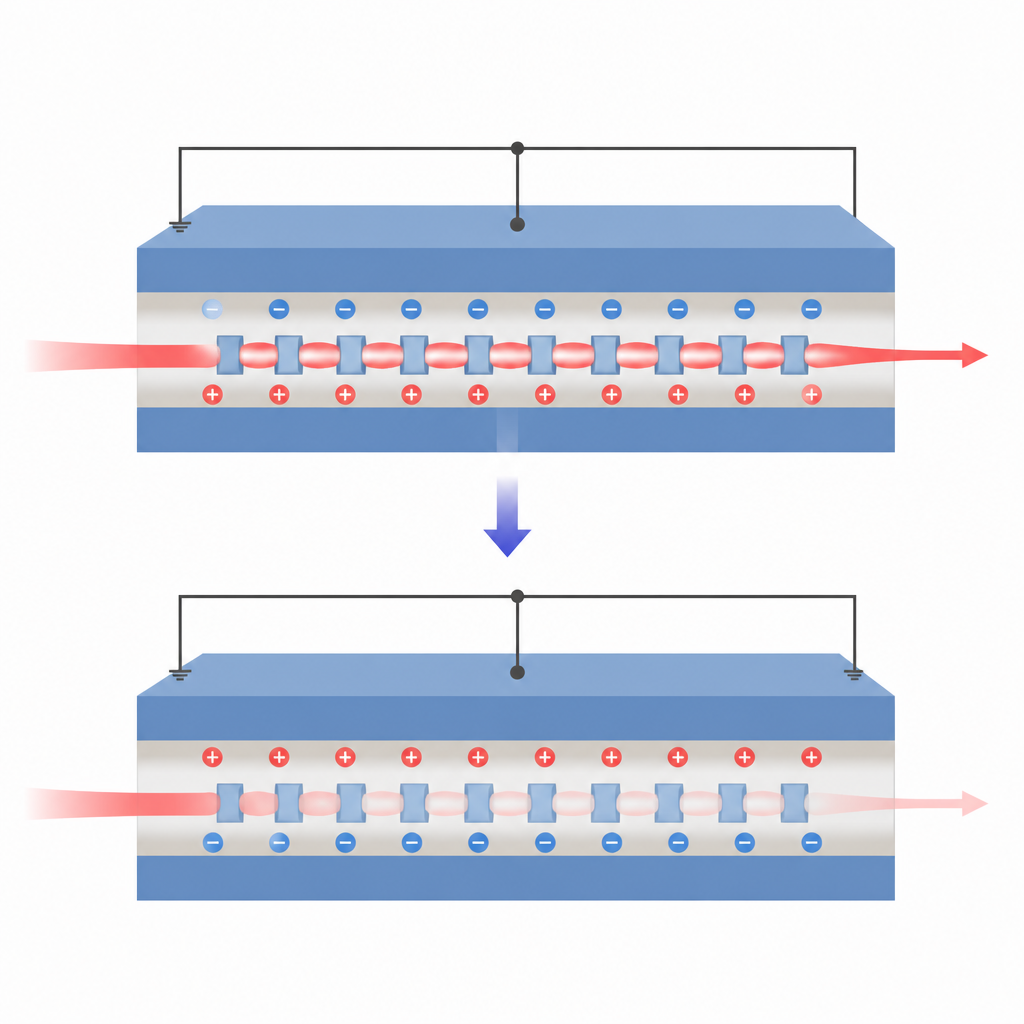
What this means for future optical links
In simple terms, the study shows that combining slow-light resonator chains with a vertical capacitor structure and III–V materials can deliver a tiny optical modulator that needs low voltage, wastes little power, and still operates at very high speeds. The proposed design approaches the size and efficiency of ring modulators, but with the broader bandwidth and better stability of Mach–Zehnder devices. As chip makers refine bonding and integration methods for III–V compounds on silicon, this type of modulator could become a key part of next-generation optical links that move data between chips quickly and efficiently.
Citation: Kim, K., Lee, J. & Kim, Y. Performance comparison of coupled-resonator optical waveguide Mach–Zehnder modulators with III–V SIS structures. Sci Rep 16, 15595 (2026). https://doi.org/10.1038/s41598-026-43882-1
Keywords: silicon photonics, optical modulator, slow light, InGaAsP, chip interconnects