Clear Sky Science · en
Observed hand-movement reversals postdictively bias ambiguous motion judgements
How Watching Someone’s Hands Can Change What You See
Imagine watching two identical bars glide toward each other on a screen until they meet. Do they pass through each other, or bounce off and reverse direction? This simple animation is surprisingly ambiguous, and what you see can be swayed by tiny cues. This study shows that even watching another person’s hand move a computer mouse—movement that you know cannot affect the animation—can still change your judgement of what happened. In other words, what you see now can be quietly rewritten by what you see a split second later.
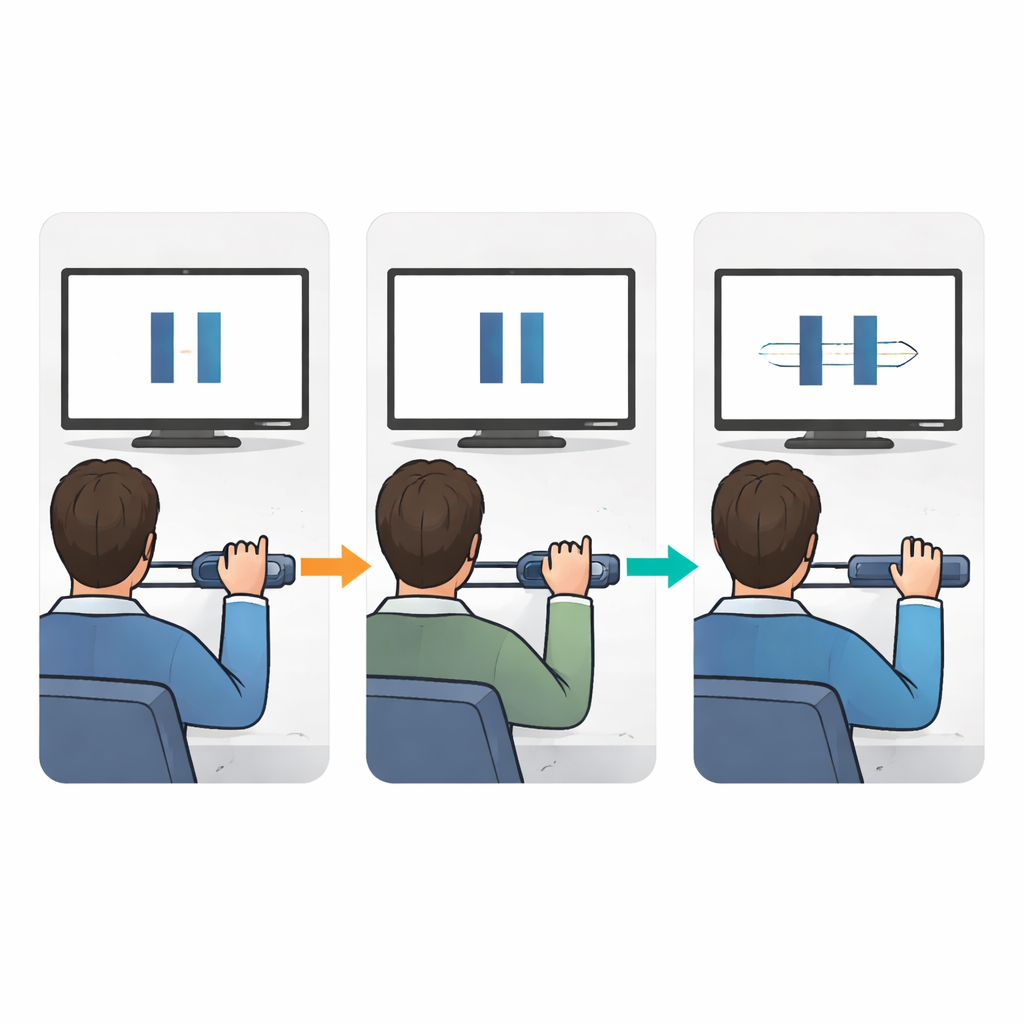
A Visual Coin Toss: Do Objects Pass or Bounce?
The researchers used a classic illusion called the “stream/bounce” display. Two identical white bars move toward each other on a black background, overlap completely in the center, and then move apart. Because the bars look the same, your brain has to choose between two stories: either they streamed through each other, or they bounced and reversed direction. Earlier work showed that adding a brief sound right when the bars overlap makes people much more likely to say they bounced, revealing that the brain waits a short time—about a tenth of a second—before finalizing what happened.
Adding a Second Person Whose Actions Shouldn’t Matter
To test whether someone else’s movements can also sway this late decision, the authors brought a second person—the experimenter—into the scene. Participants sat facing a monitor while this other person sat opposite them, holding a mouse mounted on a motorized slider that moved left and right beneath the screen. Crucially, participants were told the truth: the other person’s mouse had no control over the bars on the screen. Across trials, the slider followed five patterns: staying still, moving steadily in one direction, or moving and then reversing direction just before, exactly at, or shortly after the bars overlapped in the center of the screen. Throughout, participants simply watched the display and reported whether they saw the bars stream or bounce.
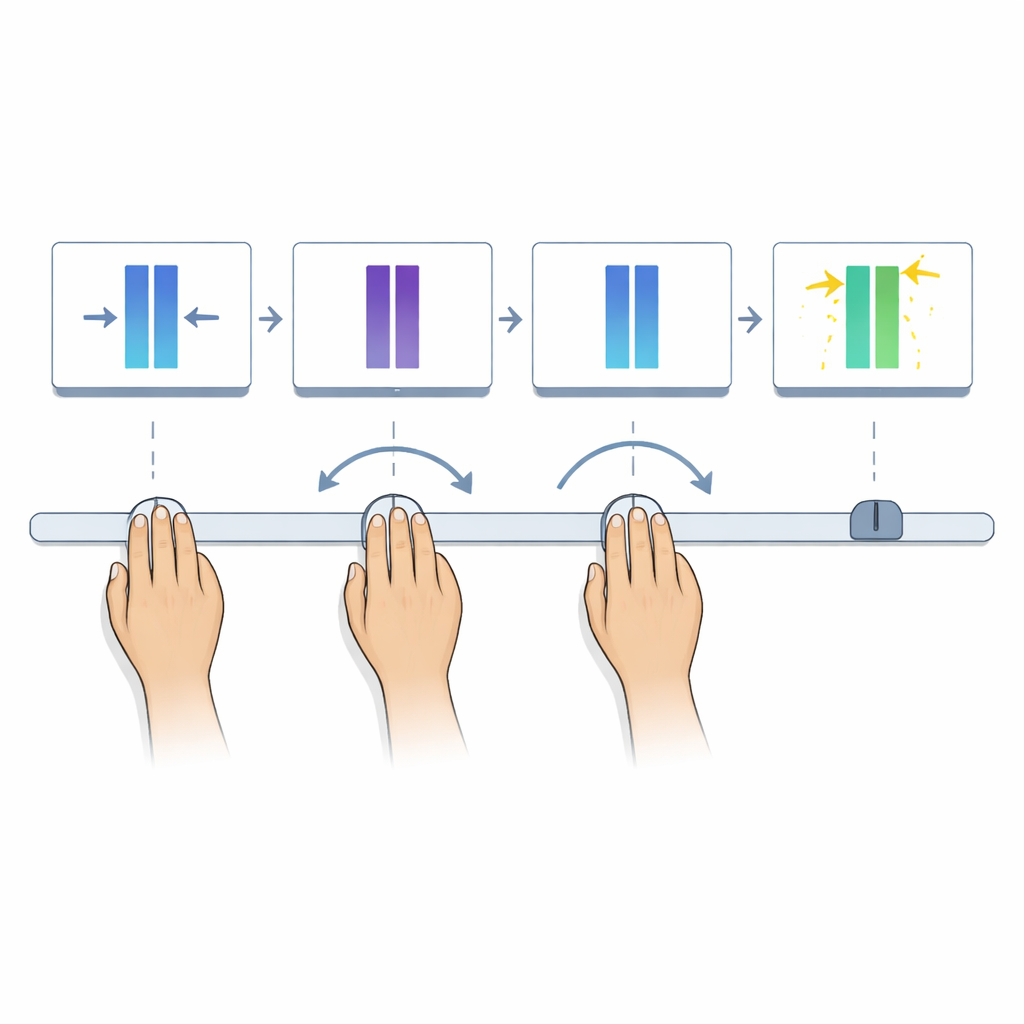
Seeing a Reversal Makes “Bounce” More Likely—Even After the Fact
The striking result was that the other person’s hand reversal strongly biased what observers reported. When the experimenter’s mouse reversed direction around the moment the bars overlapped—whether slightly before, exactly at, or even 150 milliseconds after the overlap—participants were more likely to say the bars bounced. When the hand just moved smoothly in one direction with no reversal, people actually reported fewer bounces than in the no-movement control condition. This pattern appeared both when participants initially moved the bars themselves and then stopped (Experiment 1) and when the bars always moved automatically with no self-movement (Experiment 2). Careful statistical modeling confirmed that these effects were large and reliable, and that factors such as how fast participants moved their own mouse could not explain them.
A Brief Window Where the Past Is Still Up for Grabs
These findings fit with the idea that perception is not a simple real-time camera feed but a best guess assembled over a short time window. The brain continually weighs incoming sensory evidence against expectations or “priors” about how the world typically works. In this case, watching another person’s hand suddenly reverse direction creates a strong hint that a collision or change of direction has occurred, and the brain folds that hint into its interpretation of the ambiguous bar motion. Importantly, the effect is “postdictive”: a reversal that happens after the bars have already overlapped still reaches back in time and tilts the judgement toward “bounce.” The timing profile—strongest at overlap, somewhat weaker before and after—matches what has been seen when a simple beep is used instead of a hand movement.
Why This Matters for Everyday Seeing and Social Interaction
For a non-specialist, the takeaway is that your perception of events is shaped not only by what you directly see and hear, but also by the movements of people around you—even when those movements have no real influence on the physical events you are judging. Your brain treats others’ actions as meaningful context and quietly uses them to resolve ambiguities in what just happened. This suggests that in crowded, interactive settings—such as sports, driving, or working with robots—quick glimpses of others’ gestures may subtly rewrite how we see motions unfold, blurring the line between what happened and what we infer must have happened.
Citation: Nomura, O., Ogawa, K. Observed hand-movement reversals postdictively bias ambiguous motion judgements. Sci Rep 16, 14648 (2026). https://doi.org/10.1038/s41598-026-43840-x
Keywords: visual perception, motion illusions, action observation, time perception, social cues