Clear Sky Science · en
Comparison of oral water ingestion and intravenous fluid infusion on fluid responsiveness in healthy volunteers, a prospective, randomized trial
Why how we take fluids matters
When people are ill or undergoing surgery, doctors often give fluids through a vein to help the heart pump enough blood to vital organs. Yet large amounts of intravenous fluid can sometimes do more harm than good, contributing to swelling, lung problems, or kidney strain. This study explores a simple but important question with wide appeal: in healthy young adults, can drinking a large glass of water support the heart’s pumping ability as effectively as a standard fluid drip in the arm?
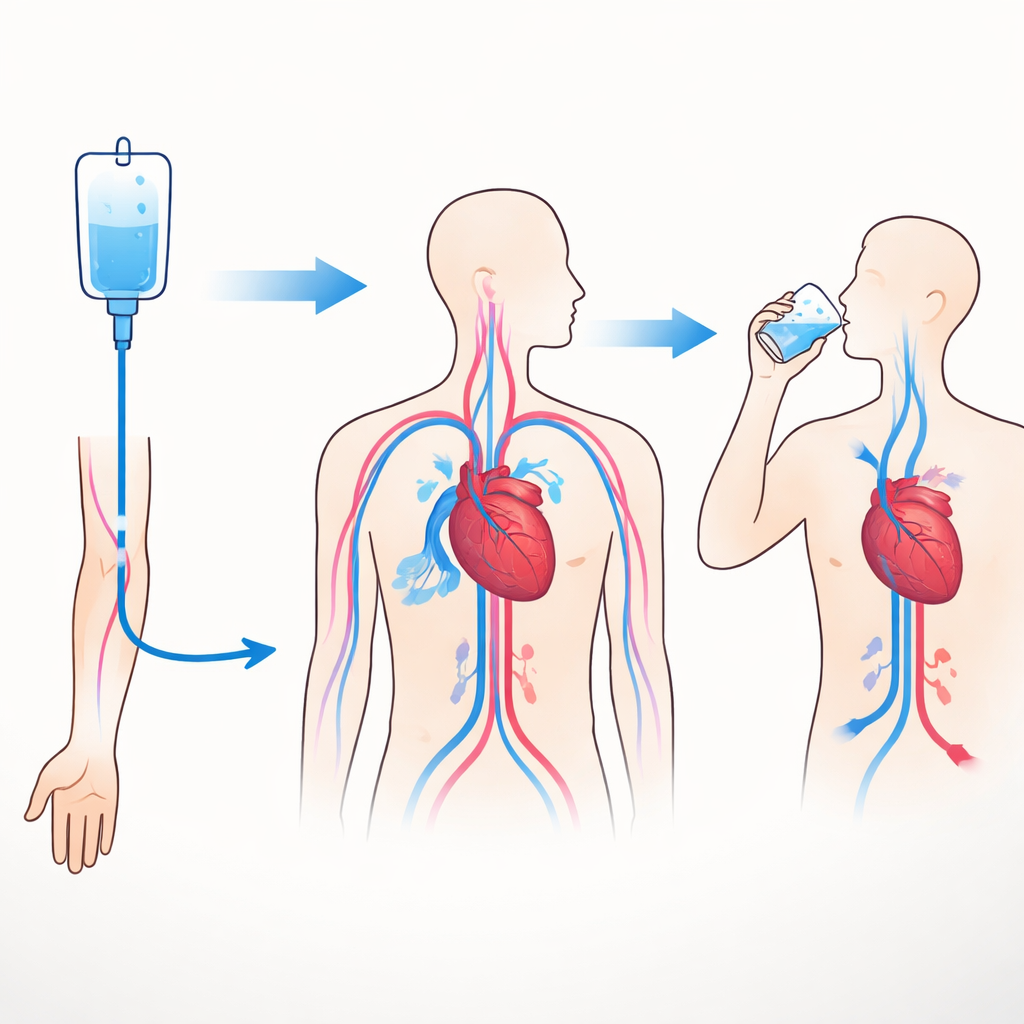
Two simple ways to boost blood flow
The researchers focused on a concept called “fluid responsiveness” – in plain terms, whether the heart actually pumps more blood with each beat after extra fluid is given. Sixty healthy volunteers between 18 and 30 years old were randomly assigned to receive one of two options over five minutes: either 500 milliliters of salty water (saline) through an intravenous line, or 500 milliliters of plain drinking water by mouth. Everyone had fasted since midnight so their starting conditions were similar. The team then used ultrasound scans of the heart and major blood vessels, along with blood pressure and heart rate measurements, to see how each person’s circulation changed over the following half hour.
Tracking the heart’s response over time
Ultrasound allowed the investigators to calculate how much blood the left side of the heart pushed out with each beat, known as stroke volume. A person was considered a “responder” if this amount rose by at least 15 percent thirty minutes after finishing the fluid. The main result was striking in its simplicity: there was no meaningful difference between the two groups. About one in six people responded to the intravenous saline, and about one in four responded to the oral water, a difference that could easily have been due to chance. On average, stroke volume and overall blood flow changed only modestly in both groups, while blood pressure stayed stable.
Who actually benefits from extra fluid?
When the researchers looked more closely at the 13 responders, they found an important pattern: before any fluid was given, these individuals already had lower stroke volume and cardiac output than non-responders, despite having similar body size. In other words, their hearts started out pumping less blood per beat. After either oral or intravenous fluid, these people showed clear increases in the amount of blood pumped, though the exact timing of the change differed slightly between water and saline. Non-responders, whose hearts were already pumping more at baseline, showed little change regardless of the route of fluid. This suggests that a person’s starting circulatory state, rather than the way fluid is delivered, is what really determines whether extra fluid helps.
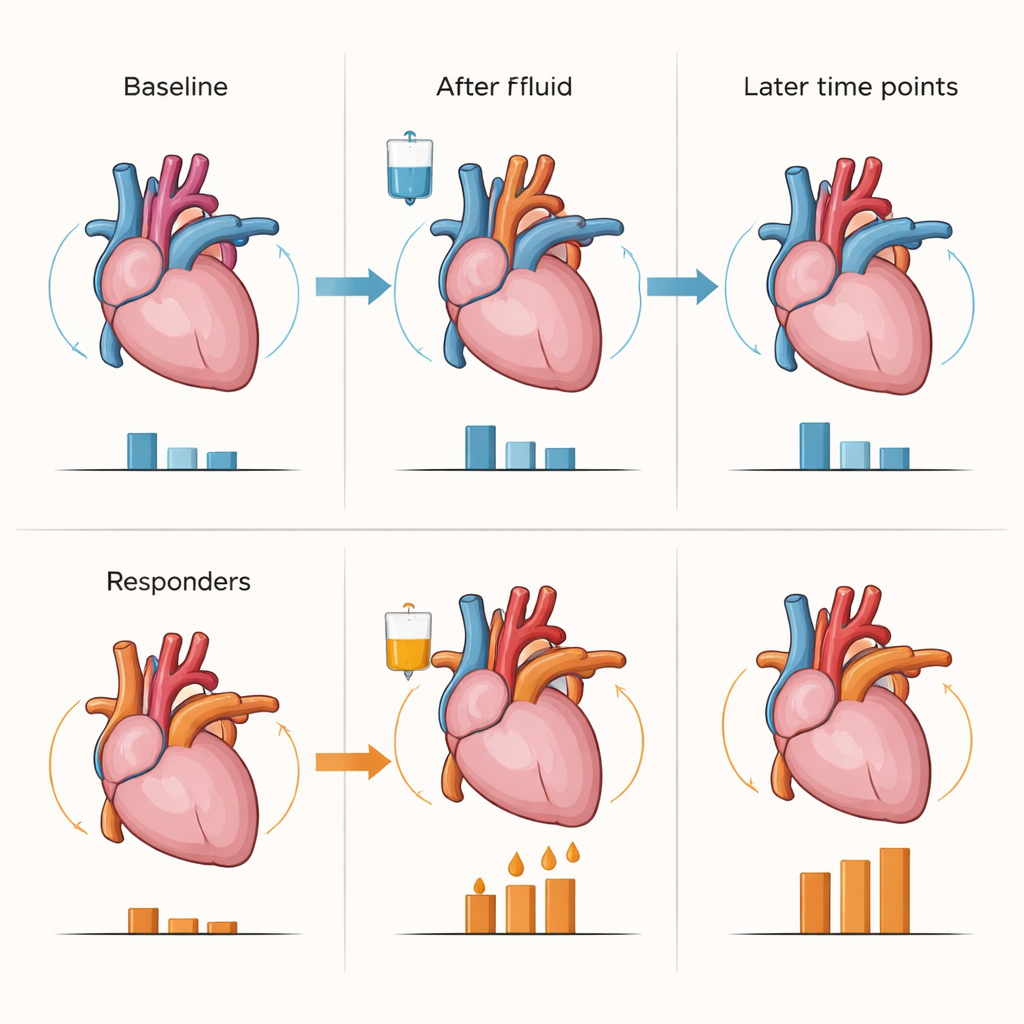
What stays steady and what does not
Beyond the heart itself, the team also examined blood flow in the carotid artery in the neck and the portal vein that drains blood from the gut to the liver. These measures stayed remarkably stable in both groups, whether people responded to fluid or not. Heart rate, however, tended to fall slightly after both water and saline, while blood pressure remained tightly controlled. The authors suggest that in healthy young adults the body’s regulatory systems keep brain and gut blood flow steady, even when a fluid bolus modestly boosts the heart’s filling and pumping. They also note that the 500 milliliter dose may simply be too small to provoke large changes in most people whose circulation is already well balanced.
What this means for everyday and clinical care
For lay readers, the take-home message is reassuring and intuitive: in young, healthy adults, quickly drinking a half-liter of water can support the heart’s pumping about as well as receiving the same amount of fluid through a drip, at least over the first 30 minutes. Only a minority of people actually need this extra fluid to improve their circulation, and they are the ones whose hearts start out pumping less. While this study does not yet tell doctors how to treat seriously ill patients, it offers a proof of concept that, in selected situations, the gut may be a safe and effective route for testing and supporting the circulation. Future research will need to explore whether careful oral hydration can reduce reliance on intravenous fluids in real-world hospital settings, where avoiding unnecessary drips could lower risks and improve comfort.
Citation: Huette, P., Beyls, C., Bayart, G. et al. Comparison of oral water ingestion and intravenous fluid infusion on fluid responsiveness in healthy volunteers, a prospective, randomized trial. Sci Rep 16, 13938 (2026). https://doi.org/10.1038/s41598-026-43839-4
Keywords: fluid therapy, oral hydration, intravenous fluids, cardiac output, blood volume