Clear Sky Science · en
Dynamic characteristics of frozen ballast beds in cold-region railways under cyclic train loading
Why frozen train beds matter
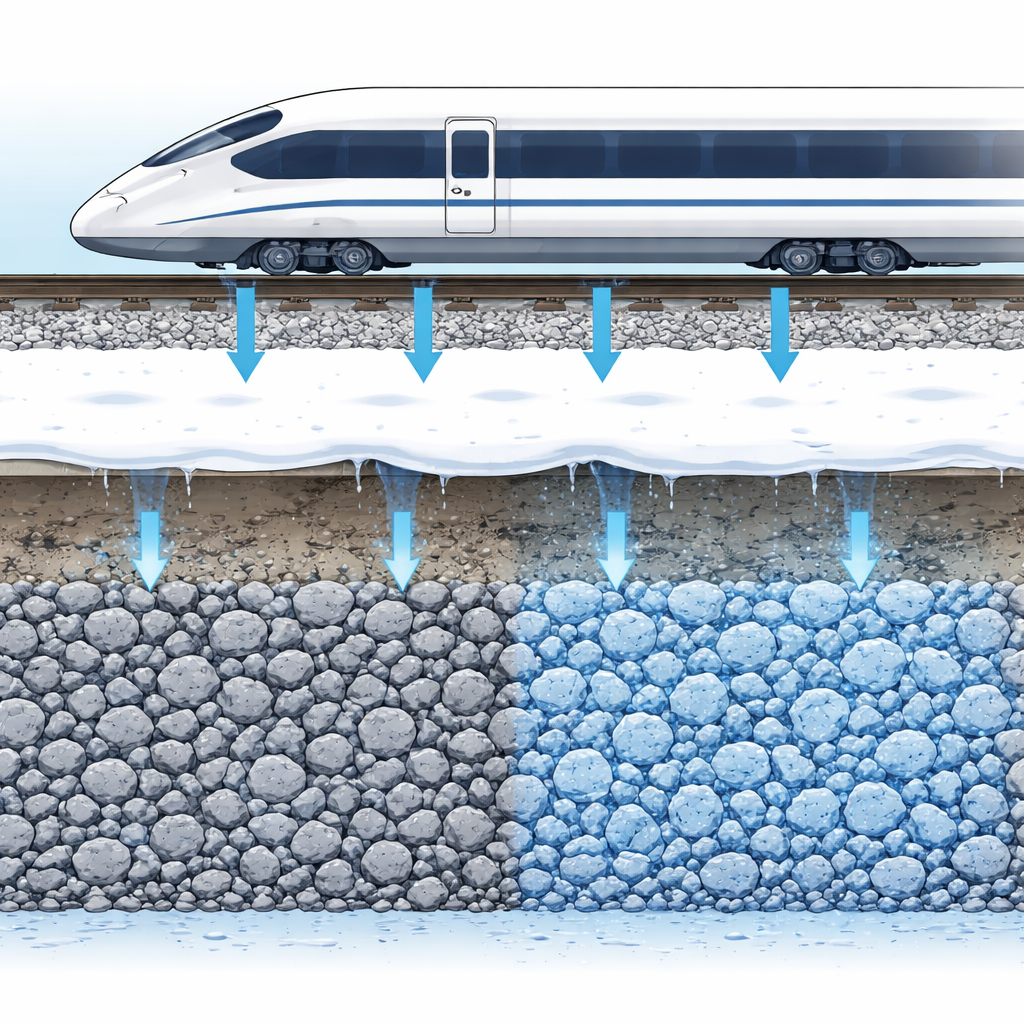
Railways that cross snowy mountains and subarctic plains rely on a hidden but vital layer of crushed rock, called the ballast bed, to carry the weight of speeding trains. In cold regions this rock layer does not just get cold; water inside it can freeze, forming ice that glues particles together. That freezing can either protect the track from sinking and damage or create new risks if the ice cracks. This study explores how different amounts of ice inside the ballast bed change the way tracks move and deform under thousands of passing train loads, with an eye toward safer and more economical railways in harsh climates.
The rocky foundation below the rails
The ballast bed sits just beneath the sleepers and rails, spreading train loads, damping vibrations, and letting water drain away. Modern high-speed and heavy-haul services place this layer under intense, repeated stress, which gradually grinds particles, reshapes the track geometry, and raises maintenance costs. In countries with long, cold winters—such as those in northern Europe, Russia, Japan, the United States, and China—ballast beds also endure freezing and thawing. Earlier field and laboratory work had shown that frost can cause the track to heave upwards or settle unevenly. Yet there was little detailed knowledge of how frozen ballast behaves dynamically, grain by grain, when a fast train passes overhead.
Building a virtual frozen track
To tackle this problem, the researchers combined full-scale laboratory experiments with advanced computer simulations. They used the discrete element method, which represents each ballast stone as a set of 3D particles that can push, roll, and slide against one another. First they reproduced the behavior of an unfrozen ballast bed under a realistic train load taken from a standard vehicle–track dynamics model of a Chinese high-speed train. They verified their model by matching sleeper velocities, accelerations, and settlement over 1,000 loading cycles against measurements from a life-size test track in the lab. Next they extended the model to cold conditions by inserting small “ice particles” into the gaps between stones and connecting them with virtual bonds that mimic freezing. These bonds were carefully calibrated using compression tests on pure ice blocks and on mixed ice–ballast specimens cooled to –20 °C.
How ice reduces sinking of the track
With this calibrated virtual track, the team simulated ballast beds containing different amounts of ice, from none up to 30 percent of the void space. Under repeated train loading, the unfrozen bed kept settling, though at a gradually slowing rate. In contrast, frozen beds showed a two-stage pattern: a quick initial settlement during roughly the first 50 load cycles, followed by a much slower phase that became nearly stable after about 200 cycles. As ice content grew, the total amount of settlement dropped sharply. Lightly frozen cases settled only about half a millimeter, while heavily frozen ones settled by just a fraction of that. At the same time, the calculated bearing stiffness—the resistance of the ballast bed to vertical movement—increased with ice. Around an ice content of 20 percent, stiffness jumped dramatically, signaling a major change in how the structure was carrying load.
What happens inside the frozen stones
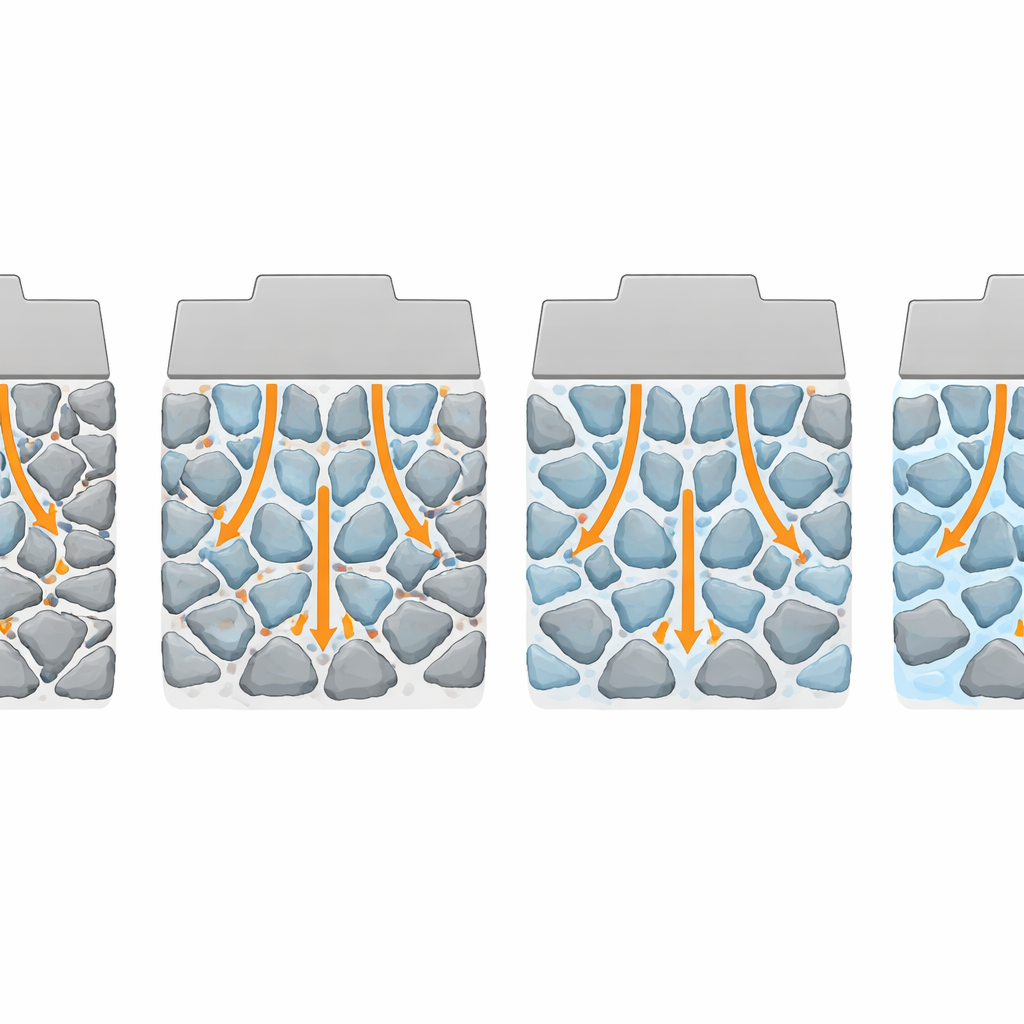
Looking inside the simulated ballast bed, the authors traced how individual particles moved, how many contacts each grain had with its neighbors, and how many ice bonds existed and broke during loading. As more ice was added, stones and ice merged into larger frozen clusters that moved together rather than individually. The average number of contacts per particle rose, especially once ice content exceeded about 20 percent, showing a shift from a loose granular skeleton to a dense frozen network. At low ice contents, many of the ice bonds broke under cycling, revealing a brittle, easily damaged structure. At higher ice contents, far more bonds formed and only a small fraction failed, creating a robust web that could carry loads more effectively. Force-chain maps—paths along which forces concentrate—showed that in unfrozen ballast, stresses were spread through many weak links, while in frozen ballast they focused into strong columns directly under the sleeper. This concentration stiffened the track but also hinted at zones where cracks could eventually initiate.
Balancing safety and risk in icy tracks
For non-specialists, the main message is that freezing can make the stone bed beneath the rails behave less like a loose gravel pile and more like a solid block. A moderate to high amount of ice sharply limits how much the track sinks with repeated use and boosts its stiffness, which is good for keeping trains running smoothly. However, beyond a key level—about one-fifth of the pore space filled with ice—the load becomes focused into narrow frozen columns that may be prone to brittle cracking over long service times. The work suggests that track designers and maintenance teams in cold regions should treat ice content as a controllable parameter, monitoring and managing moisture and freezing in the ballast so that they harness the stabilizing benefits of ice without letting hidden frozen damage threaten the safety of trains.
Citation: Liu, J., Cao, Y., Chen, A. et al. Dynamic characteristics of frozen ballast beds in cold-region railways under cyclic train loading. Sci Rep 16, 13060 (2026). https://doi.org/10.1038/s41598-026-43766-4
Keywords: railway ballast, frozen soil, cold-region railways, track settlement, discrete element modelling