Clear Sky Science · en
Visual awareness of stimulus features shapes motor control through action end-state comfort
Why this matters for everyday actions
Every time you reach for a coffee mug or your phone, your brain has to turn what you see into smooth, accurate movement. But do you always need to be fully aware of what you see for your hand to move correctly? This study asks when conscious visual awareness actually matters for guiding our actions, and when our bodies can quietly rely on information we don’t clearly “see.” The answer reveals how vision, comfort of movement, and motor control are intertwined in surprising ways.
How the study tested seeing without seeing
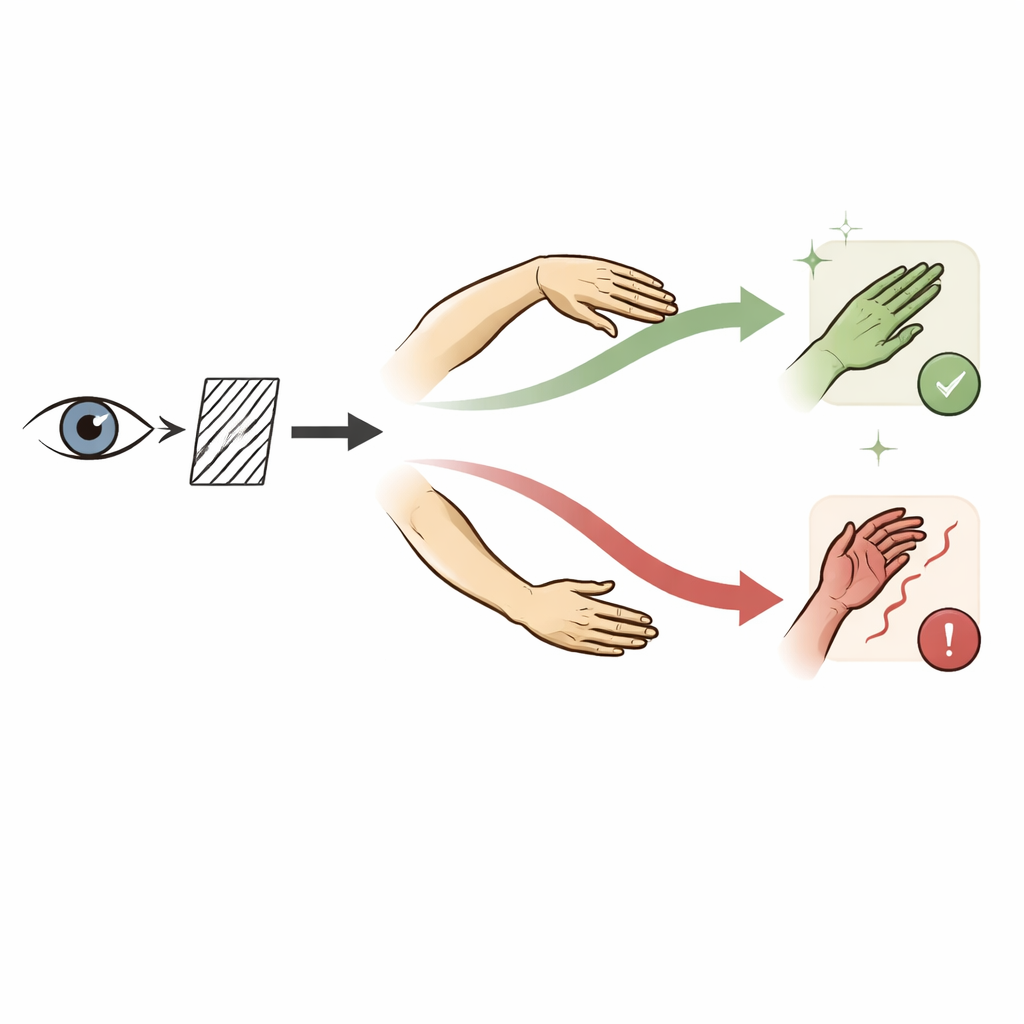
The researchers asked volunteers to reach toward simple striped patterns briefly flashed on a screen. These patterns were tilted slightly up or down, and participants had to rotate their hand so that their thumb and index finger matched the tilt, as if grasping the pattern. The trick was that the tilt was presented at each person’s perception threshold—sometimes they clearly saw the tilt, and sometimes they did not, even though the visual information still reached the brain. After each movement, participants reported whether they had consciously perceived the tilt. This allowed the team to compare how well people moved on “aware” versus “unaware” trials, using motion-capture cameras to measure how accurate, how fast, and how smooth the hand rotations were.
Comfortable versus awkward hand positions
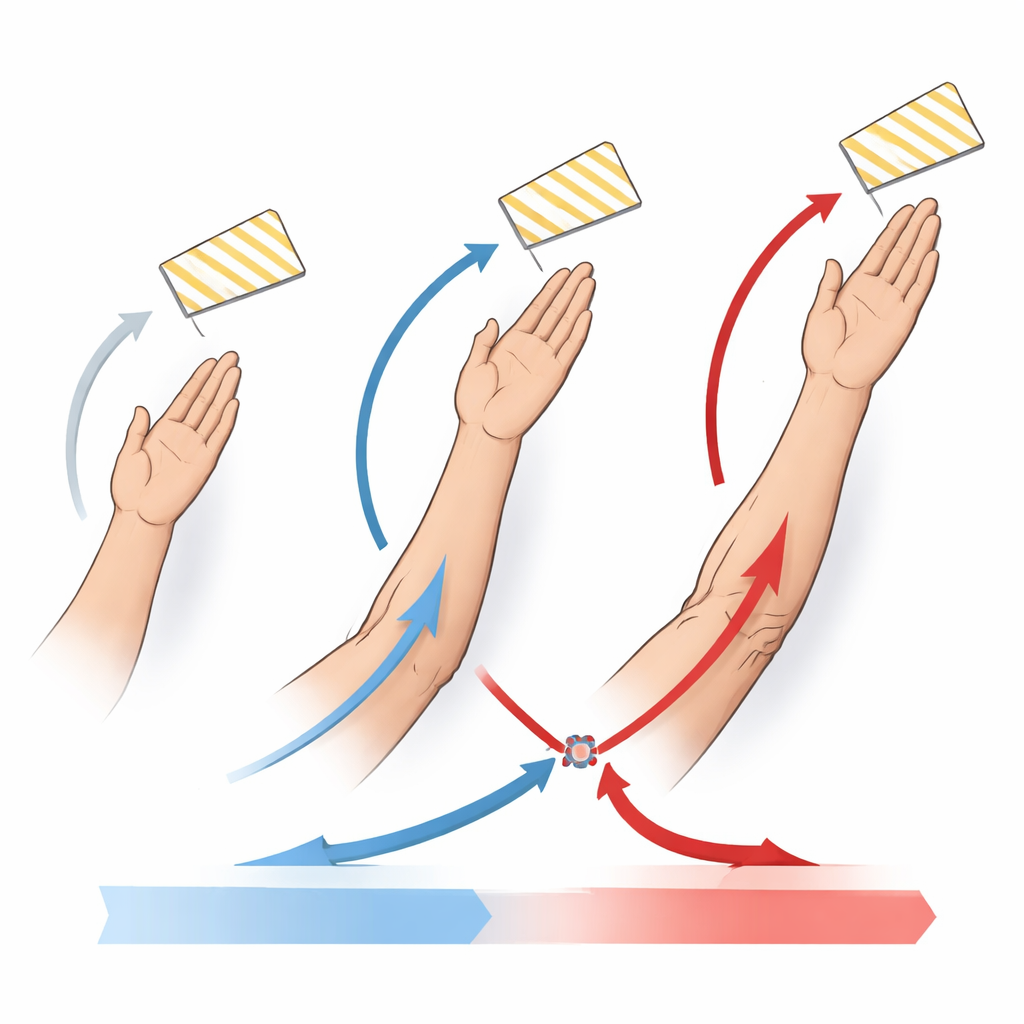
A key idea in movement science is “end-state comfort”: we naturally prefer finishing a movement in a comfortable, mid-range joint position rather than in a strained or twisted one. The authors took advantage of this tendency by designing some hand rotations that ended in easy, comfortable positions (small rotations) and others that finished in more awkward, stretched positions (large rotations). In a second experiment, they also changed whether the hand rotated clockwise or counterclockwise, creating a broader range of easy and hard combinations. This let them ask whether unconscious visual information is enough to guide action only when the required movement is physically easy, and whether awareness becomes crucial when the body is pushed into less comfortable poses.
What happened when people were aware or unaware
Across both experiments, people often chose the correct rotation direction even when they reported not seeing the tilt—performance was reliably better than chance. That means some visual details about the stimulus could shape movements without entering conscious awareness. However, this “blind guidance” had limits. When the movement ended in a comfortable position, participants could still be fairly accurate and their hand paths remained reasonably smooth, even on unaware trials. When the required rotation was large and awkward, accuracy dropped sharply on unaware trials, sometimes down to chance level, and movements became less smooth. In contrast, when participants were aware of the tilt, they were more accurate overall, started rotating their hand earlier, and, in many conditions, executed movements more smoothly.
Different effects during planning and execution
The study also found that awareness influenced different phases of the movement in distinct ways. During preparation, conscious perception of the tilt helped people decide and initiate the correct action more quickly, particularly for uncomfortable rotations. But during execution, awareness did not always help. In the more challenging conditions of the second experiment, movements could actually become less smooth when people were aware. The authors suggest that, when a movement feels difficult and we know exactly what we are trying to do, we may monitor every detail too closely. This extra conscious control can interfere with the body’s automatic, finely tuned adjustments, making the motion jerkier even as it remains more accurate.
What this means for how we see and move
To a layperson, the take-home message is that our brains can sometimes steer our hands using visual details we are not fully aware of—but only up to a point. For movements that end in comfortable, familiar positions, unconscious visual information can be good enough to guide action. When the body has to reach into more awkward, demanding postures, conscious visual awareness becomes essential for choosing and starting the right movement, even if that same awareness may slightly disrupt the smoothness of execution. Rather than being strictly “vision for action” versus “vision for perception,” the study suggests that seeing and doing are tightly coupled, and that how clearly we see something matters most when the task is physically challenging for our bodies.
Citation: Montani, V., Pascucci, F., Colombari, E. et al. Visual awareness of stimulus features shapes motor control through action end-state comfort. Sci Rep 16, 10801 (2026). https://doi.org/10.1038/s41598-026-43752-w
Keywords: visual awareness, motor control, hand movement, perception and action, end-state comfort