Clear Sky Science · en
Accelerating photonic gas sensor design: machine learning-driven inverse optimization of silicon photonics Bragg gratings
Why smarter gas sensors matter
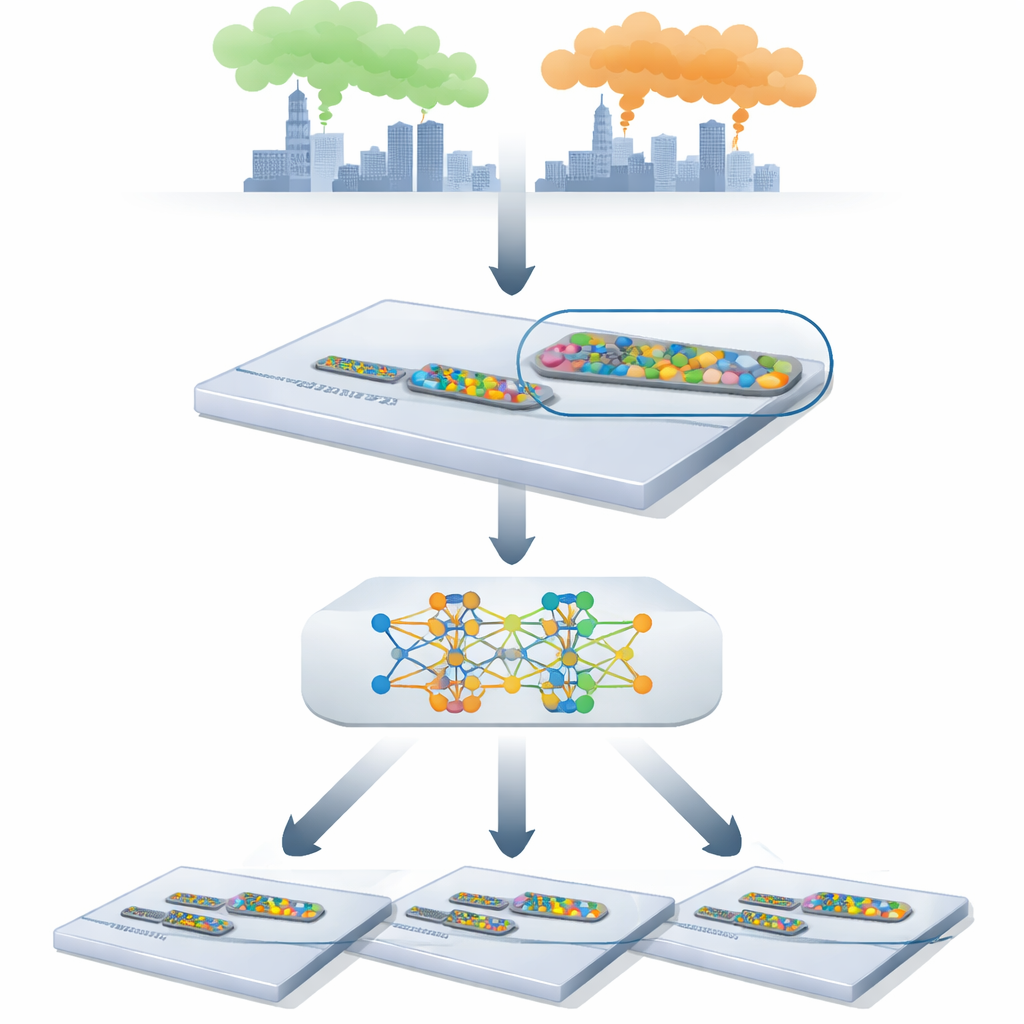
From urban air pollution to climate change, our lives increasingly depend on knowing exactly what is in the air around us. Two of the most important greenhouse gases, carbon dioxide and methane, can be hard to measure accurately at low concentrations without bulky or expensive equipment. This paper presents a new way to design tiny light-based gas sensors on silicon chips far more quickly, using machine learning to automate what used to be a slow, trial‑and‑error process.
Tiny light traps on a chip
At the heart of this work is a special type of optical structure called a Bragg grating, built on a silicon chip. Imagine a microscopic railway for light, where the track periodically changes width so that certain colors of light are strongly reflected. The authors use a “slot” design: two thin silicon rails separated by a narrow gap filled with a tailor‑made polymer. Gas molecules slip into this gap and subtly change how light travels through it. That, in turn, shifts the color at which the structure reflects light, allowing the sensor to register the presence of gases like carbon dioxide and methane without any added dyes or coatings.
Smart materials that feel the gas
The team selects polymers that interact differently with different gases. When a target gas is present, it can slightly change the polymer’s optical properties or even cause gentle swelling. Because the light in the slot region is tightly confined to this polymer-filled gap, even tiny changes strongly affect the reflected color. By swapping one polymer for another, the same basic chip design can be tuned for different gases, turning the platform into a kind of modular toolkit for gas sensing. This material choice, combined with the slot geometry, allows the device to reach high sensitivity while remaining compact and compatible with standard silicon manufacturing.
Turning the design problem backwards
Designing these miniature light traps by hand is tricky. Several geometric knobs—such as the spacing of the ridges, how deep they are, the width of the silicon rails, and the height of the slot—jointly determine the final optical response. Traditionally, engineers would pick a design, run heavy simulations, and slowly tweak parameters until they obtained the desired spectrum. Here, the authors flip the problem: they start from the desired optical behavior (for example, a certain resonance color and linewidth for a chosen gas) and ask a machine‑learning model to predict the chip geometry that will produce it. This “inverse design” approach aims to replace thousands of laborious simulation runs with a single fast prediction.
How the learning engine works
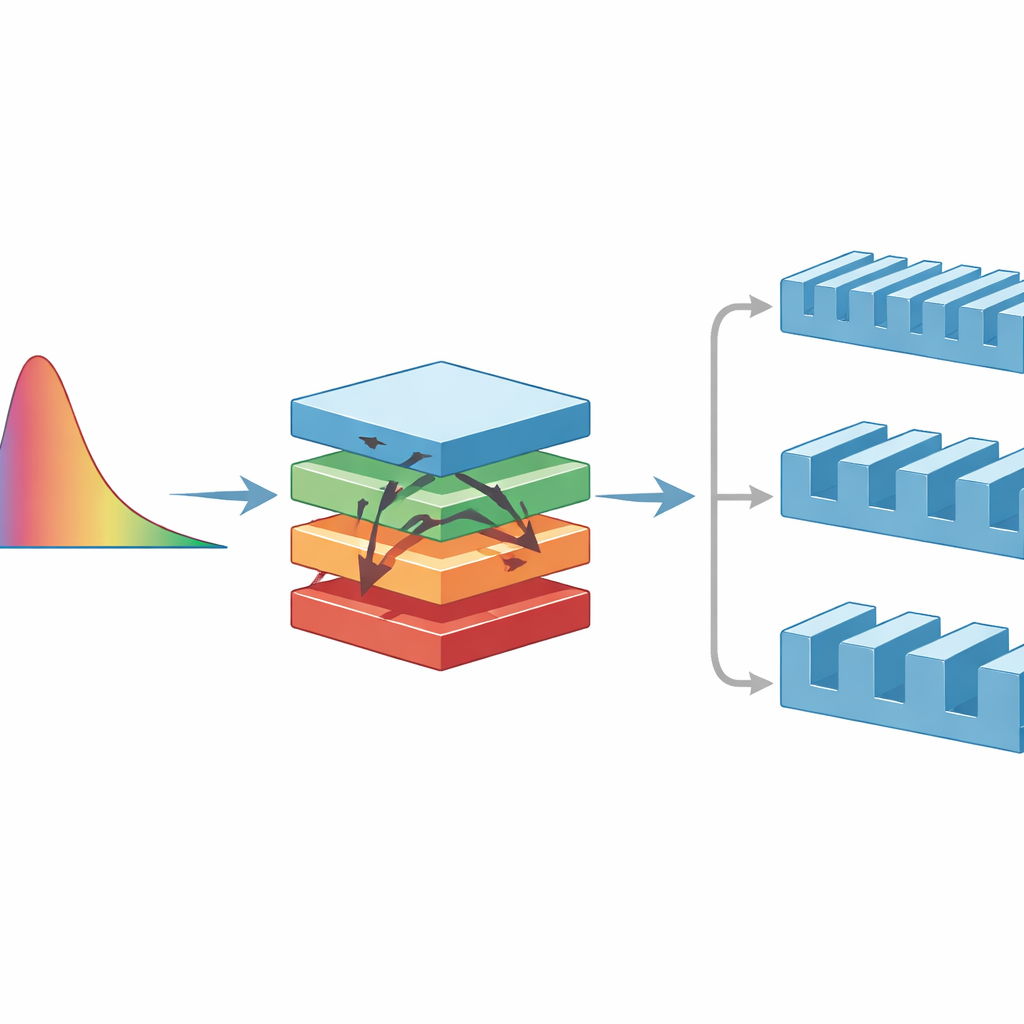
To train this engine, the researchers first built a dataset of just over a thousand simulated sensor designs for carbon dioxide and methane. For each design, they recorded the type of gas, how much light passed through at resonance, the exact position of the resonance color, and how sharp that feature was. They then used these spectral features as inputs and the four key geometric parameters as outputs for their learning system. Before training, they expanded the inputs to include combinations of features, and encoded the gas type using its physical refractive index, baking real physics into the data representation. A carefully tuned neural network, optimized automatically by a tool called Optuna, was combined with several tree‑based models in a “stacking” ensemble, where multiple predictors feed into a final decision layer.
Fast, accurate designs on demand
The resulting hybrid model can reproduce all four geometric parameters with extremely high accuracy, capturing over 99% of the variation seen in the simulation data. In a realistic test, the authors asked the model to design a new structure for sensing carbon dioxide that it had never seen before. When they simulated the geometry predicted by the model, the resulting optical spectrum almost perfectly matched the target, while the computation was roughly two thousand times faster than a traditional optimization run. They also checked how the design tolerates small fabrication errors, finding that the sensor performance remains stable for modest variations, an important requirement for real‑world manufacturing.
What this means going forward
For a lay reader, the key message is that the authors have built a “design autopilot” for chip‑scale gas sensors. Instead of slowly tuning and simulating every new device by hand, engineers can specify how they want the sensor to behave and let the trained model instantly suggest a suitable geometry. This approach could accelerate the development of compact, high‑performance gas sensors for environmental monitoring, industrial safety, and health applications. As the framework is extended to more gases, materials, and measured data, it may help turn precise optical gas sensing into a scalable, customizable technology platform.
Citation: Khafagy, M., Khafagy, M. & Swillam, M.A. Accelerating photonic gas sensor design: machine learning-driven inverse optimization of silicon photonics Bragg gratings. Sci Rep 16, 11650 (2026). https://doi.org/10.1038/s41598-026-43725-z
Keywords: optical gas sensing, silicon photonics, Bragg grating, machine learning design, inverse design