Clear Sky Science · en
Wnt signaling promotes inflammation and EMT-associated gene expression in mesenchymal TNBC
Why this breast cancer study matters
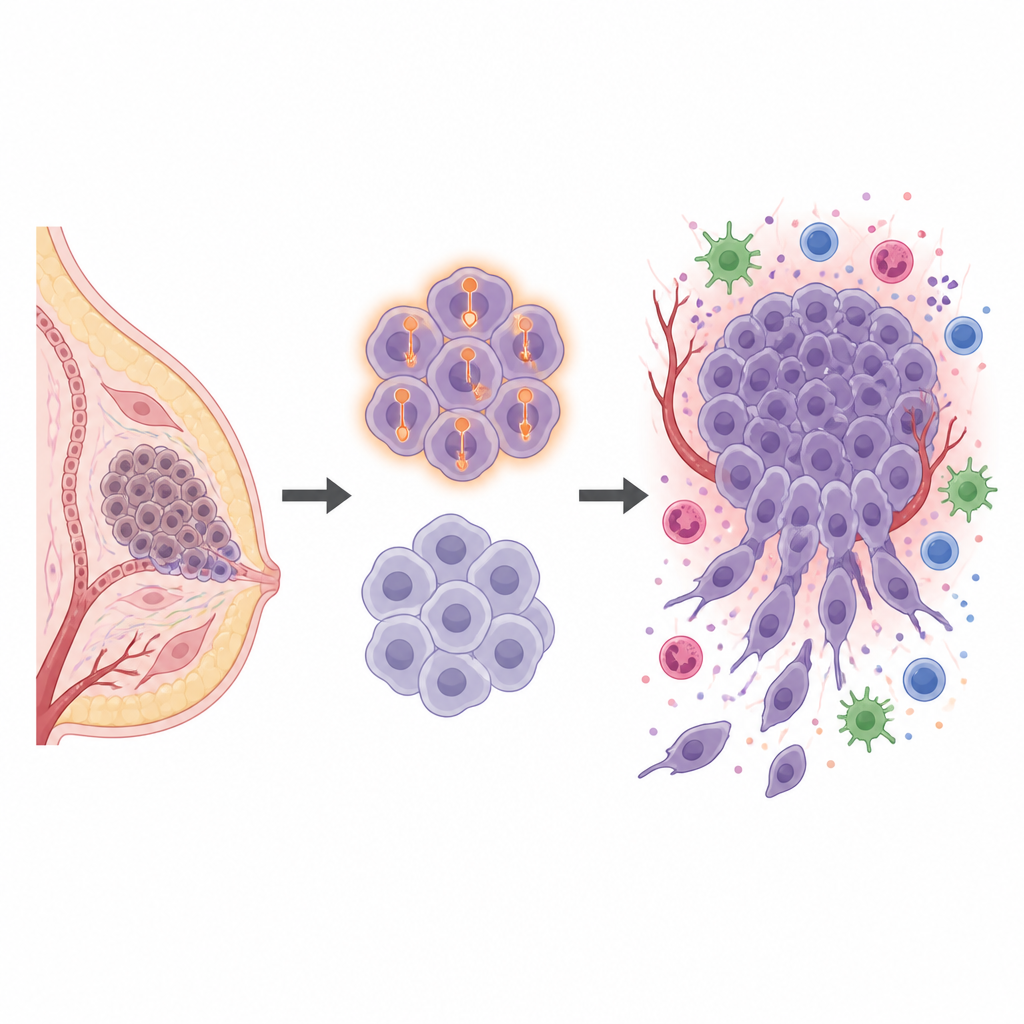
Triple negative breast cancer is one of the hardest breast cancers to treat, in part because its tumors are very mixed, with different kinds of cells behaving in different ways. This study looks closely at one key control system inside these cells, called the Wnt pathway, to ask how it shapes tumor behavior, how aggressive the cells become, and how they interact with the body’s defenses. Understanding this inner wiring could point toward better ways to match treatments to patients and to weaken the most dangerous tumor cells.
Following a cancer signal inside tumor cells
The researchers focused on triple negative breast cancers with a "mesenchymal" character, meaning the cells tend to be more mobile and invasive. They built special versions of two widely used cell lines that light up when the Wnt pathway is active. Using this reporter system, they discovered that Wnt activity is not uniform: it varies not only between the two cell lines but also from cell to cell within the same line. By repeatedly sorting cells with high reporter activity and cells with little or no activity, they created paired populations that differ mainly in how strongly this pathway is turned on.
What Wnt active cells look like on the inside
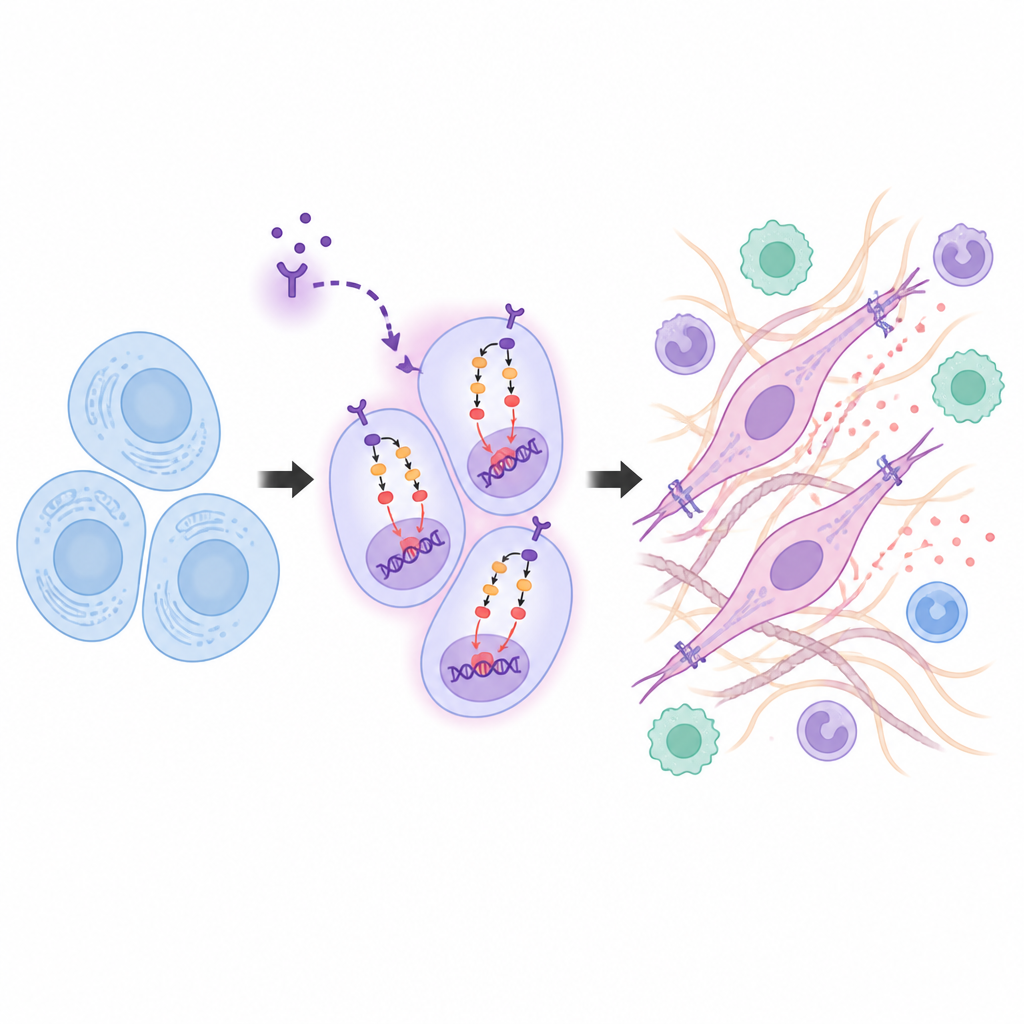
To see how these differences in signaling change cell behavior, the team compared the full set of active genes in Wnt high and Wnt low cells under both nutrient-poor and nutrient-rich growth conditions. They found that cells with higher Wnt activity consistently switched on groups of genes linked to cell shape change, movement, and tissue remodeling. These included genes involved in the shift from an orderly, attached state to a looser, more mobile state, as well as genes that reshape the surrounding support mesh of proteins. In contrast, Wnt low cells more often showed gene programs related to metabolism, growth control, and certain stress responses.
Links between cancer signals and inflammation
One of the striking findings was that Wnt high cells also turned on many genes involved in inflammation and immune signaling. These cells showed stronger activity in pathways driven by molecules such as interleukins and tumor necrosis factor, which are normally used by the immune system to coordinate responses to injury or infection. The study’s analyses suggest that when Wnt is active, it helps cancer cells produce chemical signals that can attract or shape immune and support cells, while at the same time reinforcing their own invasive, stem cell like features. This combination could help explain why certain triple negative tumors are both aggressive and difficult to eradicate.
A 55 gene fingerprint and a high risk tumor subtype
From thousands of genes, the authors distilled a compact fingerprint of 55 genes that behaved the same way in both cell models and in both nutrient settings whenever Wnt was high. This signature captured three main traits: cell shape change, inflammation, and remodeling of the surrounding tissue. The team then tested how this fingerprint, and several larger related gene sets, appeared in tumor samples from 699 patients whose cancers had already been grouped into four molecular subtypes. They found that tumors in the "mesenchymal like immune altered" group showed the highest levels of these Wnt linked gene patterns, more so than the other triple negative subtypes.
What this means for patients and future therapy
Taken together, the results suggest that steady, baseline Wnt activity helps drive a package of traits that make some triple negative breast cancers more mobile, more inflammatory, and potentially more resistant to treatment. By connecting detailed work in cell lines with patterns seen in hundreds of patient tumors, the study indicates that this pathway is especially important in one high risk subtype. While more work is needed before this can guide care, the findings highlight Wnt related gene signatures as potential markers to classify tumors and as possible targets to weaken aggressive behavior and improve responses to existing treatments.
Citation: García-Areas, R., Girard, E., Lasla, H. et al. Wnt signaling promotes inflammation and EMT-associated gene expression in mesenchymal TNBC. Sci Rep 16, 15798 (2026). https://doi.org/10.1038/s41598-026-43678-3
Keywords: triple negative breast cancer, Wnt signaling, tumor heterogeneity, epithelial mesenchymal transition, tumor inflammation