Clear Sky Science · en
The moderating role of gender in the association between latent psychosocial profiles and myopia severity among adolescents
Why mood and eyesight may be linked in teens
Nearsightedness is rising rapidly among young people, especially in East Asia, and it is usually blamed on genes, long hours of study, and too little time outdoors. This study asks a less obvious question with big implications for families and schools: could a teenager’s inner psychological resources—how they cope with stress and manage emotions—and even their gender help shape how severe their myopia becomes?
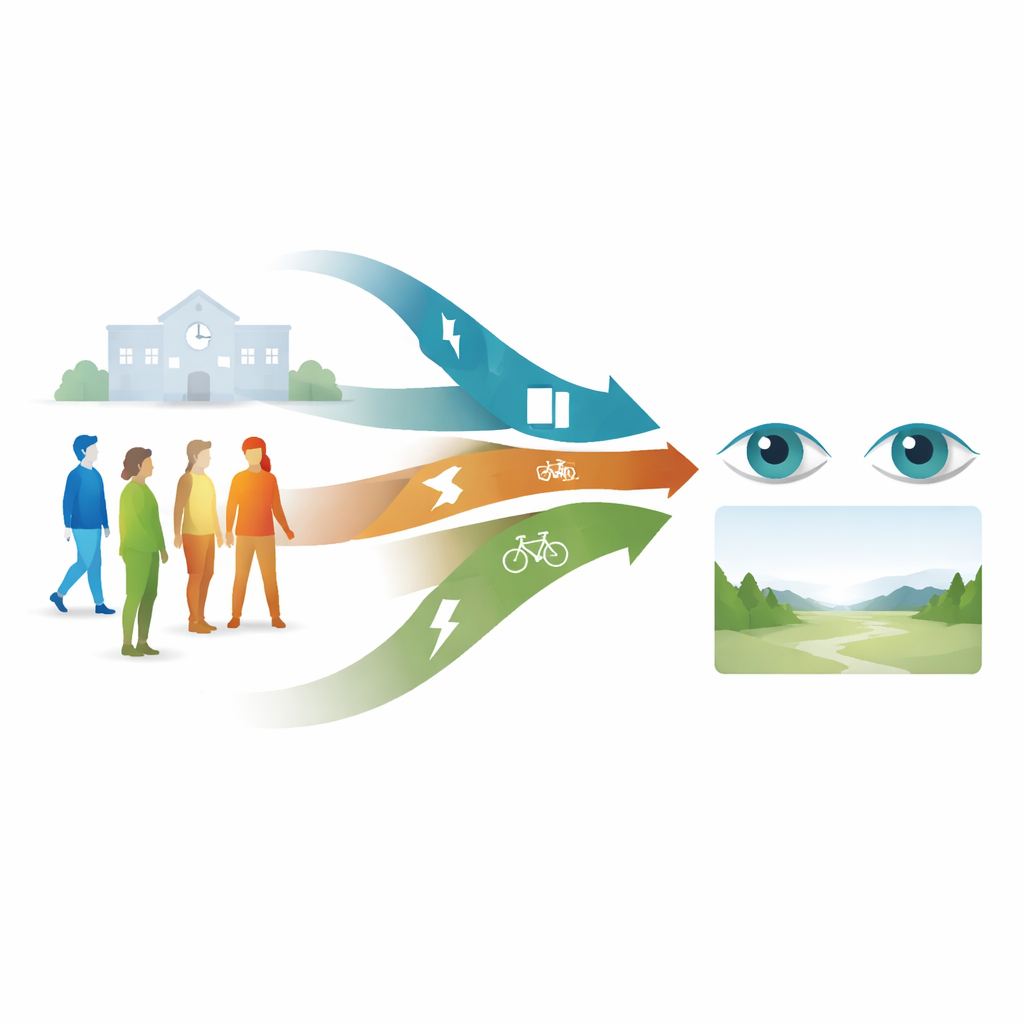
Looking beyond screens and schoolwork
Researchers in Shenzhen, China, worked with just over a thousand seventh-grade students, most about 12 years old. All students completed detailed questionnaires about their resilience (how well they bounce back from difficulties), how they handle emotions, and their levels of depression and anxiety. At the same time, trained eye-care professionals measured the strength of each student’s myopia using standard, instrument-based tests. Instead of examining each psychological trait separately, the team used a person-centered statistical method to see whether natural “types” of psychological profiles emerged across the group.
Three different patterns of inner resources
The analysis revealed three distinct psychosocial patterns. One group, called “high-resource,” scored strongly on most measures of resilience, positive thinking, family and peer support, and use of helpful emotion strategies. A second, “emotion-driven,” showed strong emotional control but weaker scores on goal focus and optimistic thinking, suggesting a tendency to rely on managing feelings in the moment rather than reshaping stressful situations. The largest group, “balanced-adaptive,” sat in the middle, with moderate scores across most traits. Surprisingly, this “in-between” group had the highest levels of depression, anxiety, and the most severe myopia, hinting that having only average resources may not be enough to buffer the pressures of early adolescence.
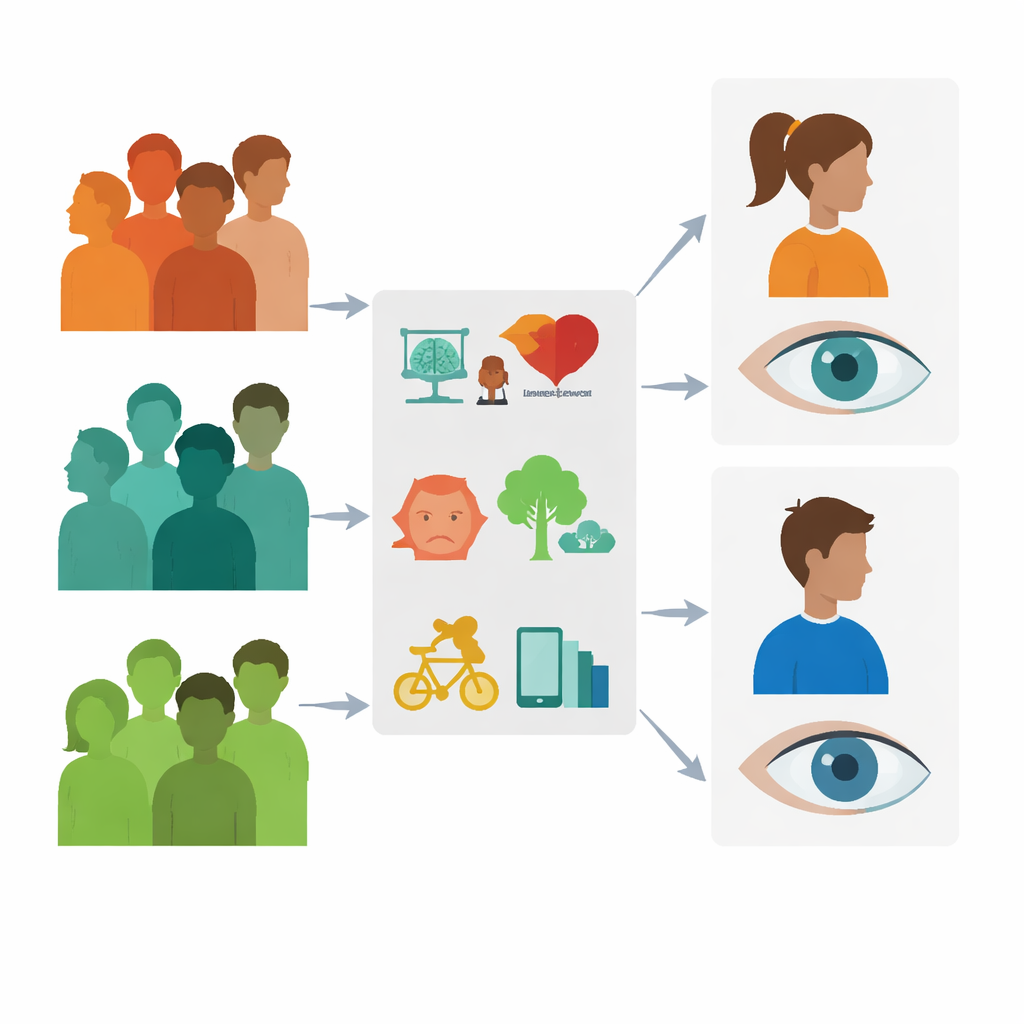
Girls, coping styles, and eye health
The team then asked whether gender changed the link between these psychological profiles and myopia severity. Overall, girls in the sample had slightly worse myopia and higher scores on depression and anxiety than boys. Yet when the psychological profiles were taken into account, a more nuanced picture emerged. Among girls, those in the high-resource and emotion-driven groups tended to have less severe myopia than girls in the balanced-adaptive group. In other words, certain patterns of coping, social support, and emotional skills were tied to healthier eyes—but only for female students. For boys, myopia severity did not differ meaningfully across the three psychological types.
Possible mind–body pathways
How might inner resilience and emotion skills affect eyesight? The authors outline two plausible routes. First, psychological resources are linked to how the body’s automatic stress systems operate. Key structures in the eye that help control its growth, such as the choroid and focusing muscles, are influenced by these stress pathways. Chronic strain or poor emotion regulation might subtly alter eye growth and encourage myopia to progress. Second, teens with stronger coping skills may maintain healthier daily habits—spending more time outdoors, taking breaks from close work, and following good “visual hygiene”—all known to slow myopia. Because girls often use different emotion strategies than boys and may be more sensitive to hormonal and stress-related changes, these mind–body links may show up more clearly in female adolescents.
What this means for protecting young eyes
For non-specialists, the main takeaway is that myopia is not only about screens, schoolwork, or genetics. This study suggests that a teenager’s psychological world—how supported, resilient, and emotionally skilled they feel—may also play a role, especially for girls. While the research is cross-sectional and cannot prove cause and effect, it points to a broader view of eye health: strengthening resilience, teaching healthier ways to reframe stress, and building social support could complement outdoor time and optical treatments. In the future, gender-sensitive programs that help girls manage emotions and stress more adaptively might not only improve mental well-being, but also contribute to clearer vision.
Citation: Xiang, Y., Mu, J., Wei, S. et al. The moderating role of gender in the association between latent psychosocial profiles and myopia severity among adolescents. Sci Rep 16, 13729 (2026). https://doi.org/10.1038/s41598-026-43664-9
Keywords: myopia in adolescents, psychological resilience, emotion regulation, gender differences, mental health and vision