Clear Sky Science · en
Design and thermo-structural analysis of multiple composite layers with ablative materials for passive thermal protection systems
Why heat shields matter for space travel
Every spacecraft that dives back through Earth’s atmosphere faces a blast furnace of searing air and crushing pressure. If its heat shield fails, critical equipment—and the crew—would not survive. This study looks at a new way to design and test the layered “skins” that protect spacecraft, focusing on materials that deliberately burn and crumble away to carry heat with them. By creating a fast but realistic computer model, the authors aim to help engineers design safer, lighter heat shields for future missions.
Layers that stand between fire and hardware
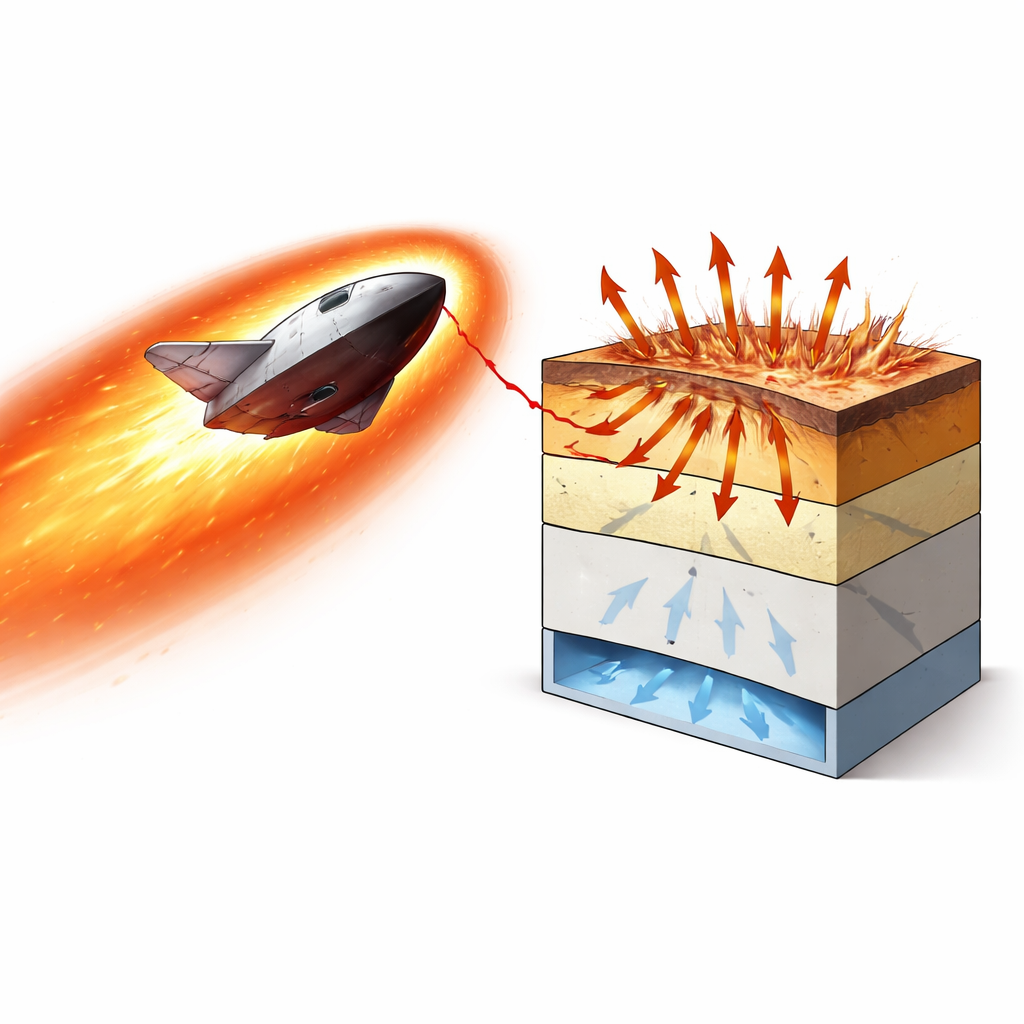
A typical passive thermal protection system is built like a high-tech club sandwich. On the outside sits an ablative layer that slowly burns and erodes under extreme heating, carrying energy away in the process. Under that lie a heat‑resistant metal layer, a thick insulation layer, and finally a structural composite layer that must stay cool and strong enough to carry loads. The paper studies how all four layers behave together when exposed to intense heating, especially how the sacrificial outer layer breaks down and how this affects temperatures and stresses deeper inside the structure.
What happens when the outer layer “sacrifices” itself
The outer ablative layer does more than just get hot; it chemically breaks apart in a process called pyrolysis. As the material decomposes, it forms a charred region, an active “reaction zone,” and untouched material below. Gases generated inside escape toward the surface, carrying heat away. The authors build a detailed mathematical description of this process, including how heat flows, how quickly the material loses mass, and how its density and thermal properties change as it chars. They then embed this description into a commercial simulation program using custom routines, so that a computer model can track both the erosion of the surface and the shifting properties within the layer over time.
From lab tests to fast design tools
To make the simulations realistic, the team measured key properties of a silica–phenolic ablative material in the lab. They burned samples in a combustion chamber to track how quickly material was lost and how its density changed. They also used thermogravimetric analysis, a technique that heats small samples in a controlled way while measuring their mass, to determine how rapidly the material decomposes at different temperatures. These measurements feed into the computer model, which first simulates the detailed two‑dimensional behavior of the ablative layer and then uses that information in a simpler one‑dimensional model to predict temperatures and thermal stresses across all four layers. This hybrid approach keeps the physics rich while greatly reducing computing time.
Finding designs that stay cool and don’t crack
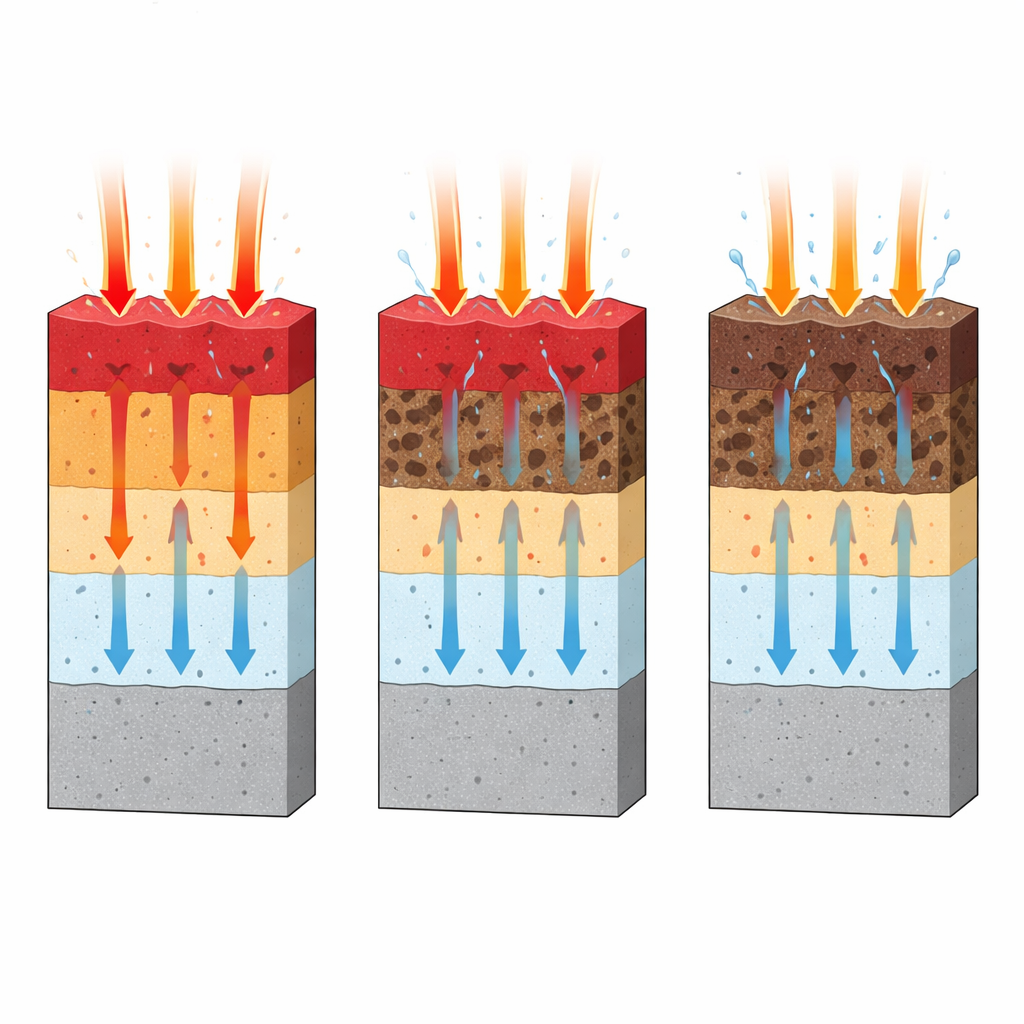
With this framework in place, the authors systematically varied the thickness of each layer to see how design choices affect performance. They looked at how hot the innermost structural layer becomes and whether any layer approaches its failure limits under the combined effects of heat and thermal expansion. Their simulations matched ablation tests within about ten percent, giving confidence in the model. The results show that making the ablative layer at least 10 millimeters thick and carefully balancing the insulation and metal layer thickness can keep the structural layer below 100 °C while avoiding excessive stresses. Thicker metal can actually worsen risk in the composite layer, so simply adding more material is not always safer.
A faster way to design safer heat shields
In the end, the study delivers a practical design tool: a computational method that captures the complex burn‑off of ablative materials and the resulting thermal and mechanical behavior of a multilayer heat shield, yet is efficient enough for early design studies. For non‑specialists, the key takeaway is that the best heat shields do not just resist heat—they are carefully engineered to let some material be sacrificed in a controlled way, while the deeper layers stay cool and structurally sound. The approach presented here helps engineers tune that balance more quickly and reliably, paving the way for safer, lighter spacecraft that can better withstand the fiery journey through an atmosphere.
Citation: Park, J., Kim, Y., Cha, JH. et al. Design and thermo-structural analysis of multiple composite layers with ablative materials for passive thermal protection systems. Sci Rep 16, 12225 (2026). https://doi.org/10.1038/s41598-026-43658-7
Keywords: thermal protection system, ablative materials, spacecraft heat shield, pyrolysis modeling, composite structures