Clear Sky Science · en
A deployable digital twin framework for bolt-torque specification compression in EV chassis assembly
Why this matters for everyday electric cars
Modern electric vehicles (EVs) are held together by thousands of bolts. If these bolts are tightened too loosely, parts can rattle or fail; too tightly, and components wear out or production slows down. Carmakers cope by using long, complicated tables of torque settings—one for almost every bolt type. This paper shows how a “digital twin” of both the car and the factory can dramatically simplify those torque tables while keeping EVs safe, quiet, and affordable to build.
How bolts and factory rhythm are linked
In an EV chassis, bolts must survive years of shaking, cornering, braking, and the pulsing forces of electric drive. Engineers usually play it safe by assigning many slightly different torque targets to different bolt families. But each unique torque requires specific tool programs and end-effectors, which slows production and complicates scheduling for automated guided vehicles (AGVs) that deliver parts. The authors reframe this as a whole‑system problem: can we standardize torque settings across the car while still protecting safety margins and keeping the assembly line running smoothly and cheaply?
A virtual factory that predicts, optimizes, and double‑checks
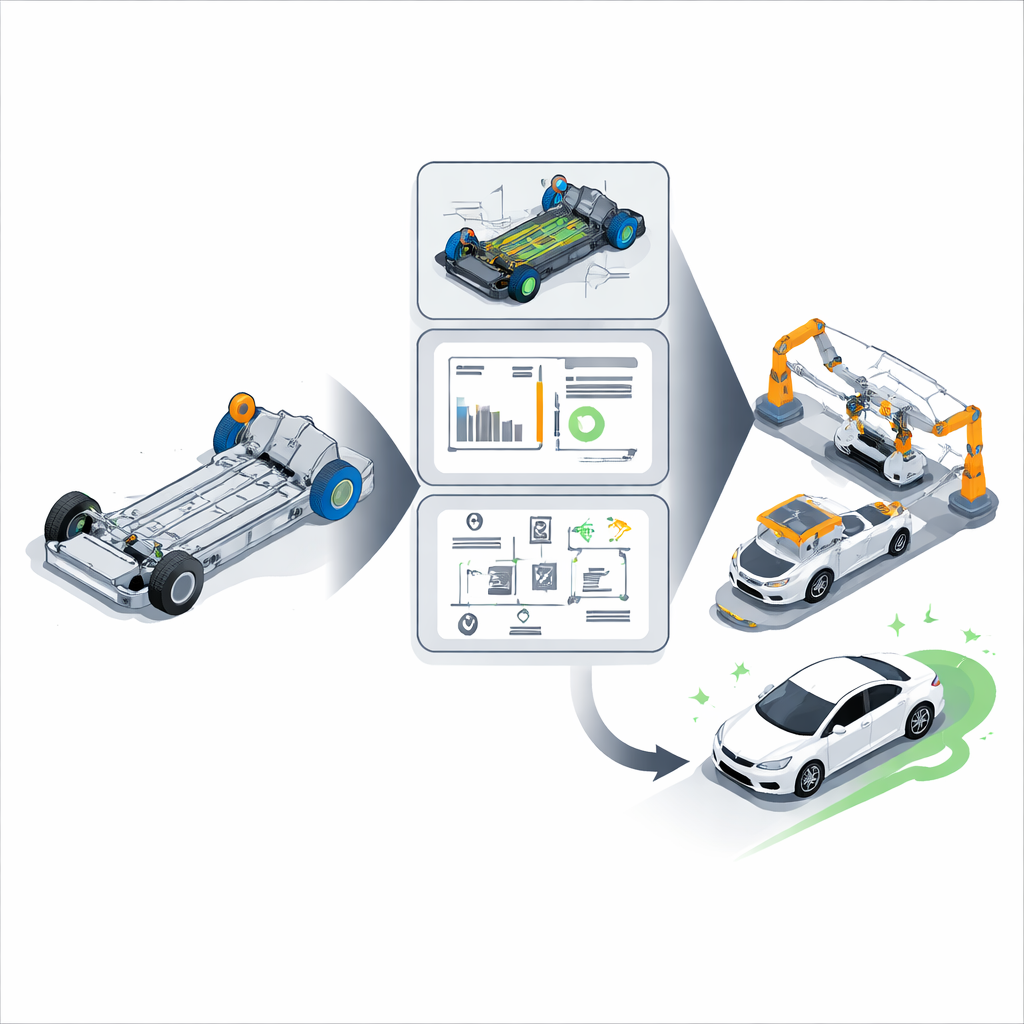
The team builds a deployable digital twin that mirrors both the mechanics of bolted joints and the realities of the shop floor. One layer models how a commanded torque translates into the clamping force that holds parts together, taking into account friction, bolt geometry, wear from reuse, and the three‑dimensional vibration environment around each joint. It checks that bolts meet fatigue and safety limits under worst‑case loads. A second layer watches tightening “signatures” – the torque‑versus‑angle curves recorded as each bolt is driven – and uses a modern sequence‑learning model to estimate the chance that a fastening will later be rejected. A third layer represents line logistics, including AGV travel times, workstation balance, and the impact of changing tools or torque settings on overall equipment effectiveness.
Searching for better torque tables, not just one “best” answer
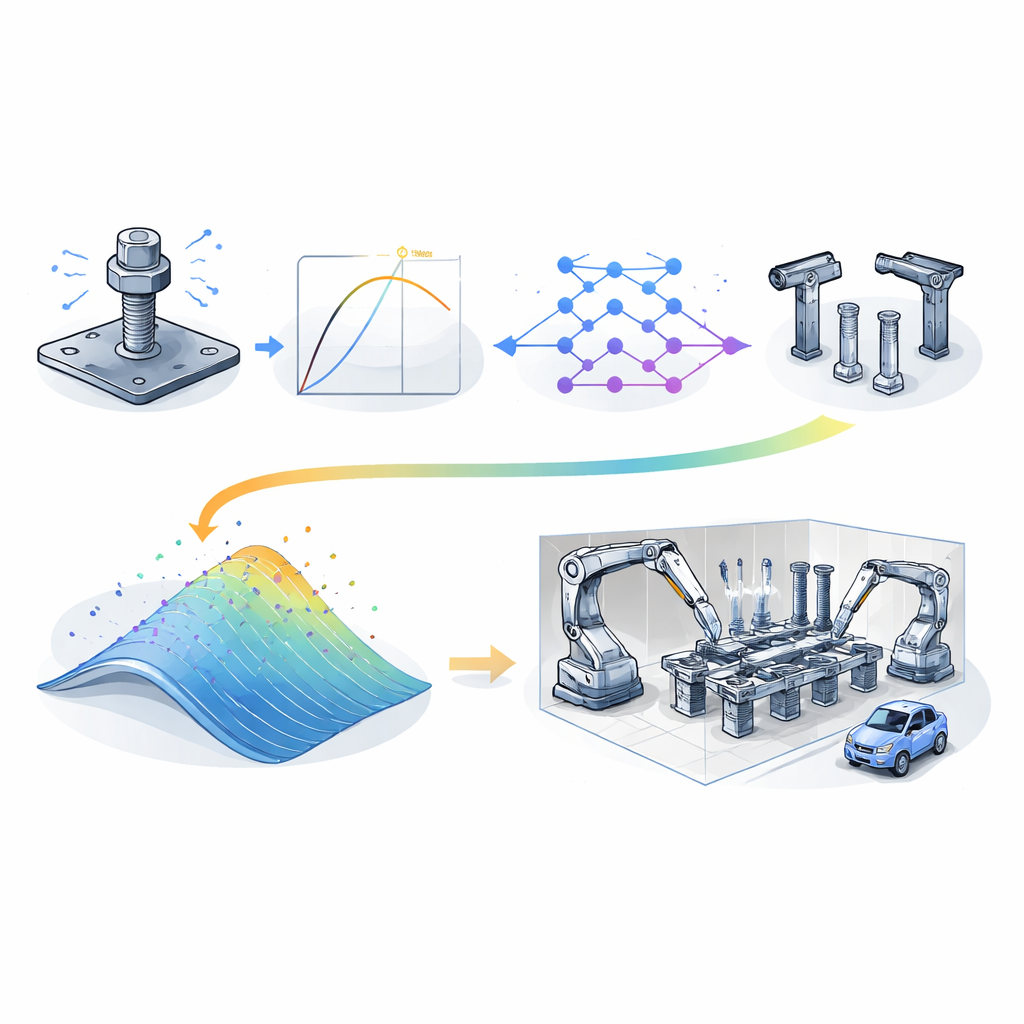
Because there is no single perfect trade‑off between quality, cost, and speed, the authors use a multi‑objective search algorithm inspired by the motion of swarms. Each “particle” in this swarm encodes a full torque table plus related decisions such as how many workstations are needed and how AGVs are routed. The swarm explores combinations that reduce expected rejects and unit cost while respecting strict safety rules, a reject‑rate cap, and practical limits on vibration and friction. Near‑miss solutions are nudged back into the safe region by making only tiny torque adjustments, and an external archive keeps the most promising trade‑offs. Crucially, the best candidates are periodically re‑evaluated by a higher‑fidelity version of the digital twin that propagates uncertainties, acting as a release gate before any setting is approved for the shop floor.
From simulation to real EVs on the road
The workflow is tested on three related EV platforms and then deployed for a full year on an industrial line building 5,524 vehicles. The digital twin learns platform‑specific details such as mass and wheelbase yet finds very similar “knee” points—operating regions where a small increase in cost buys a large gain in quality. Using these insights, engineers compress the torque table from 23 different settings down to 8, cutting the number of tool and program variants by about two‑thirds. This simplification reduces end‑effector changeovers by 31% and AGV idle time by 14%, all while keeping measured bolt‑loosening rates between 0.01% and 0.05%, within the company’s internal target. Cross‑checks with road tests over varied surfaces confirm that the standardized torques still protect against loosening under real‑world vibration.
What this means for drivers and factories
To a layperson, the message is that smarter virtual models can let carmakers tighten fewer knobs without loosening safety. By tying together physics‑based models, data‑driven quality prediction, and factory logistics in a closed loop, the proposed framework finds torque schedules that keep EV chassis bolts secure while streamlining production. The result is a more consistent build process, less wasted time and tooling, and quietly reliable vehicles—benefits that appear not only on one car model but across several related platforms.
Citation: Wang, H., Huang, Z., Lan, Z. et al. A deployable digital twin framework for bolt-torque specification compression in EV chassis assembly. Sci Rep 16, 13164 (2026). https://doi.org/10.1038/s41598-026-43641-2
Keywords: electric vehicle assembly, bolt tightening, digital twin, factory optimization, multi-objective algorithms