Clear Sky Science · en
On topological co-index polynomials for predictive modeling of the physicochemical properties of antiviral drugs
Why math can speed up the search for Ebola medicines
Finding new antiviral drugs is usually slow and expensive, because each promising molecule must be made and tested in the lab. This study explores a shortcut: using ideas from mathematics and graph theory to "read" a drug’s structure like a barcode and predict how it will behave, without mixing a single chemical. The work focuses on medicines proposed against Ebola virus and shows how carefully designed numerical fingerprints of molecules can forecast important physical properties that matter for how a drug works in the body.
Turning molecules into simple pictures
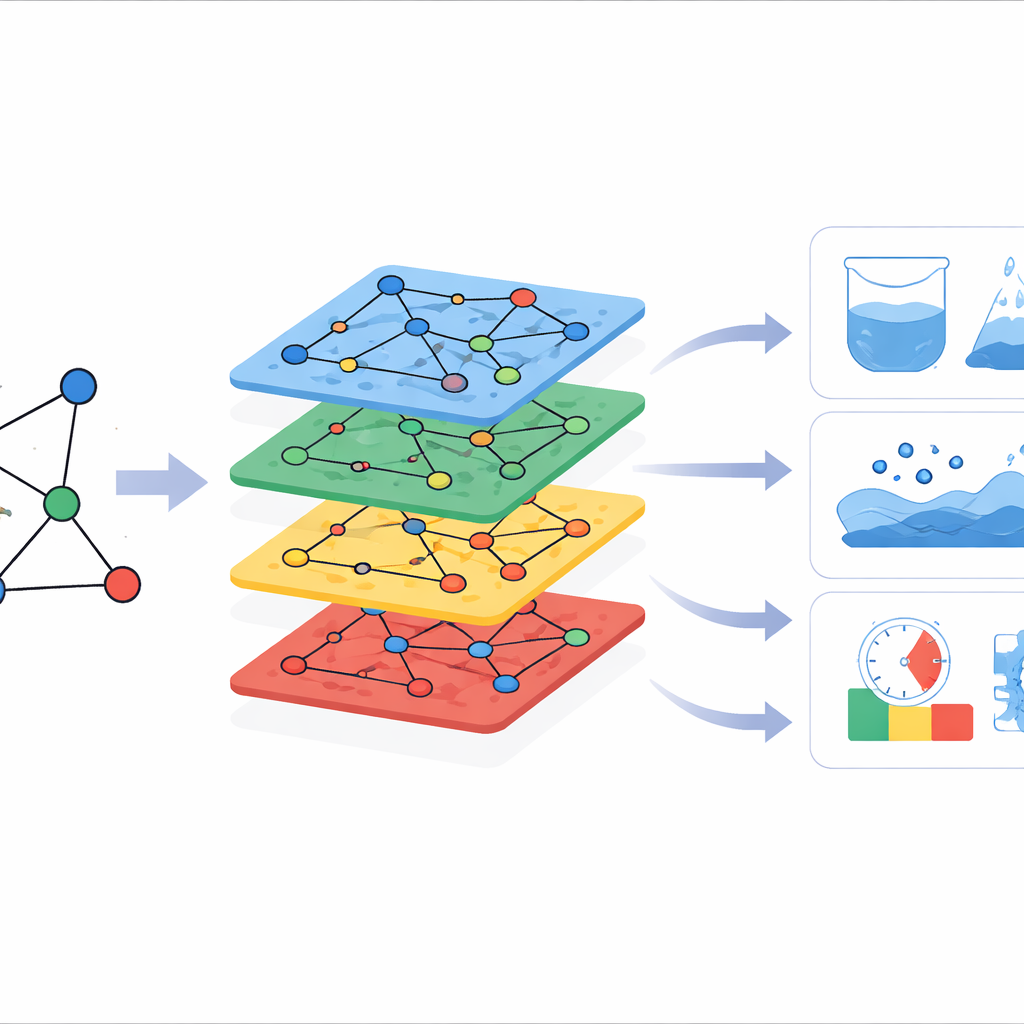
At the heart of this approach is a way to redraw a molecule as a simple network: atoms become points and chemical bonds become lines connecting them. Once a drug is represented as a network, the authors compute topological indices—numbers that capture features like how many branches the molecule has, how tightly its atoms are connected, or how symmetric its overall shape is. These indices condense a complex 3D structure into a handful of descriptive values, making it possible to compare and analyze many molecules quickly on a computer.
New molecular fingerprints with extra detail
Building on earlier work, the researchers introduce and analyze a family of refined indices called topological co-indices, derived from two mathematical constructions known as CoM and CoNM polynomials. Rather than looking only at atoms that are directly bonded, these new descriptors also consider pairs of atoms that are not directly connected but still influence each other through the overall structure. CoM focuses on how many bonds meet at each atom, while CoNM tracks the "neighborhood" around each atom. By encoding this richer information into compact polynomials, the method can generate many different indices in one step, offering a more nuanced fingerprint of each molecule without a heavy computational cost.

Testing the method on Ebola drug candidates
The team applied their framework to eight antiviral drugs that have been discussed in the context of Ebola treatment, including Galidesivir, Chloroquine, Favipiravir, Amodiaquine, Azithromycin, Brincidofovir, Clomiphene, and Remdesivir. For each drug, they calculated a suite of degree-based and neighborhood-based co-indices and compared them with experimental data taken from the ChemSpider database. The physical properties examined included molar volume, molar refractivity, polarizability (how easily a molecule’s electrons are distorted), surface tension, overall structural complexity, how oily or water-loving the molecule is (LogP), density, and refractive index. In effect, they asked: can these mathematical fingerprints stand in for time-consuming measurements?
Finding the best links between structure and behavior
To probe these links, the authors built Quantitative Structure–Property Relationship (QSPR) models—equations that relate each topological co-index to a given physical property. They tried three families of models: simple straight-line (linear) fits, logarithmic fits, and curved (quadratic) fits. Many properties showed strong correlations with particular indices, with correlation coefficients often close to one, meaning the predictions tracked the experimental data very closely. Some descriptors, such as the atom-bond connectivity co-index and several neighborhood-based indices, repeatedly emerged as the most reliable predictors for key properties like molar volume, molar refractivity, polarizability, and structural complexity. For more subtle traits like oil–water balance and density, nonlinear models—especially logarithmic and quadratic forms—captured the relationships better than straight lines, underscoring that the structure–property link is often inherently curved rather than linear.
What this means for future drug discovery
Overall, the study shows that carefully designed topological co-indices, generated from CoM and CoNM polynomials, can serve as powerful stand-ins for laboratory measurements of antiviral drug properties. By accurately predicting how candidate molecules will behave, these mathematical tools can help scientists quickly filter large libraries of compounds, focus experiments on the most promising leads, and fine-tune molecular designs before synthesis. While they do not replace biological testing, such descriptors offer a fast, low-cost way to navigate chemical space—an especially valuable asset when responding to fast-moving threats like Ebola and other emerging infectious diseases.
Citation: Meharban, S., Ullah, A., Zaman, S. et al. On topological co-index polynomials for predictive modeling of the physicochemical properties of antiviral drugs. Sci Rep 16, 12456 (2026). https://doi.org/10.1038/s41598-026-43640-3
Keywords: Ebola antiviral drugs, topological indices, QSPR modeling, molecular graph theory, computational drug design