Clear Sky Science · en
Comparative evaluation and architectural enhancement of a genetic algorithm-tuned fuzzy logic battery control in microgrid energy management
Keeping the Lights On with Clean Energy
As more homes and communities plug into solar panels and wind turbines, a tricky question arises: how do we keep the lights on when the sun ducks behind a cloud or the wind suddenly drops? This paper explores a smarter way to manage batteries in a small-scale power network called a microgrid, where local solar, wind, and a battery work together with the main grid. The authors show that the overall "brain" of the control system matters more than the fine-tuning of its internal knobs, and that a better control design can squeeze more value out of renewable energy while treating the battery more gently over time. 
Why Microgrids Need Smart Brains
Microgrids combine rooftop-style solar panels, small wind turbines, batteries, and a connection to the wider utility grid. They can power buildings on their own or cooperate with the main grid, which makes them attractive for remote areas, campuses, or neighborhoods that want more resilience and cleaner power. But the output of sun and wind changes from minute to minute, while people expect steady electricity. Batteries buffer these ups and downs, yet they must be kept within safe charge levels to avoid damage. Traditional control methods either assume the system behaves in a simple, predictable way or demand heavy calculations and precise models that are hard to obtain in real life. This creates a need for control strategies that can handle messy, changing conditions without becoming too complex or fragile.
Letting Rules Handle the Messy Real World
The authors build on a technique called fuzzy logic control, which works less like a rigid formula and more like a set of human-style rules: "if the battery is quite full and demand is high, then discharge; if there is extra solar power and the battery is low, then charge," and so on. Instead of crisp thresholds, fuzzy logic uses overlapping ranges like "low," "medium," and "high" to capture gray areas. In this study’s first phase, a genetic algorithm—a search method inspired by evolution—automatically tunes the shapes of these fuzzy ranges so that the battery current and state of charge follow desired patterns. The same microgrid setup had already been tuned in past work with two other popular optimization methods, particle swarm optimization and backtracking search. By repeating the exercise with genetic algorithms under identical conditions, the authors could compare how much the choice of tuning method really matters.
What Matters More: Tuning or Design?
In Phase 1, all three tuning methods produced very similar behavior. The battery’s charge level stayed safely between 20% and 80%, current differences between methods were small, and the overall energy flow looked much the same, even though the genetic algorithm needed more iterations to settle on good settings. This suggested that once the basic fuzzy controller is well designed, swapping one metaheuristic optimizer for another mainly affects how quickly the tuning converges, not how the microgrid behaves day to day. Recognizing this, the authors shifted focus in Phase 2 from adjusting numbers inside a fixed design to rethinking the design itself. 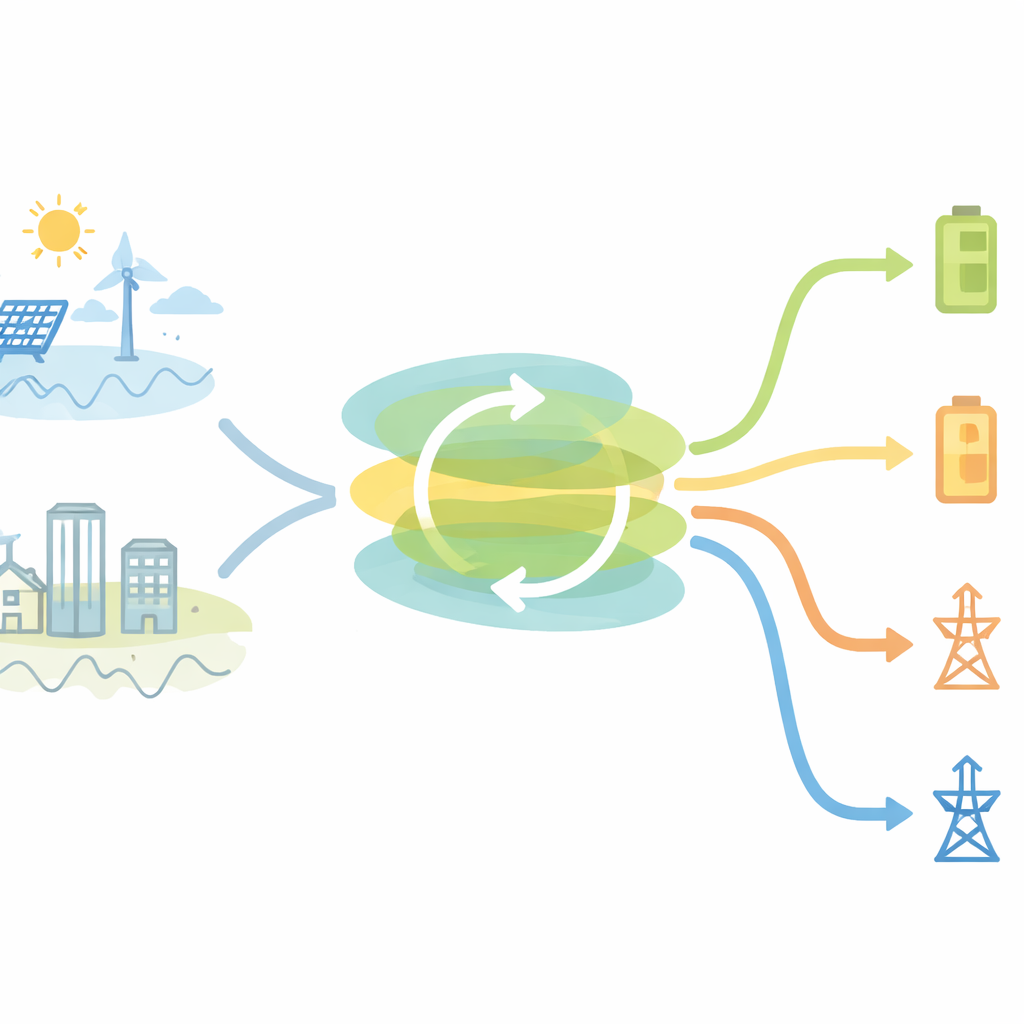
Building a More Realistic Decision Maker
In the second phase, the fuzzy controller is reshaped into a more practical decision tool. Instead of only deciding how much current the battery should push or pull, it now also chooses among clear actions: charge the battery, discharge it, draw power from the grid, or send surplus power back. The controller looks at two main signals: how full the battery is and whether local renewables are currently supplying more or less power than the load needs. It then follows rule sets that favor using local solar and wind first, protect the battery from overuse, and turn to the grid only when necessary. Simulations show that this redesigned controller keeps the battery at healthy charge levels for longer stretches, reduces unnecessary cycling, uses more of the available renewable energy, and still maintains stable voltages and currents at the grid connection.
What This Means for Future Energy Systems
For readers, the central message is that in complex systems like renewable-rich microgrids, the structure of the control “brain” matters at least as much as how finely its parameters are tuned. The study finds that different tuning algorithms all deliver similar day-to-day performance when the underlying controller is fixed, but a smarter control architecture—one that directly decides when to charge, discharge, import, or export—can significantly improve how clean energy and batteries are used in practice. This insight suggests that future progress in managing neighborhood-scale power may come less from ever more exotic optimization tricks and more from clear, well-thought-out decision designs that mirror the real choices operators care about.
Citation: Meliani, M., El Attafi, A., El Barkany, A. et al. Comparative evaluation and architectural enhancement of a genetic algorithm-tuned fuzzy logic battery control in microgrid energy management. Sci Rep 16, 14209 (2026). https://doi.org/10.1038/s41598-026-43620-7
Keywords: microgrid battery control, renewable energy storage, fuzzy logic energy management, genetic algorithm optimization, grid-connected solar and wind