Clear Sky Science · en
Carboxy-terminal 24-amino-acid peptide of integral membrane protein 2A is produced in the heart and stimulates atrial natriuretic peptide release
Why a Tiny Heart Signal Matters
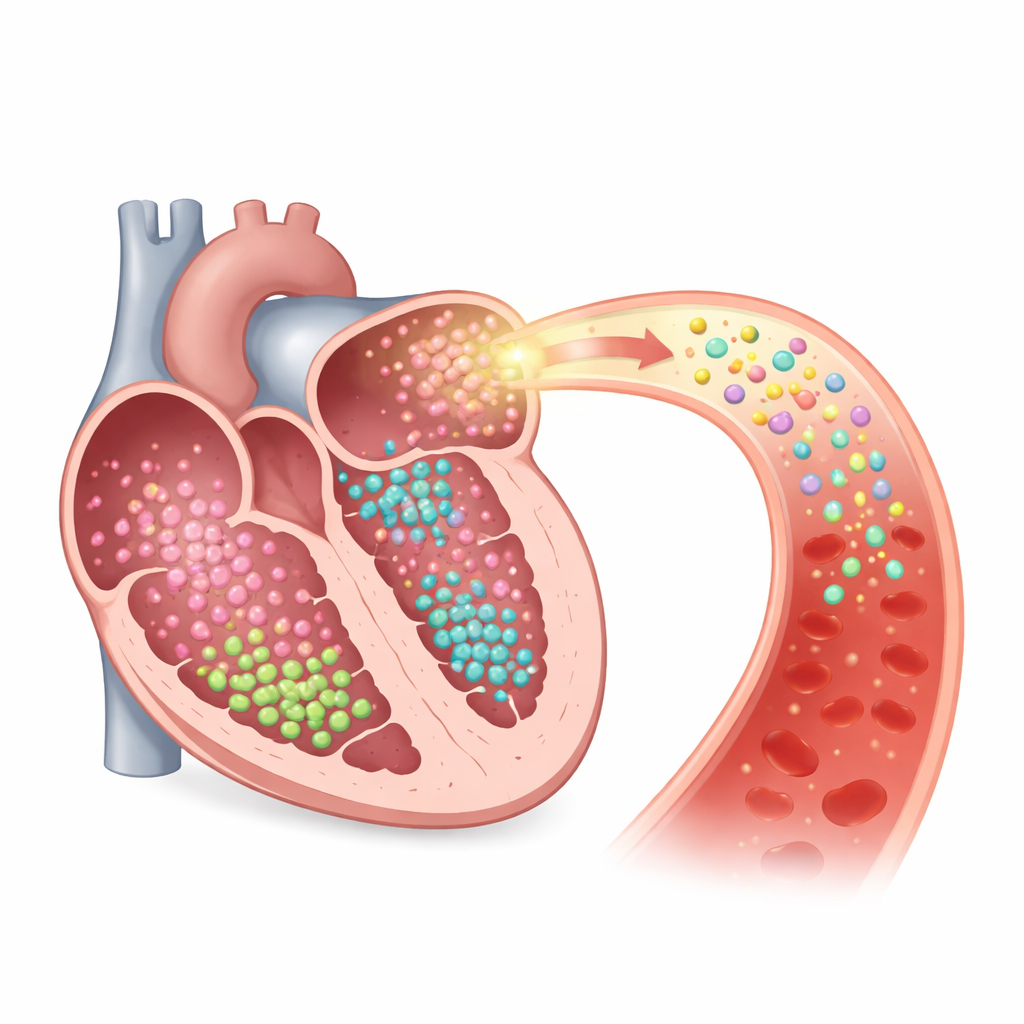
Heart failure and heart attacks are often described in terms of clogged arteries and weakened muscle, but they are also diseases of faulty communication inside the heart. Heart cells constantly trade chemical signals that help the organ adapt to stress. This study reveals a previously unknown messenger peptide made in the heart that can boost the release of atrial natriuretic peptide (ANP), a hormone that helps the body get rid of excess salt and water and protects the heart from overwork.
Hidden Conversations Between Heart Cells
The heart is built mainly from two kinds of cells: contracting muscle cells that drive each heartbeat, and supporting fibroblasts that help maintain structure and repair. These cells talk to each other using small proteins and peptides that act like local hormones. Earlier work showed that fibroblasts secrete something—beyond already known molecules—that makes muscle cells release more ANP, but its identity was unclear. Because ANP is a key natural defense against high blood pressure and heart strain, finding this missing signal could reveal new ways the heart protects itself.
Finding a New Peptide Messenger
To track down this mystery factor, the researchers collected the “soup” of peptides released by newborn rat heart fibroblasts and analyzed it with advanced mass spectrometry, a technique that reads the molecular weights and fragments of peptides. They focused on peptides that stick to chitin, a material previously useful for enriching biologically active, cysteine-rich peptides. Among the candidates, they identified a 24–amino-acid piece clipped from the tail end of a membrane protein called integral membrane protein 2A (ITM2A). This short segment, dubbed ITM2A-24P, has a specific internal bond between two cysteine residues and is produced in rats, mice, and humans with exactly the same sequence, hinting at an evolutionarily conserved role.
How the Peptide Affects Heart Hormone Release
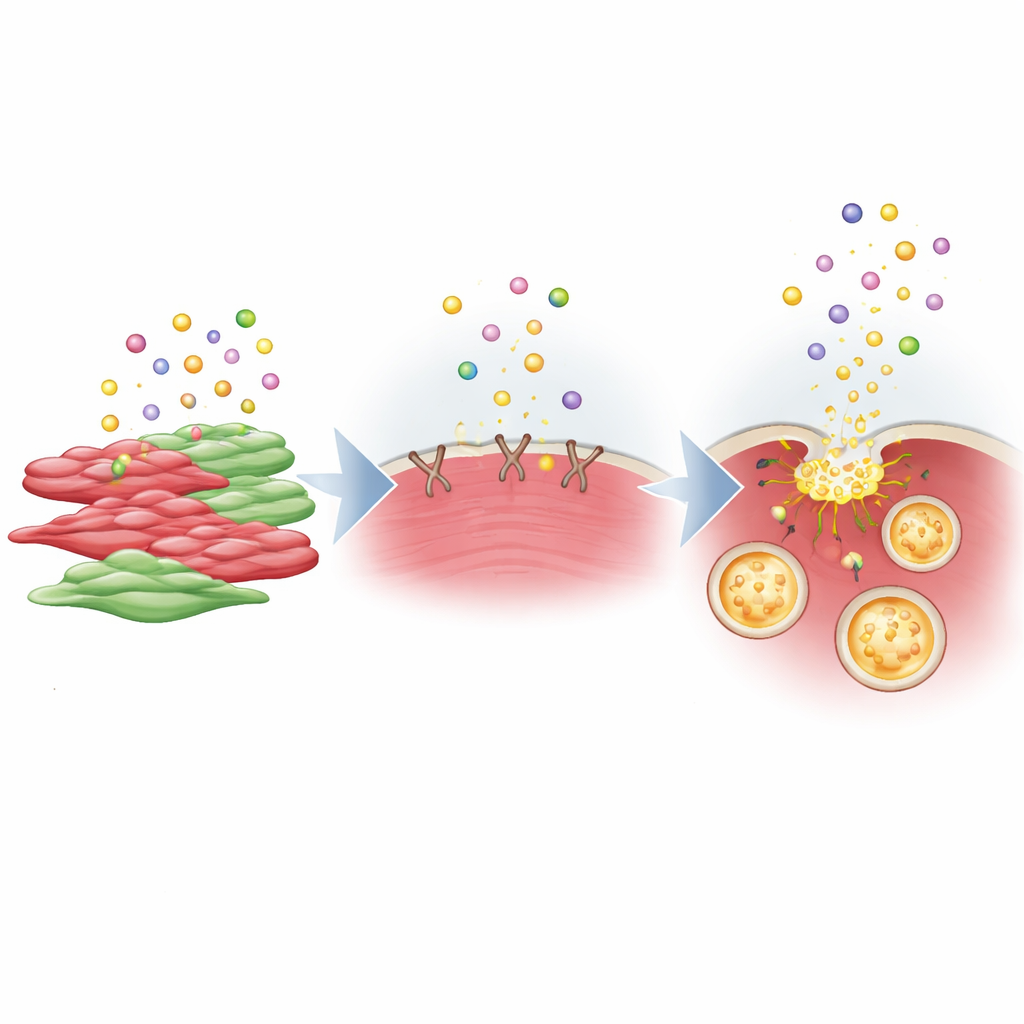
The team tested synthetic ITM2A-24P on cultured rat heart muscle cells and on isolated rat hearts kept beating outside the body using a Langendorff perfusion system. In both setups, adding the peptide increased the amount of ANP released into the surrounding fluid without speeding up the heartbeat or the cells’ own beating rate. This is important because faster beating by itself can trigger more ANP release; here, the effect came specifically from the peptide’s action. Interestingly, ITM2A-24P did not noticeably change another related hormone, brain natriuretic peptide (BNP), suggesting a more selective control over ANP. The peptide also did not boost ANP gene activity or alter classic internal signals such as calcium or cAMP, implying it acts through an as-yet-unknown pathway that directly promotes secretion.
Where and When the Peptide Is Made
Using a sensitive antibody-based assay, the researchers found that both heart muscle cells and fibroblasts secrete similar small amounts of ITM2A-24P, even though muscle cells are the main source of ANP and fibroblasts dominate production of other factors such as adrenomedullin. This suggests ITM2A-24P participates in two-way local signaling within the heart wall. In a mouse model of heart attack, levels of ITM2A gene activity in heart tissue rose several-fold and peaked about one week after the injury, mirroring the surge in ANP hormone in the bloodstream. Other studies show that the enzyme likely responsible for cutting ITM2A into the peptide form also increases after heart damage, supporting the idea that production of ITM2A-24P is ramped up under stress.
What This Means for Heart Health
Overall, the study identifies ITM2A-24P as a newly recognized cardiac signaling peptide that can locally stimulate ANP release without disturbing the heart’s rhythm or relying on the usual internal chemical messengers. In everyday terms, it appears to be part of an internal safety system that tells heart cells to send out more of a protective hormone when the organ is under strain, such as after a heart attack. Although much remains unknown—especially which receptor the peptide uses and exactly how it triggers secretion—this discovery adds a fresh piece to the puzzle of how the heart defends itself and may eventually inspire therapies that amplify the body’s own protective signals.
Citation: Osaki, T., Mochiduki, A., Nishigori, M. et al. Carboxy-terminal 24-amino-acid peptide of integral membrane protein 2A is produced in the heart and stimulates atrial natriuretic peptide release. Sci Rep 16, 13703 (2026). https://doi.org/10.1038/s41598-026-43576-8
Keywords: heart peptides, atrial natriuretic peptide, cardiac cell signaling, myocardial infarction, heart hormone regulation