Clear Sky Science · en
Impact of hydrokinetic turbines on rainbow trout behaviour
Power from Rivers without Big Dams
Supplying clean, reliable electricity to remote communities often means turning to nearby rivers. Traditional hydropower dams can generate a lot of energy, but they also block fish migrations and disrupt entire river ecosystems. This study asks a simple but crucial question: can smaller in‑stream turbines that sit directly in flowing water provide power without getting in the way of fish, in this case young rainbow trout?
Small Turbines in Flowing Water
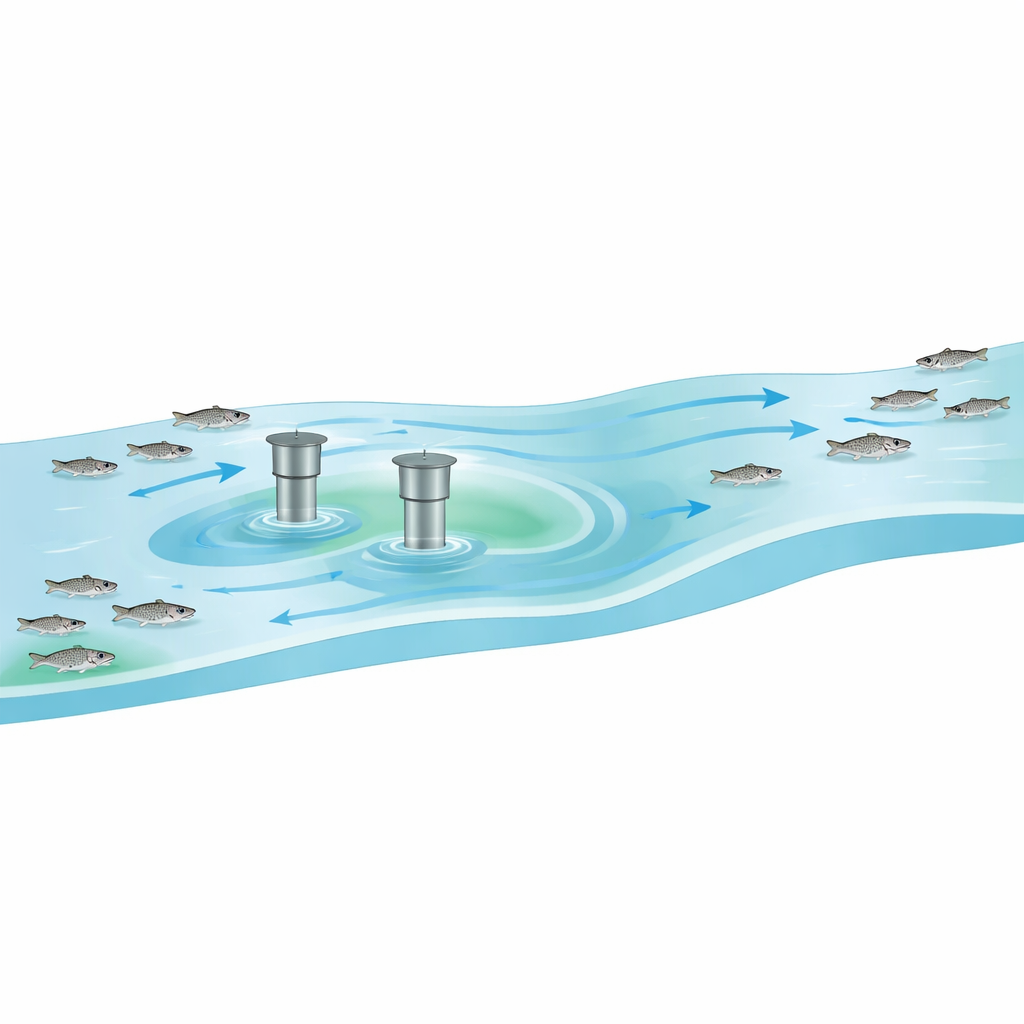
Instead of walling off a river with a dam, hydrokinetic turbines are placed directly in the current, a bit like underwater windmills. The researchers focused on a common design called a vertical‑axis turbine, which can turn even in relatively slow water. These devices take up only part of the river’s width, leaving open “corridors” of free‑flowing water. To understand how fish respond, the team built a clear‑walled artificial stream in the lab and installed either one turbine or a pair of turbines spinning in different directions. They then released juvenile rainbow trout, either alone or in groups of three, and filmed their movements from above.
Following Fish in a Test Channel
High‑speed video and tracking software allowed the scientists to reconstruct each fish’s path, how much of the channel it explored, how often it swam past the turbines, and even how quickly its tail was beating, which reflects swimming effort. They compared five setups: no spinning turbine, one spinning turbine with a single fish, one spinning turbine with a shoal, and two different ways of running a pair of turbines together. For every trial, water speed and turbine rotation were kept the same so that changes in behavior could be tied directly to turbine layout and social setting.
Safe Passage and Preferred Resting Spots
The central finding is reassuring: the turbines did not block trout from swimming upstream or downstream. Passage rates past the machines were just as good as in the control case without moving blades, and in one twin‑turbine setup the trout actually crossed more often. Direct hits with turbine blades were very rare and caused no visible harm. The fish did, however, change where they chose to spend their time. They gravitated toward areas just downstream and just upstream of operating turbines where the spinning blades created pockets of slower water. These “wake” regions offered the trout a place to hold position with less effort while the faster main flow rushed by elsewhere in the channel.
Braver in a Crowd
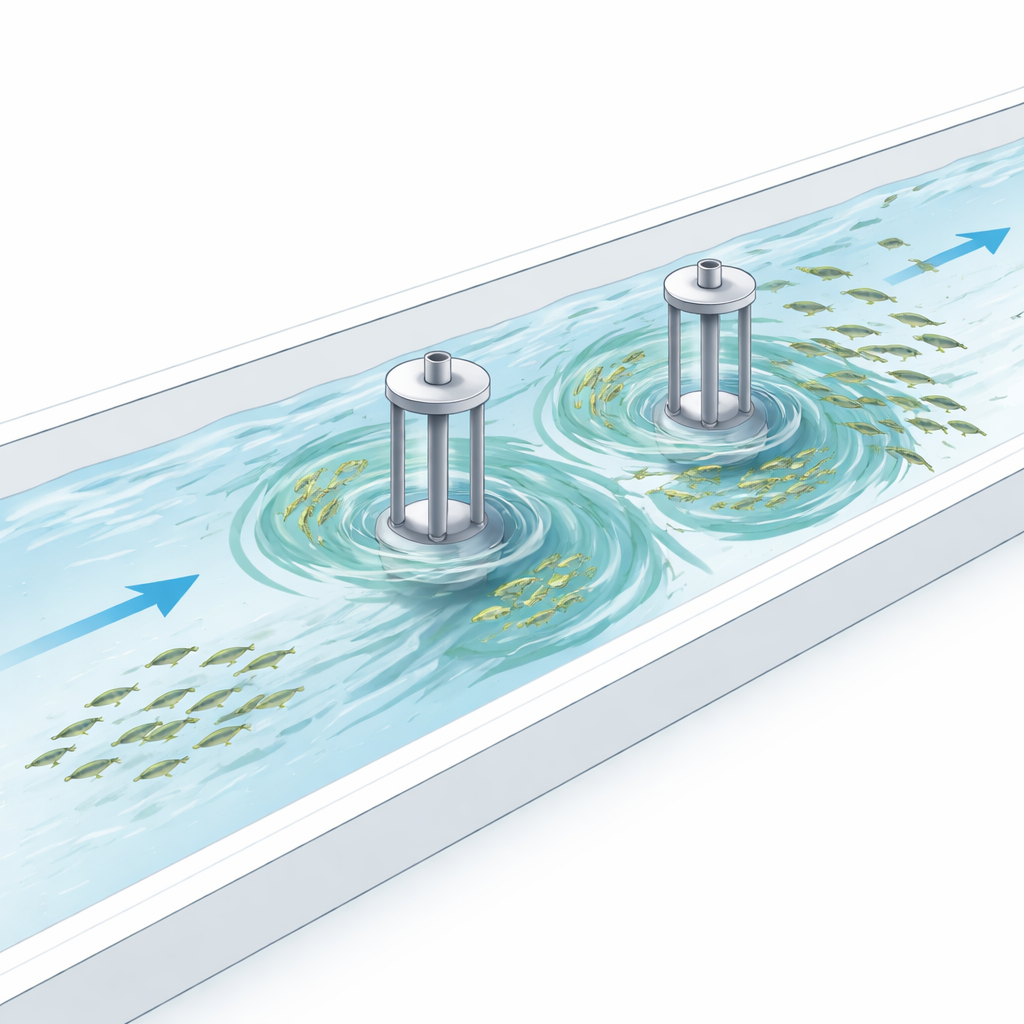
Whether trout swam alone or in a small group turned out to matter. Single fish tended to keep their distance from a spinning turbine, spent more time resting on the channel bottom, and had fewer close encounters with the blades. Fish in shoals, by contrast, were bolder. Groups approached turbines more often, stayed closer to them, and made greater use of the low‑speed wake zones, especially when two turbines were operating side by side and created a larger calm region. Interestingly, simply being in a group did not automatically save energy: overall tail‑beat rates were lower mainly in the calmer wake regions, not just because of shoaling itself.
What This Means for Rivers and Energy
For managers trying to balance clean energy and river health, these results are encouraging. In a relatively wide channel, in‑stream turbines that only partially occupy the flow allowed young trout to move freely and survive uninjured, while also offering calm patches of water the fish seemed to appreciate. At the same time, gathering of fish in turbine wakes could create attractive spots for predators in real rivers, and full‑scale devices will generate stronger currents than the lab models. Even so, compared with large dams that can cause heavy fish losses, carefully sited hydrokinetic turbines appear to be a promising way to tap renewable energy from rivers while keeping aquatic life on the move.
Citation: Sonnino Sorisio, G., Müller, S., Wilson, C.A.M.E. et al. Impact of hydrokinetic turbines on rainbow trout behaviour. Sci Rep 16, 13652 (2026). https://doi.org/10.1038/s41598-026-43568-8
Keywords: hydrokinetic turbines, rainbow trout, fish behavior, renewable river energy, aquatic ecology