Clear Sky Science · en
Mechanism of bolt rib geometry in controlling the brittle-to-ductile failure transition of bolt-grout interfaces
Holding Underground Rock Together
Deep tunnels and caverns—whether for trains, hydropower, or mining—rely on metal rods called rock bolts to keep the surrounding rock from caving in. These bolts are glued into holes with cement-like grout, and tiny ridges along the bolt help lock everything together. This study shows that the size and spacing of those ridges can decide whether the support system fails suddenly and dangerously, or stretches and absorbs energy in a safer, more forgiving way.
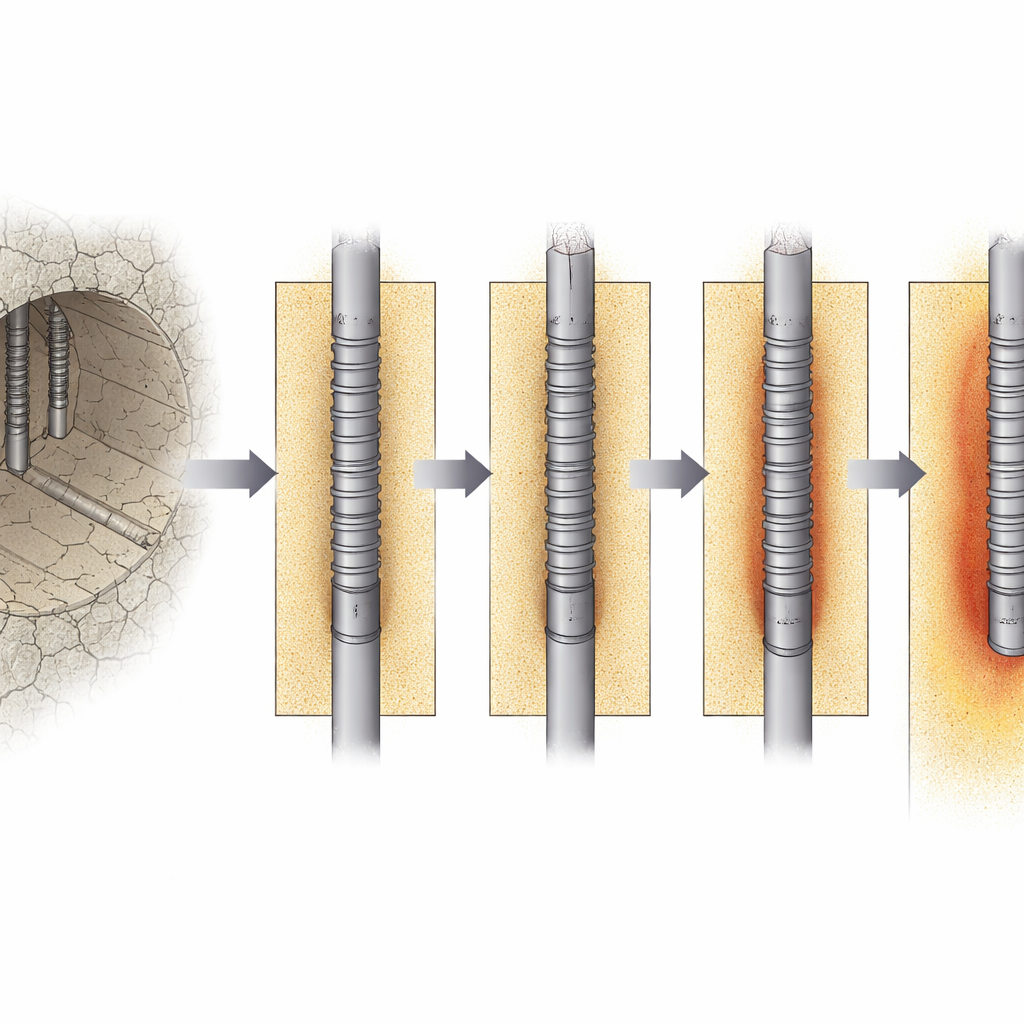
Why the Shape of Bolt Ridges Matters
In a fully grouted rock bolt, loads are passed from the steel bar to the grout and then into the rock. The weak link is often the thin contact zone between bolt and grout. Engineers have long known that changing the rib pattern on a bolt changes how strong that connection is, but not exactly why. The authors focus on a simple geometric measure: the ratio between the spacing of the ribs and their height. By systematically varying this ratio, they ask how ridge geometry controls whether the bond breaks in a brittle snap or deforms in a more gradual, energy-absorbing way.
Testing Bolts Until They Pull Free
The team carried out controlled laboratory pull-out tests on three kinds of high-strength steel bolts embedded in strong granite blocks using standard cement mortar. One bolt had closely spaced ribs, another had more widely spaced ribs, and a third had every second rib removed to maximize spacing. Although all bolts handled similar peak loads, their failures looked very different. The tightly ribbed bolt tended to slice the grout cleanly along the interface, leaving a smooth cylindrical surface and crushed material trapped between ribs—a classic brittle shear failure with a steep drop in load once the peak was passed.
From Sudden Breaks to Stretching Failures
Bolts with more widely spaced ribs behaved more gently. Instead of a sharp break, their load–displacement curves showed a broader peak followed by a slow decline, with substantial remaining strength even after noticeable movement. When the specimens were opened, the grout between ribs was not only sheared but also crushed and pushed outward, causing visible cracking and slight expansion in the surrounding rock. This mixed shearing and bulging—known as shear-dilation—spread damage over a larger region and allowed the system to absorb two-and-a-half to more than three times as much energy before peak load as the brittle case. Measurements of strain along the bolts confirmed that, in these ductile cases, forces penetrated deeper into the grout, engaging more material in carrying the load.
Peering Inside with Digital Grains
To understand what happens inside the grout where experiments cannot easily see, the authors built a detailed numerical model using a discrete element method. In this approach, grout and rock are represented as many small particles bonded together, so that cracks can form and grow naturally. After carefully tuning the model to match lab stress–strain data and pull-out curves, they tracked how forces and cracks evolved around ribs of different spacing. For closely spaced ribs, force paths ran almost horizontally along the interface, and cracks quickly merged into a thin shear band, explaining the sudden loss of strength. For larger spacing, force chains left the ribs at steep angles and penetrated deep into the grout, while cracks formed as a dispersed network of inclined tensile–shear fractures throughout a broader zone.
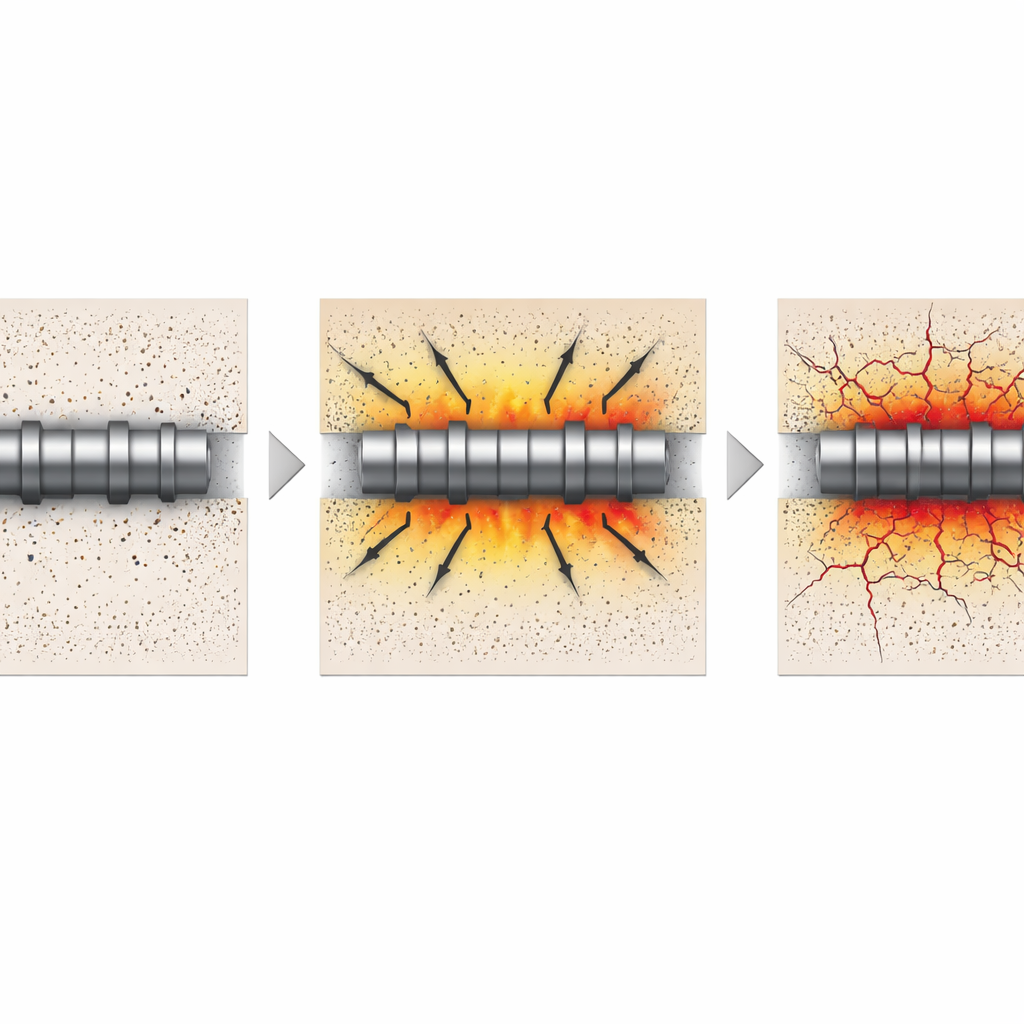
How Geometry Creates Extra Grip
The simulations also revealed that as the grout between widely spaced ribs crushes and slips, it is forced to expand sideways. This self-generated expansion presses harder against the surrounding material, creating an internal confining stress that actually increases friction and residual strength along the interface. In other words, the right rib geometry turns the interface into an active energy absorber: instead of letting a single thin plane fail, it encourages a thicker region of material to crack, crush, and slide in a controlled way while continuing to carry load.
Designing Safer Underground Support
For non-specialists, the key message is that the tiny ridges on a rock bolt are not mere manufacturing details—they are powerful design levers. By increasing the spacing-to-height ratio of bolt ribs into an optimized range, engineers can deliberately shift the failure mode from sudden, brittle breakage to gradual, ductile deformation that soaks up much more energy. This insight supports a move from simply making bolts stronger to tailoring how they fail, enabling support systems that better withstand rock bursts, large ground movements, and other extreme underground conditions.
Citation: Bian, W., Yang, J., Lu, X. et al. Mechanism of bolt rib geometry in controlling the brittle-to-ductile failure transition of bolt-grout interfaces. Sci Rep 16, 10836 (2026). https://doi.org/10.1038/s41598-026-43567-9
Keywords: rock bolts, underground tunnels, structural safety, energy absorption, material failure