Clear Sky Science · en
Demonstration of a Gandolfi-type attachment for fast high-resolution synchrotron XRD of non-ideal specimens
Seeing Hidden Structures in Real-World Materials
Many of the technologies behind clean energy, batteries, and advanced alloys depend on understanding how atoms are arranged inside real, often messy materials. Yet the most precise X-ray tools usually demand ideal, finely ground powders that don’t resemble how materials actually appear in devices or in nature. This paper presents a new X-ray measurement setup that unlocks high-quality structural information from difficult samples—like molten metals, growing crystals in liquid salt, or rare mineral grains—without needing to crush or heavily process them first.
Why Traditional X-Ray Methods Fall Short
Powder X-ray diffraction is a standard way to reveal which crystal structures are present in a material and how they change with temperature, pressure, or chemical reactions. Synchrotron facilities, which generate extremely bright X-rays, can collect these data very quickly and with great detail. However, the method works best when the sample is a fine, random powder. Coarse crystals, single grains, or molten samples give spotty or distorted patterns, making it hard to extract reliable numbers. Preparing perfect powders is not always possible—and sometimes grinding the sample actually damages the very structure researchers want to study.
Spinning the Sample in Two Directions
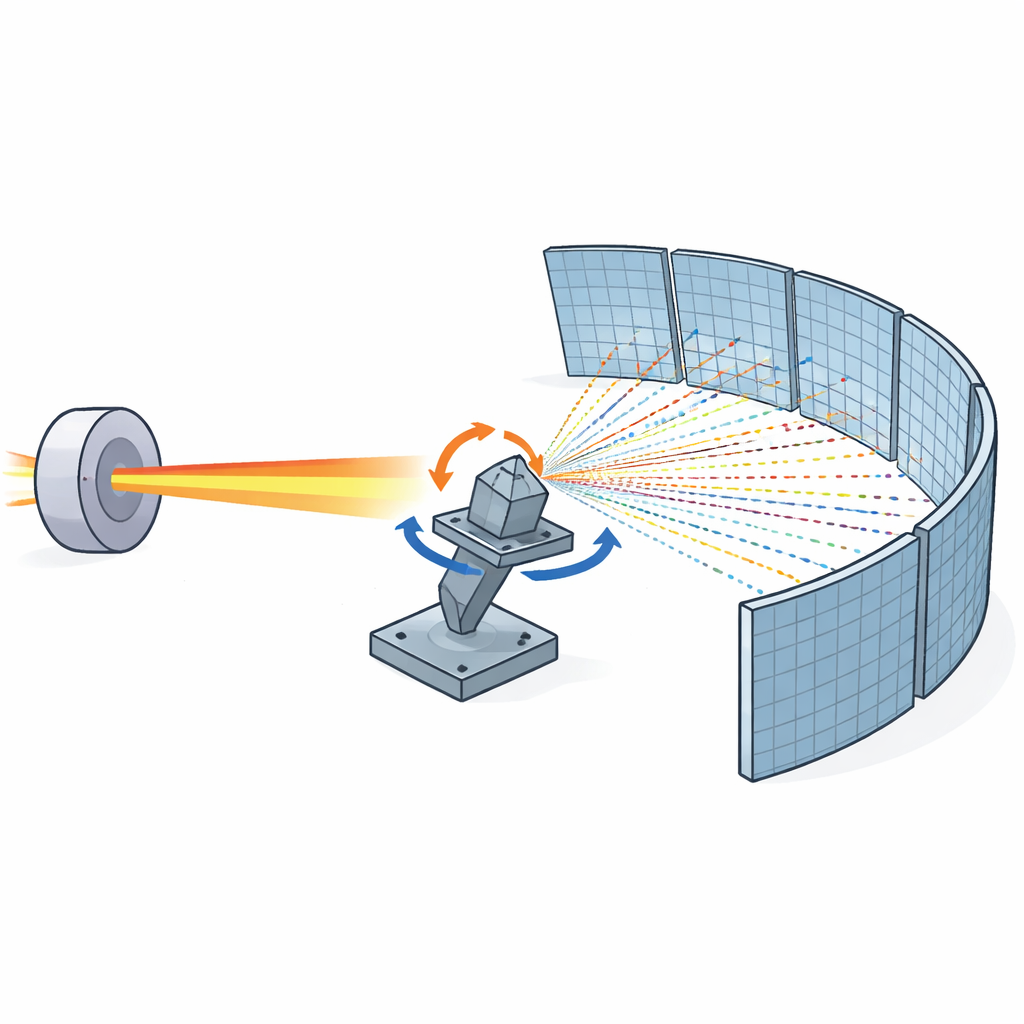
To overcome this hurdle, the authors designed a “Gandolfi-type” attachment that rotates the sample around two axes at once. One axis lies perpendicular to the X-ray beam, while the second is tilted by 45 degrees and can spin extremely fast. As the sample tumbles in this carefully controlled way, many more crystal orientations line up to satisfy the diffraction condition, so the resulting signal resembles that of an ideal powder. The setup is installed on high-resolution beamlines at the SPring-8 synchrotron in Japan and works together with multiple fast, two-dimensional X-ray detectors positioned at a long distance from the sample. This combination allows both sharp angular resolution and very rapid data collection.
Capturing Liquids, Melts, and Crystal Growth in Real Time
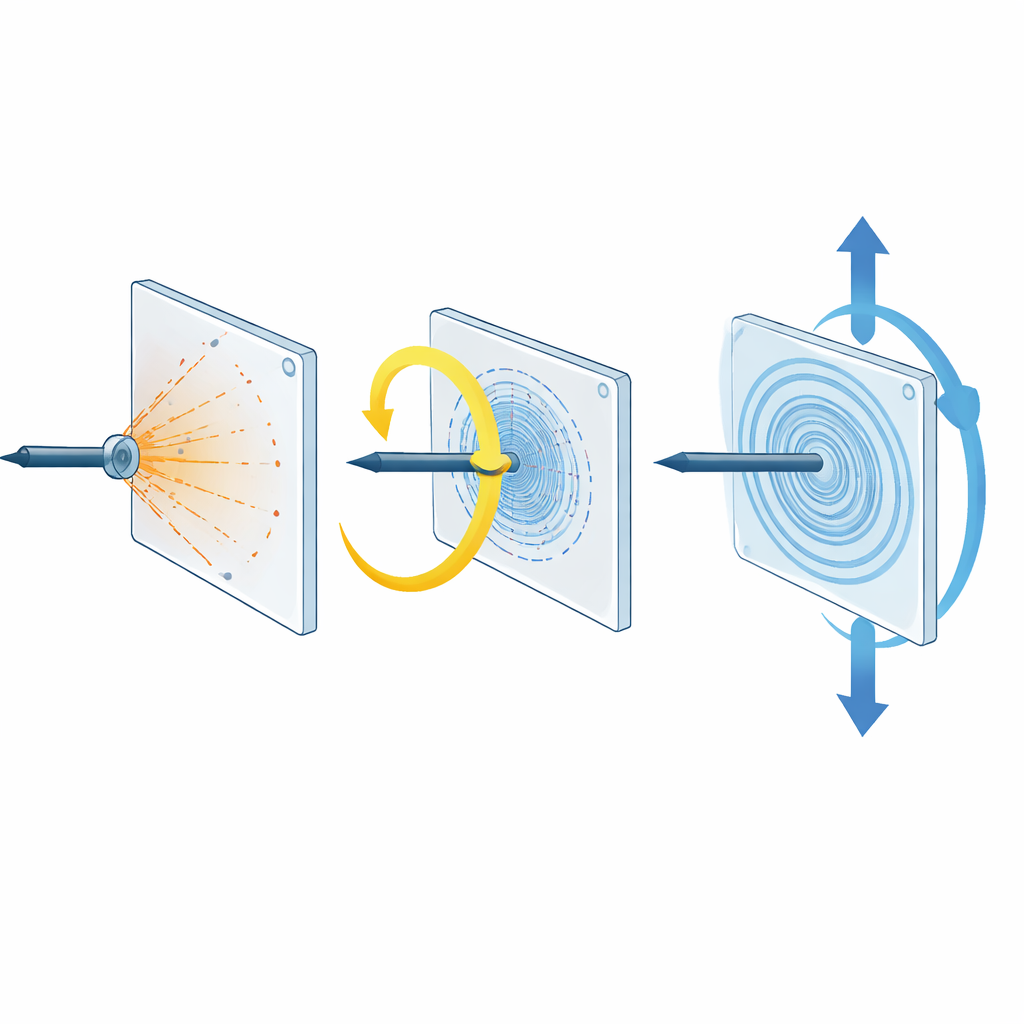
The team put their system to the test in several demanding scenarios. First, they measured zinc that had been melted and then solidified in a glass capillary, a case where large crystals form and normally ruin powder data. Without rotation, the detector showed just a few sharp spots; with one-axis rotation, the pattern improved but remained incomplete. Two-axis rotation, however, produced smooth, nearly continuous rings and markedly better agreement with structural models, proving that the particle statistics were now sufficient. Next, they looked at zinc above its melting point and analyzed how atoms are arranged in the liquid. By tilting the spinning capillary, the molten metal remained stably positioned despite gravity, yielding smooth, continuous patterns and pair-distribution-function curves that matched previous high-quality studies.
Following Battery Materials and Tiny Minerals
The researchers then followed the formation of the battery cathode material LiCoO₂ inside a molten salt mixture as the temperature was raised. Because the liquid and solid phases stayed steady in the tilted geometry, the evolving diffraction peaks could be tracked reliably as initial cobalt oxide phases disappeared and LiCoO₂ became dominant. Finally, they examined a small crystal of San Carlos olivine, a widely studied mantle mineral. Using the two-axis rotation with fast detectors and long sample-to-detector distances, they collected high-resolution patterns within about two minutes. Frame-by-frame analysis allowed them to separate overlapping peaks and identify nearly all expected reflections, leading to precise lattice parameters and demonstrating that even tiny or hard-to-pulverize crystals can be characterized efficiently.
Opening the Door to More Realistic Measurements
Overall, the new two-axis rotating attachment turns a demanding synchrotron instrument into a far more versatile tool. It delivers fast, high-quality diffraction data and detailed local-structure information from samples that are coarse-grained, molten, rare, or sensitive to grinding. This means researchers can study materials closer to their real working states—such as battery electrodes in flux, metals undergoing phase changes, or precious extraterrestrial grains—without sacrificing data quality. In practical terms, the method promises to speed up materials development and broaden the range of systems that can be probed with advanced X-ray techniques.
Citation: Kobayashi, S., Kawaguchi, S., Mori, Y. et al. Demonstration of a Gandolfi-type attachment for fast high-resolution synchrotron XRD of non-ideal specimens. Sci Rep 16, 13213 (2026). https://doi.org/10.1038/s41598-026-43550-4
Keywords: synchrotron X-ray diffraction, Gandolfi rotation, non-ideal samples, in situ crystal growth, high-resolution PXRD