Clear Sky Science · en
Topology optimization design of excavator working device based on equivalent static loads
Why lighter diggers matter
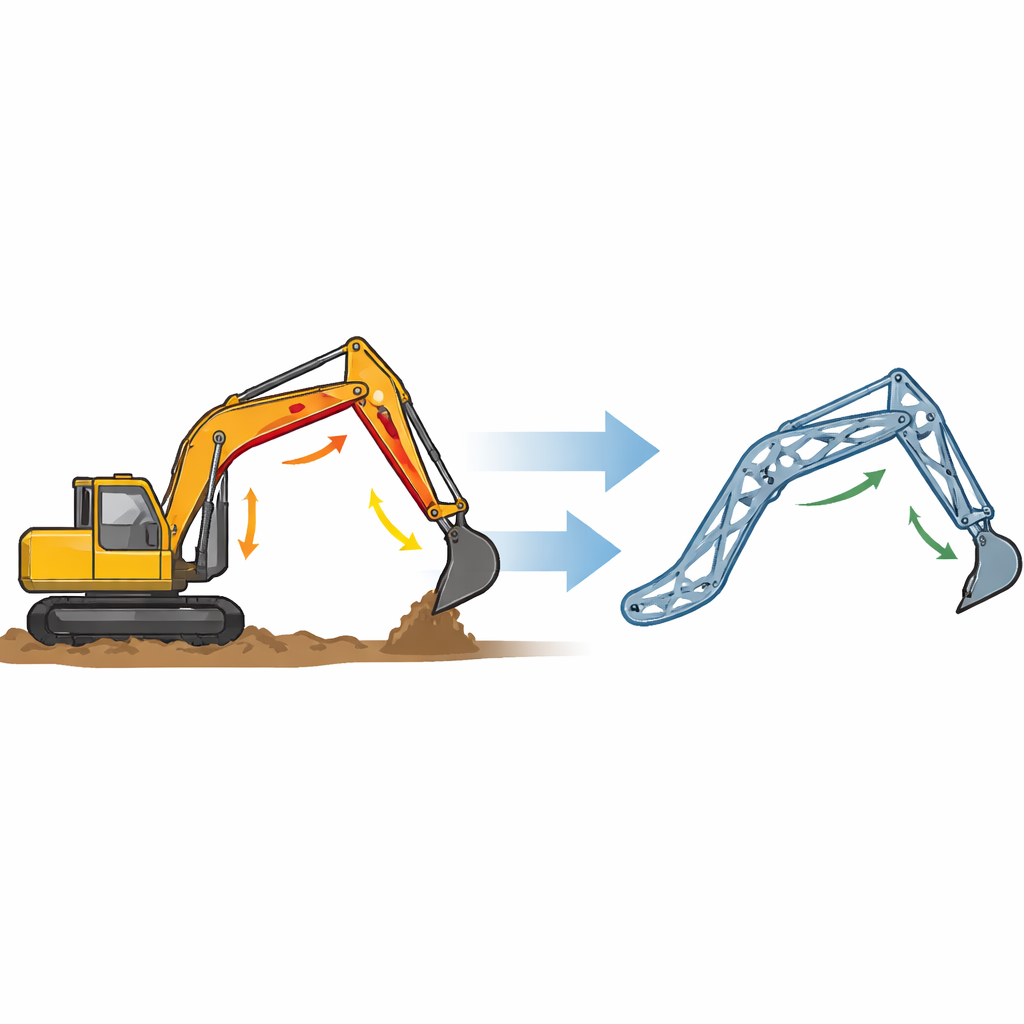
Excavators are the workhorses of construction and mining, but their massive steel arms and booms come with a cost: more fuel burned, more emissions, and higher material use over the machine’s lifetime. This study explores how to redesign one of the key parts of an excavator—the arm that links the bucket to the main boom—so that it uses much less metal while still surviving the harsh, ever-changing forces of digging. The authors combine computer simulations of motion with advanced structural design tools to carve away unnecessary material without compromising safety.
From static thinking to moving reality
Traditionally, engineers have designed excavator arms by treating the loads as if they were fixed in size and direction, a simplification known as static loading. In real digging, however, forces rise and fall rapidly as the bucket bites into soil or rock, hits obstacles, and swings material away. Designs based only on static assumptions tend either to be overbuilt and heavy, wasting steel and fuel, or to miss critical stress hot spots that appear only during motion. The authors argue that a realistic design must consider the full dynamic behavior of the machine while it works.
Turning motion into simpler forces
To bridge the gap between complex motion and practical design tools, the researchers adopt an approach called “equivalent static loads.” First they build a detailed digital model of the excavator’s working device—bucket, arm, boom, and hydraulic cylinders—and let it run through a demanding digging cycle in a multibody dynamics simulation. At tiny time steps, the software records how the flexible arm bends and vibrates and what stresses arise in its steel plates. For each instant, the changing forces of motion are converted into an imagined set of steady forces that would produce the same deformation. These stand-in loads make it possible to treat a genuinely dynamic problem with the more mature methods of static structural optimization.
Searching for the best use of metal
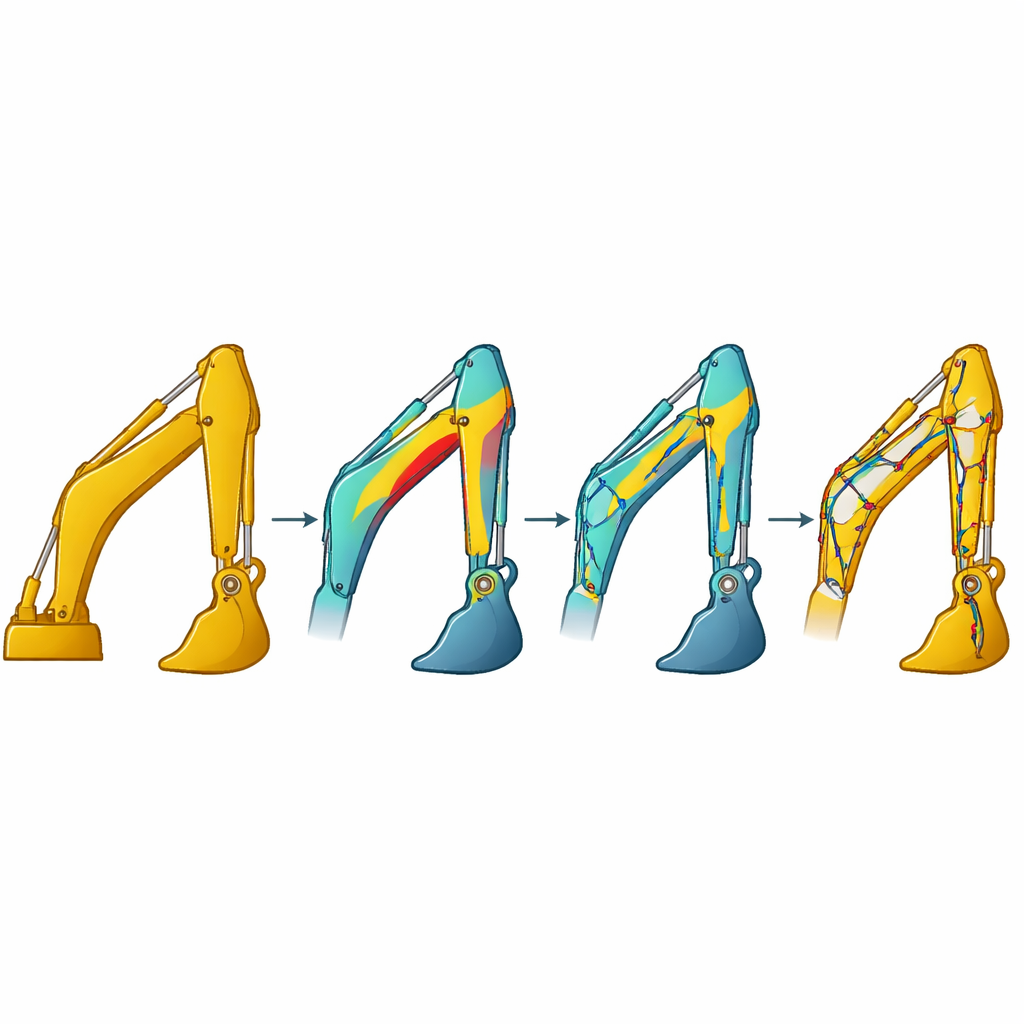
With this series of equivalent loads in hand, the team sets up a computer-driven material layout problem for the arm. The design space is divided into thousands of small elements whose “density” can vary between solid and void, and the algorithm is tasked with arranging material so that the arm bends as little as possible while keeping stresses safely below the material limit and respecting a target range of remaining volume. To keep computation manageable, many individual stress values are combined into a single overall measure, and practical manufacturing rules are enforced, such as minimum wall thickness and a symmetrical layout. Several scenarios are tested, from very aggressive material removal to more conservative weight cuts, to see how the internal structure and stress distribution evolve.
What an optimized arm looks like
The simulations reveal that when too much material is stripped away, stress spikes dangerously near critical joints, especially where the arm connects to the main boom. As the allowed volume is increased slightly, the arm develops a clear network of internal load paths, resembling a truss hidden within the original box-shaped shell. In the most balanced case, where roughly 30–40% of the original volume is kept in the design space, the stresses remain well below the safe limit and are spread smoothly, while unused regions of plate can be removed. Based on this pattern, the authors rebuild the arm’s geometry into a manufacturable form: the outer top and bottom plates stay largely intact for stiffness and ease of welding, while the side plates are reshaped and selectively cut out according to the optimized layout.
Lighter machines with safe strength
When the redesigned arm is fed back into the full dynamic model of the excavator and subjected to the same demanding digging cycle, it performs robustly. The new arm weighs about a quarter less than the original, yet its peak stress rises only slightly and remains comfortably under the design limit, with no severe concentrations. Compared with a conventional optimization that ignores stress constraints, the proposed method sacrifices a bit of the maximum possible weight saving but reduces the risk of hidden weak spots. For non-specialists, the key message is that by intelligently “hollowing out” structures based on how they actually move and carry loads, heavy construction machines can become significantly lighter and more efficient without compromising safety.
Citation: Zhang, H., Shao, Xd., Jia, Mm. et al. Topology optimization design of excavator working device based on equivalent static loads. Sci Rep 16, 13054 (2026). https://doi.org/10.1038/s41598-026-43544-2
Keywords: excavator design, lightweight structures, topology optimization, dynamic loading, finite element analysis