Clear Sky Science · en
A spiking neural network inspired by neuroscience and psychology for Western mode- and key-conditioned music learning and composition
Why teaching computers to hear keys matters
Most people can sense when a song has “come home” to its final note, or when a wrong chord makes everything sound off. That gut feeling rests on hidden rules of musical key and mode—the tonal skeleton beneath Western music. Modern artificial intelligence can churn out endless melodies, yet often ignores these rules or hard-codes them in crude ways. This article presents a new brain‑inspired model that learns musical keys and modes more like a human listener does, then uses that knowledge to compose four‑part harmony. It aims to make music‑making machines not only more musical, but also more understandable.
From everyday listening to internal maps of sound
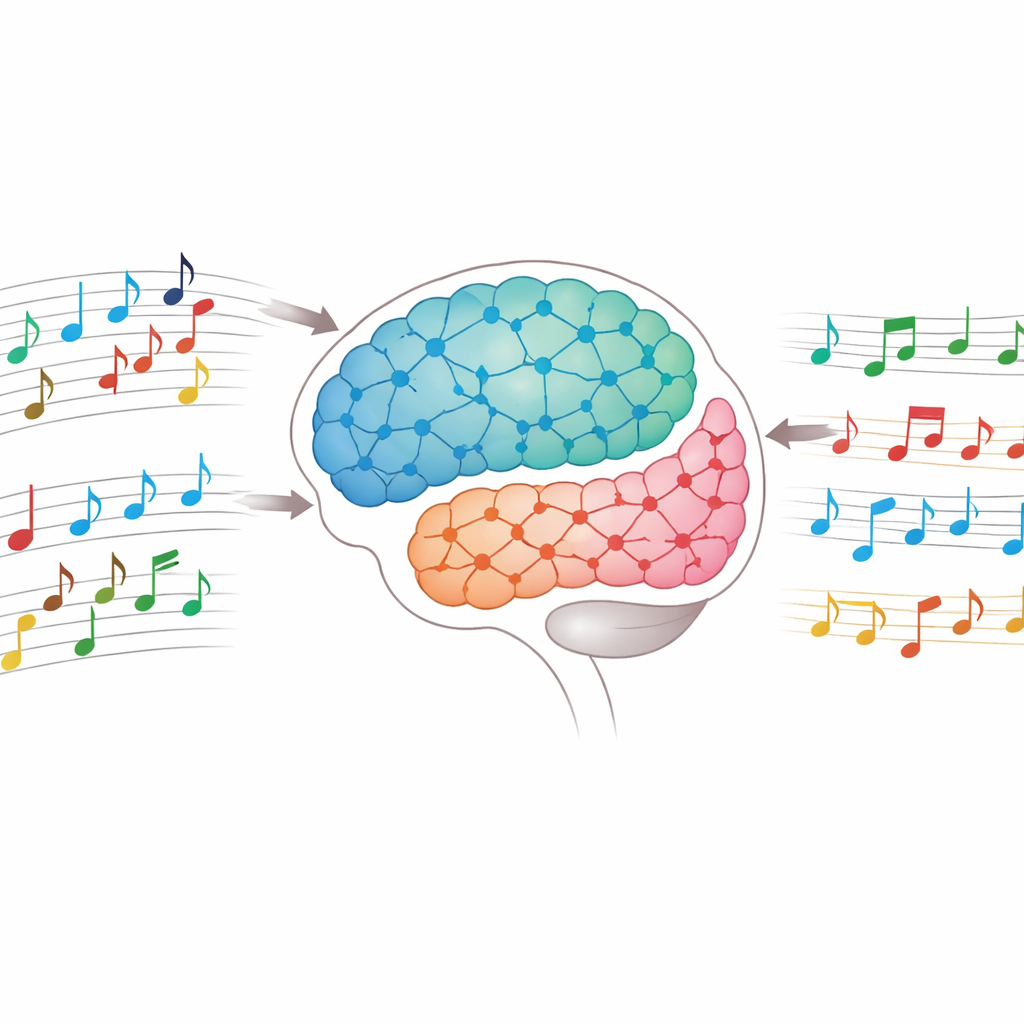
When you listen to music, your brain gradually builds an internal map of which notes feel stable, which sound tense, and how patterns usually unfold. Psychologists have captured this with the Krumhansl–Schmuckler model, which measures how strongly each of the 12 pitch classes belongs in a given key. Neuroscience links this kind of schematic knowledge to brain areas that organize experience over time, such as the medial prefrontal cortex and memory structures like the hippocampus. The authors argue that most deep‑learning music systems skip these psychological and biological insights: they often force all pieces into a reference key or treat key as a simple label, and their internal workings are hard to interpret. The new work instead sets out to build a network whose inner connections can be directly compared with human tonal perception.
A brain‑like network that hears both scales and sequences
The researchers design a spiking neural network, a type of model that communicates using brief electrical pulses, echoing real neurons. They split it into two main subsystems. A “tonal” subsystem represents modes (major and minor) and the 24 keys used in Western tonal music, arranged in a hierarchy reminiscent of how the brain stores abstract schemas. A “sequential memory” subsystem holds the actual notes of a four‑part piece—their pitches and how long they last—distributed across separate streams corresponding to soprano, alto, tenor, and bass. Within these streams, pitch and duration are encoded by arrays of small columns of neurons, loosely inspired by the organization of the auditory cortex and time‑sensitive cells found in timing research.
Letting connections grow with experience
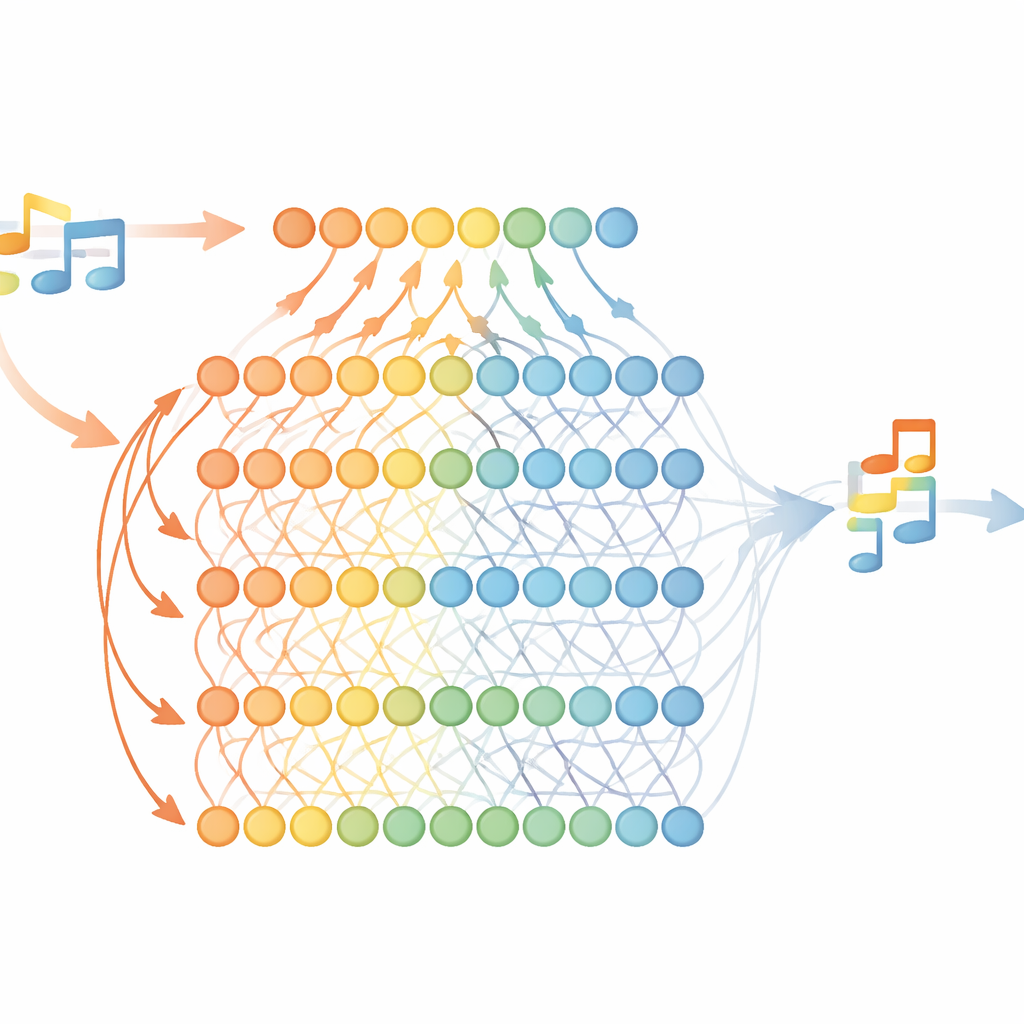
Instead of wiring everything in advance, the model lets new synapses form between the tonal subsystem and the sequential memory subsystem when neurons repeatedly fire together while a piece is played in. This mimics how neural circuits emerge and change during learning. Once a connection exists, its strength is adjusted by a rule called spike‑timing‑dependent plasticity: if a source neuron tends to fire just before a target neuron, the link strengthens; if the order is reversed, it weakens. Over many pieces, including textbook exercises carefully crafted to highlight specific harmonic ideas and a large collection of J.S. Bach chorales, the network’s internal wiring gradually comes to reflect which notes function as central, supporting, or rare in each mode and key.
Inside the machine’s sense of key
To test whether the model really developed human‑like tonal expectations, the authors measured two features of its learned connections: how many synapses each pitch class accumulated, and how strong those synapses became on average. They then compared these patterns to the well‑known psychological key profiles. Across both major and minor modes and many individual keys, the match was strikingly high. Notes that humans hear as the “home” tone or the main supporting tones also emerged as the most heavily connected in the network. Subtle differences reflected the training material—for instance, teaching exercises that stress certain chords nudged the network to weight those notes more strongly. This suggests the model captures both general tonal laws and corpus‑specific habits, much like human enculturation.
Composing new music in a chosen key
When asked to compose, the system is given a target mode and key, plus a short starting chord. Activity in the key‑specific neurons then biases the sequential memory subsystem through the learned connections. Competing note neurons fire, and a simple “winner‑takes‑all” rule picks the next note in each voice. Step by step, the model generates new four‑part harmonies that stay within the intended key while still exploring varied melodic shapes. Compared with a range of popular deep‑learning models—including recurrent networks, transformers, and diffusion models—the spiking model produces pieces whose pitch ranges, use of scale tones, and other structural statistics more closely resemble the reference datasets. In particular, it maintains a very high share of in‑key notes without becoming monotonous.
What this means for future musical machines
For a general reader, the key result is that a brain‑inspired network can learn something close to our intuitive sense of key and scale—and we can see that knowledge directly in its wiring. The model does not yet handle all the richness of real music, such as changing harmony, rhythmical variety, or expressive timing. Still, it offers a concrete bridge between music theory, psychology, and neural computation. By showing that a biologically motivated system can generate convincing, key‑aware harmonies and reveal how it arrived there, this work points toward future music‑making AI that is both more musically literate and more transparent in how it thinks about sound.
Citation: Liang, Q., Zeng, Y. & Tang, M. A spiking neural network inspired by neuroscience and psychology for Western mode- and key-conditioned music learning and composition. Sci Rep 16, 12956 (2026). https://doi.org/10.1038/s41598-026-43529-1
Keywords: spiking neural networks, music generation, musical key and mode, computational music cognition, brain-inspired AI