Clear Sky Science · en
Sensing vs. seeing: body experience rather than mere body observation is linked to efficiency of descending pain modulation
Why how we feel our body matters for pain
Pain is not just about damaged tissue or raw nerve signals. It is also about how the brain builds a sense of “this is my body.” This study asks a deceptively simple question with big implications: does it matter, for pain control, whether we merely see a body part or truly feel it as part of ourselves? The answer could help explain why some people hurt more than others in similar situations, and may point toward new ways to treat chronic pain by working with body perception, not just drugs.
Looking at your hand to turn pain down
Earlier experiments showed that simply looking at your own hand can make painful heat or laser stimuli feel less intense. This visually induced pain relief led scientists to suspect that seeing the body activates brain areas that dampen pain signals. But those studies mainly focused on activity inside the cortex—the brain’s outer layers. The present work explores a different piece of the puzzle: the “descending” pain control system, a pathway running from the brain down through the brainstem and spinal cord that can actively turn incoming pain signals up or down, much like a built‑in volume knob.
A clever mirror trick to shift body experience
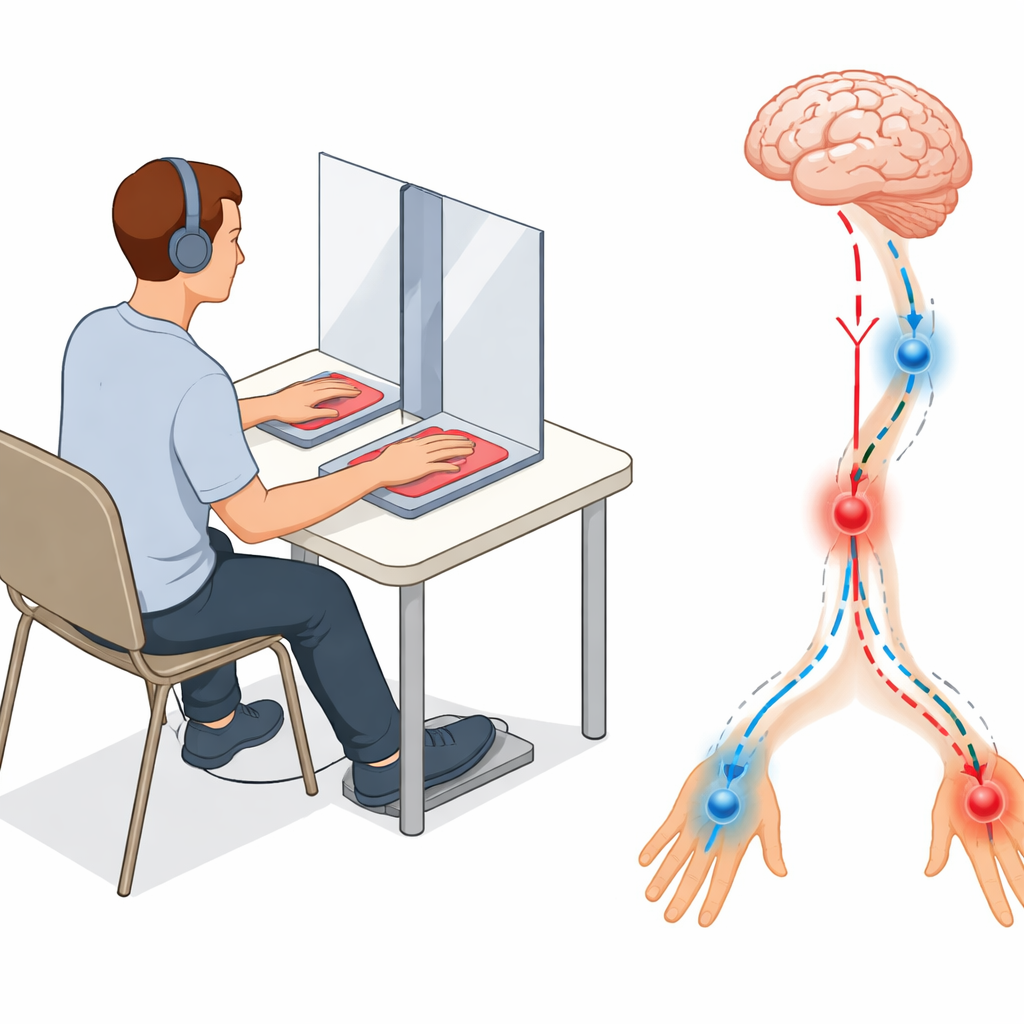
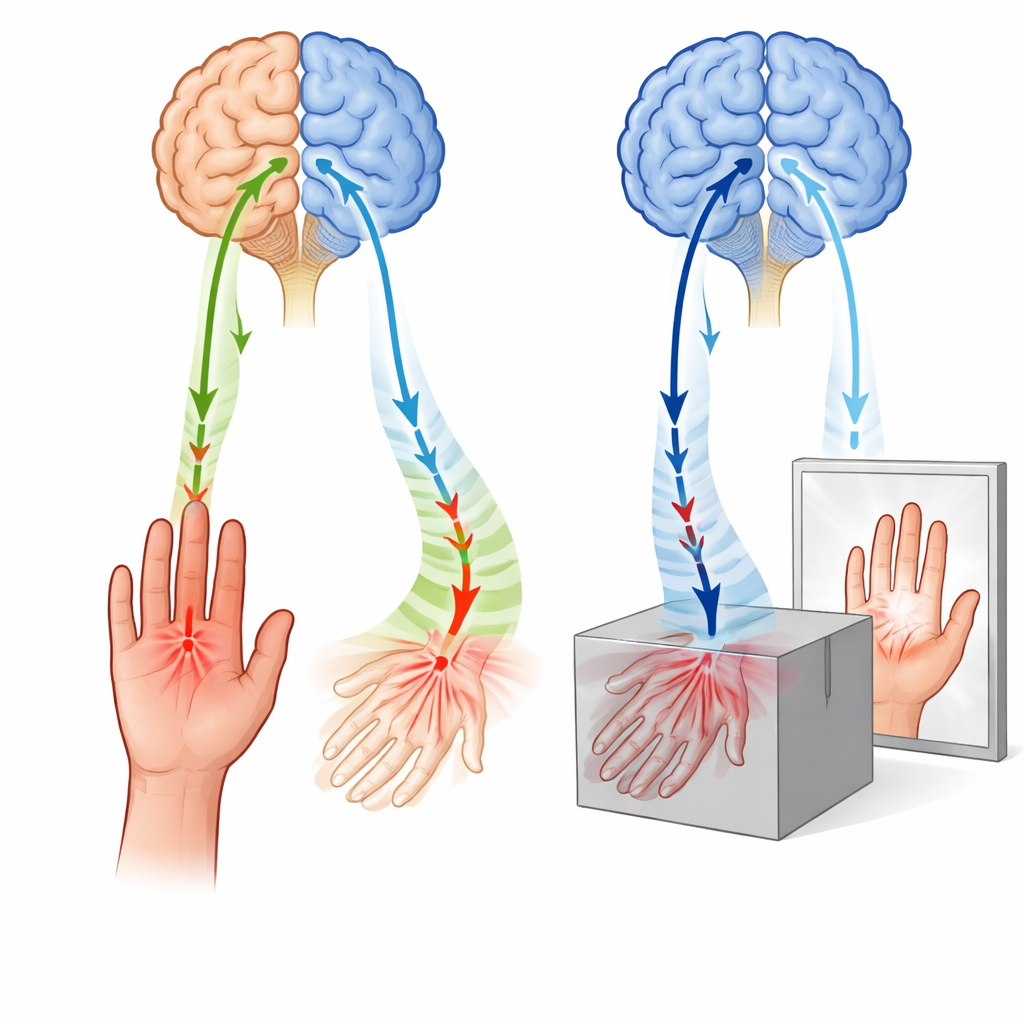
The researchers asked healthy adults to sit at a table with one hand on each of two platforms. Between the hands, they placed either a glass sheet or a mirror. Sometimes the hands were uncovered; sometimes they were hidden inside plain wooden boxes. In all cases, participants had to keep their eyes fixed on where their left hand should be. Depending on the setup, they either saw their real left hand through glass or the mirror image of their right hand aligned where the left should be, while the real left hand could be visible or hidden. This mirror arrangement is known to subtly disturb the sense that the unseen hand truly belongs to one’s body, even without obvious tricks like stroking the hands out of sync.
Putting the body and pain systems to the test
To probe descending pain control, the team used a standard “pain inhibits pain” protocol. First, they measured how hot the skin on the left hand had to get before it felt painful. Next, they applied a prolonged, moderately painful cold stimulus to the right hand. After this conditioning pain ended and the right hand rewarmed, they checked the left‑hand heat threshold again. When the brain’s descending pain system is working effectively, the second pain threshold is higher—meaning it now takes more heat to hurt. Across all four visual conditions, participants showed this expected pattern: the cold pain on one hand made the other hand less sensitive to heat, indicating robust descending pain inhibition.
When the hand feels less like yours, pain control weakens
After each run, volunteers rated unusual sensations about their real left hand, such as feeling that it was foreign, numb, or even disappearing. These ratings were combined into an overall measure of “disembodiment,” a reduced sense that the hand belongs to the self. People reported the strongest disembodiment when looking at the mirror image of their right hand while the real left hand was hidden. Interestingly, just seeing the hand (versus having it covered) did not change the strength of descending pain control. However, individuals who experienced stronger disembodiment tended to show a weaker boost in pain threshold after the cold stimulus. In other words, the more their hand felt “not quite mine,” the less efficiently their brainstem‑and‑spinal pain brake seemed to work.
What this means for everyday pain
This study suggests that it is not simple vision of the body that shapes deep pain‑control pathways, but rather the richer feeling of bodily ownership. When that feeling is disturbed—when a limb feels oddly distant or unreal—the brain’s ability to send down strong pain‑damping signals may be reduced, potentially making pain more likely or more intense. The authors propose that such altered body experience increases the “salience” of the affected body part: the brain flags it as unusual and potentially threatening, and in that state it may hold back on turning pain down. If future work confirms these findings, therapies that restore a normal, grounded sense of the body—using mirrors, virtual reality, or other illusions—might one day help strengthen natural pain‑inhibiting systems, especially in people living with chronic pain whose sense of their own body is disrupted.
Citation: Wolters, L., Barenbrügge, B., Löffler, A. et al. Sensing vs. seeing: body experience rather than mere body observation is linked to efficiency of descending pain modulation. Sci Rep 16, 11239 (2026). https://doi.org/10.1038/s41598-026-43489-6
Keywords: body ownership, pain modulation, mirror illusion, disembodiment, chronic pain