Clear Sky Science · en
Integrated ATC enhancement and load growth forecasting via WOA-based optimal DSTATCOM placement
Why moving electricity safely matters
When you flip a light switch, somewhere on the grid power has to find a clear path to your home or workplace. Those paths are getting crowded as electricity demand grows and more energy trades flow through deregulated markets. Building new power lines is expensive and slow, so grid operators are under pressure to squeeze more safe, reliable capacity out of the lines they already have. This paper explores a smarter way to do that by combining a fast-acting electronic device with a nature-inspired computer algorithm to unlock hidden transfer capability in existing transmission networks, while also forecasting how much capacity will be needed as demand rises over the next decade.
Finding room on crowded power highways
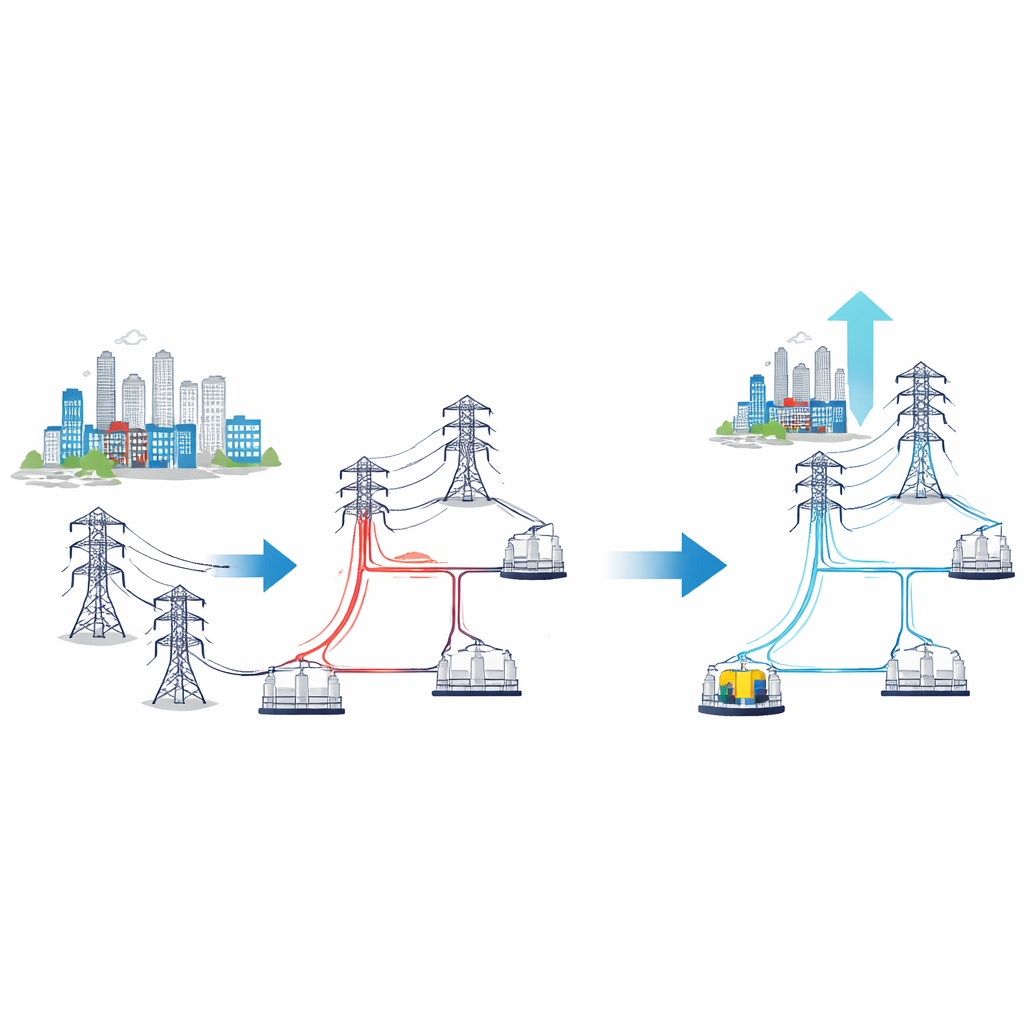
The authors focus on a key grid metric called available transfer capability, essentially the spare room left on power “highways” after accounting for safety limits. Overestimating this room can trigger cascading blackouts; underestimating it wastes valuable infrastructure. Using standard test networks of growing size (14, 118, and 300 buses), they first show how congestion appears: a few critical lines carry too much current or see their voltages sag, sharply cutting the amount of extra power that can be moved. They also study what happens when individual lines fail, finding that losing a single important link can slash transfer capability by more than 40%, while outages on less critical paths barely matter. This sensitivity underscores how uneven and fragile grid capacity can be under stress.
A smart electronic helper at the right spot
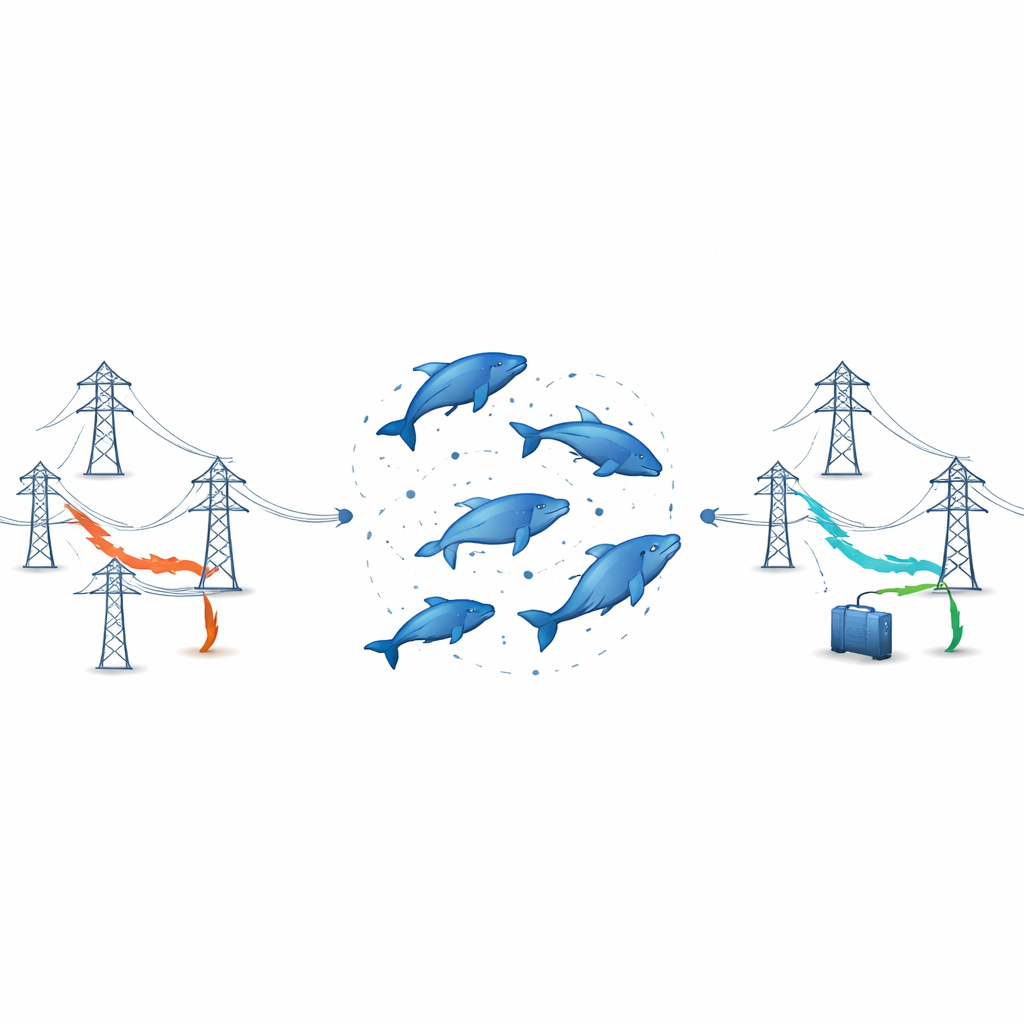
To relieve that stress, the study uses a device called a distribution static compensator. This box sits on a chosen bus and injects or absorbs reactive power, helping hold local voltages near their targets and easing the burden on nearby lines. The challenge is to decide which bus should host the device and how strongly it should act. Instead of trial and error, the authors turn to the whale optimization algorithm, a search method modeled on how humpback whales encircle and spiral around their prey. In the grid context, each “whale” represents a candidate location and setting for the compensator; the algorithm repeatedly simulates power flows, rewards combinations that raise transfer capability without breaking thermal or voltage limits, and gradually homes in on the best design.
How the whale-inspired search boosts grid performance
By running this procedure on the test systems, the authors show that a single well-placed compensator can noticeably upgrade the grid. In the smaller 14-bus network, transfer limits to several stressed buses rise by roughly 15–28%; in the larger 118- and 300-bus systems, improvements reach about 18–30% and 22–38%, respectively. In time-based studies, the device consistently increases transfer capability by around 15–18% throughout a 24-hour demand cycle. Detailed simulations of fault events reveal that voltages at weak buses dip less, recover faster, and settle closer to their desired values when the compensator is present, showing that the gains are not just numerical but translate into more resilient behavior during disturbances. The algorithm itself proves reliable: repeated runs converge to nearly the same solutions with low variability and shorter runtimes than several competing optimization methods.
Looking ten years ahead as demand grows
Beyond short-term gains, the study asks how transfer capability will evolve as electricity use grows at realistic annual rates of 3% and 6%. Using regression models fitted to simulation data, the authors derive simple equations that link future load levels at different buses to their expected transfer capability with the compensator in place. These formulas achieve forecasting errors mostly below 1%, sometimes as low as 0.01%. The projections show that even modest growth steadily eats into spare capacity, and under higher growth many buses approach or exceed current limits within a decade. However, with optimally placed compensation the grid can postpone more drastic measures such as major line reinforcements, especially when combined with new renewable generation that shares the load and further smooths voltages.
Balancing benefits, costs, and real-world limits
The paper also weighs economics and practicality. A sample cost–benefit analysis for a 10 MVAR compensator suggests that, at typical values placed on extra transfer capacity, the annual financial benefit from the added room on the grid can nearly double the annualized cost of the device, with a payback time of about five years. At the same time, the authors caution that idealized steady-state models can overstate the gains, because real devices suffer from response delays, harmonic distortions, and thermal losses that reduce their effective support. They propose subtracting a dynamic margin from calculated transfer capability to reflect these effects and highlight the need for future work combining their planning framework with detailed time-domain and hardware-in-the-loop studies.
What this means for the future grid
In everyday terms, this research shows that carefully chosen, software-guided upgrades can turn today’s power grid into a more capable and adaptable system without always resorting to new wires and towers. By pairing a fast electronic helper with a whale-inspired search strategy, operators can both unlock extra room on crowded lines and map out how much capacity they will need as cities grow and more renewables come online. With further refinement to capture real-world device behavior and the addition of advanced artificial intelligence for real-time control, this approach could become a practical tool for keeping the lights on safely and economically in an increasingly demanding and decentralized electricity landscape.
Citation: M, A., S, A., D, S. et al. Integrated ATC enhancement and load growth forecasting via WOA-based optimal DSTATCOM placement. Sci Rep 16, 10727 (2026). https://doi.org/10.1038/s41598-026-43475-y
Keywords: power transmission capacity, grid congestion, reactive power compensation, nature-inspired optimization, electricity load growth