Clear Sky Science · en
Biodegradable composites from organic waste as a circular solution for improving soil fertility, water retention, and plant productivity
Turning Waste into Help for Hungry Soils
As droughts intensify and farmland wears out, farmers and city planners are searching for ways to keep plants growing without relying on more plastic or heavy doses of fertilizers. This study explores a simple but powerful idea: turning leftover wool, jute, and plant waste into biodegradable mats that sit in the ground, gently feeding and watering plants while preventing erosion. It shows how trash from farms and textile mills can be transformed into a tool that helps soils hold more water, store more nutrients, and grow more grass, pointing toward a more circular, less wasteful way of managing land.
Why Dry, Tired Soils Need New Ideas
Across the world, soils are losing their richness. Erosion, pollution, and intensive farming strip away the thin fertile layer that supports crops. At the same time, climate change is bringing more frequent dry spells, making it harder and more expensive to keep plants alive. Conventional fixes—plastic geotextiles, synthetic water-absorbing gels, and heavy fertilizer use—can hold slopes in place and boost yields, but they also create waste, add microplastics to the environment, and depend on fossil resources. The authors argue that any long-term solution should not only protect plants and soil, but also reuse waste materials and fit into a circular economy, where resources are kept in use instead of being thrown away.
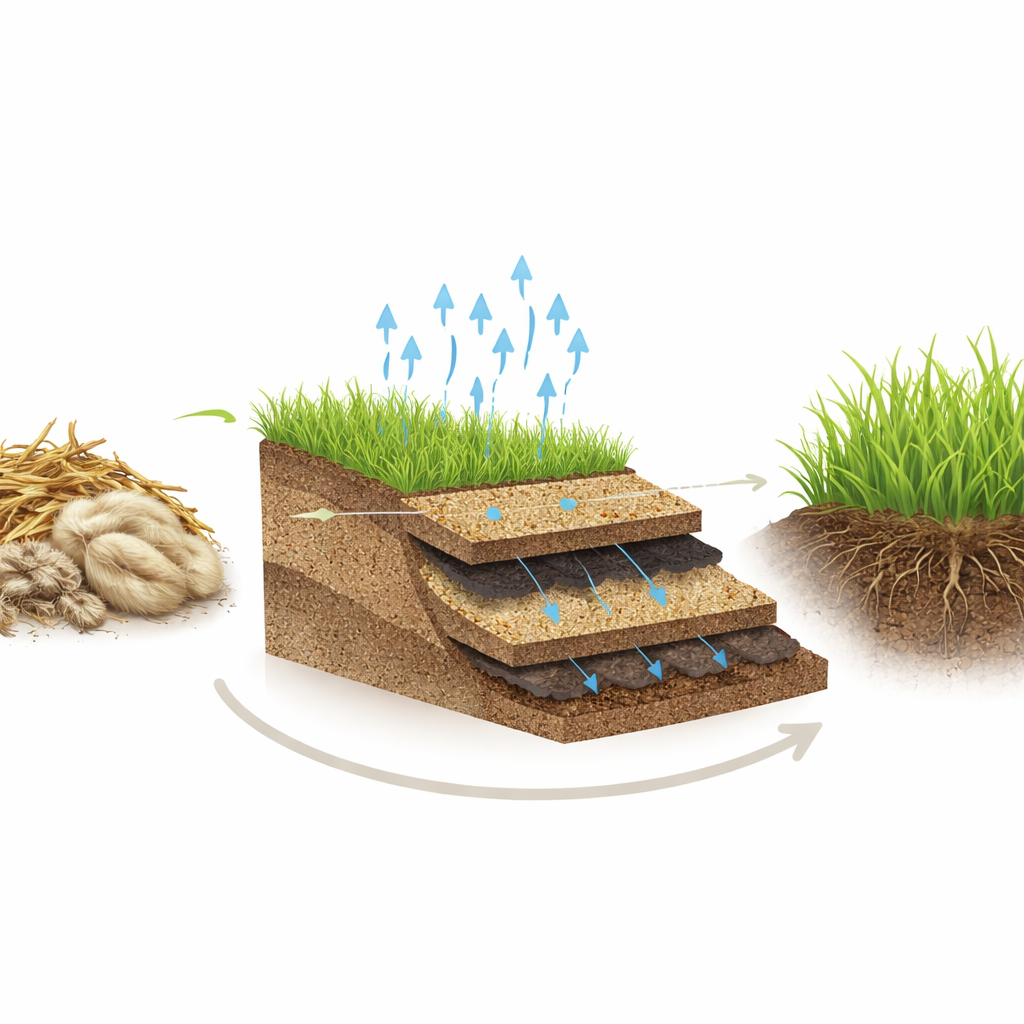
How the Biodegradable Mats Are Built
The team designed thin mats, or composites, using waste fibers and plant-based charcoal. Some mats were made entirely from discarded wool; others combined wool with jute, a common plant fiber. Between two layers of these nonwoven fabrics, they placed a band of biochar made from miscanthus, an energy crop. In a few versions, they also mixed in a growth-promoting fungus from the genus Trichoderma. The fibers act like a scaffold that stabilizes soil and, as they slowly break down, release nutrients such as nitrogen, phosphorus, potassium, and sulfur. The biochar layer, full of tiny pores, acts like a sponge, soaking up water and dissolved minerals and releasing them gradually to plant roots while helping keep carbon locked in the ground.
Testing the Idea on a Real Slope
To see if this concept works outside the lab, the researchers installed six versions of the composite plus a control (bare soil) on a man-made slope in Poland. All strips were covered with the same layer of sandy soil and sown with a common grass mixture, then left to face natural weather for two full growing seasons with no extra fertilizers or irrigation beyond the initial watering. Over this period they measured how much grass was produced, how wet the leaves stayed during growth, how dense and deep the roots became, and how the soil’s nutrient content changed beneath each treatment. This setup mimicked real engineering structures such as road embankments and levees, where vegetation is hard to establish and maintenance is costly.
What Happened to Plants and Soil
The differences were striking. In the first season, grass growing over the biodegradable composites produced up to 190% more fresh and dry biomass than grass on untreated soil. Roots were not only heavier—up to 119% more root dry mass—but also longer and denser, giving the plants a firmer grip on the slope. Leaves held more water as well; their relative water content was around 10–20% higher, a sign that plants were better hydrated during dry phases. The soil itself became richer. In the first year, nitrogen, phosphorus, and potassium levels in the amended plots rose by as much as 119%, 177%, and 145% compared with the control. Many of these benefits persisted into the second season, even as the fibers continued to decompose, especially in plots that contained biochar, which appeared to prolong the availability of nutrients and moisture around the roots.
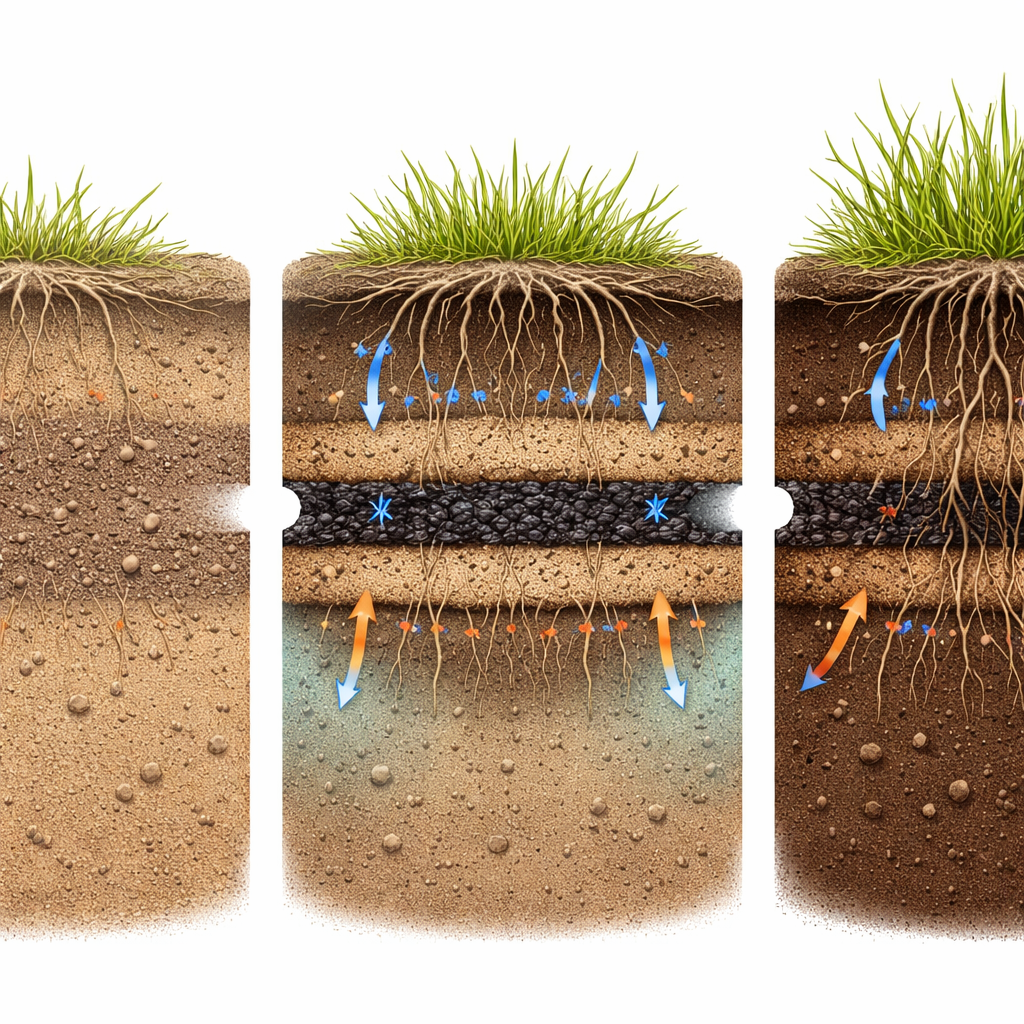
A Closer Look at the Moving Parts
The results suggest a clear division of labor between the components. The wool and jute provide a slow, season-long nutrient source as they rot in the soil, acting like a built-in organic fertilizer. Biochar does not feed plants directly but strengthens the system by holding onto water and dissolved nutrients, keeping them near the roots instead of letting them wash away. This combination creates a zone beneath the surface where roots find both moisture and food more reliably, explaining the stronger growth and thicker root systems. By contrast, the added fungus only gave a modest boost and mainly in the first year, likely because disease pressure was low; its main value may lie in future applications where plants face stronger biological threats.
What This Means for Greener Farming and Land Care
For non-specialists, the message is simple: waste wool, jute scraps, and plant residues can be reshaped into thin, fully biodegradable mats that make poor soil behave more like good soil—holding on to water, storing nutrients, and supporting lush plant growth for at least two seasons. Instead of relying on plastics or short-lived chemical gels, this approach turns local waste streams into a long-lasting aid for crops and erosion-prone slopes. If refined and tested with more plant species and in different climates, such composites could help farmers grow more with fewer synthetic fertilizers, assist engineers in stabilizing vulnerable earthworks, and cut the amount of organic and textile waste headed to landfills, closing a small but meaningful loop in the circular economy.
Citation: Marczak, D., Lejcuś, K., Kulczycki, G. et al. Biodegradable composites from organic waste as a circular solution for improving soil fertility, water retention, and plant productivity. Sci Rep 16, 14060 (2026). https://doi.org/10.1038/s41598-026-43468-x
Keywords: biochar, biodegradable mulch, soil fertility, water retention, circular agriculture