Clear Sky Science · en
Fuzzy logic sliding mode controller based solar PV fed UPQC for improvement of dynamic performance and power quality enhancement in distribution power system
Why keeping our electricity clean matters
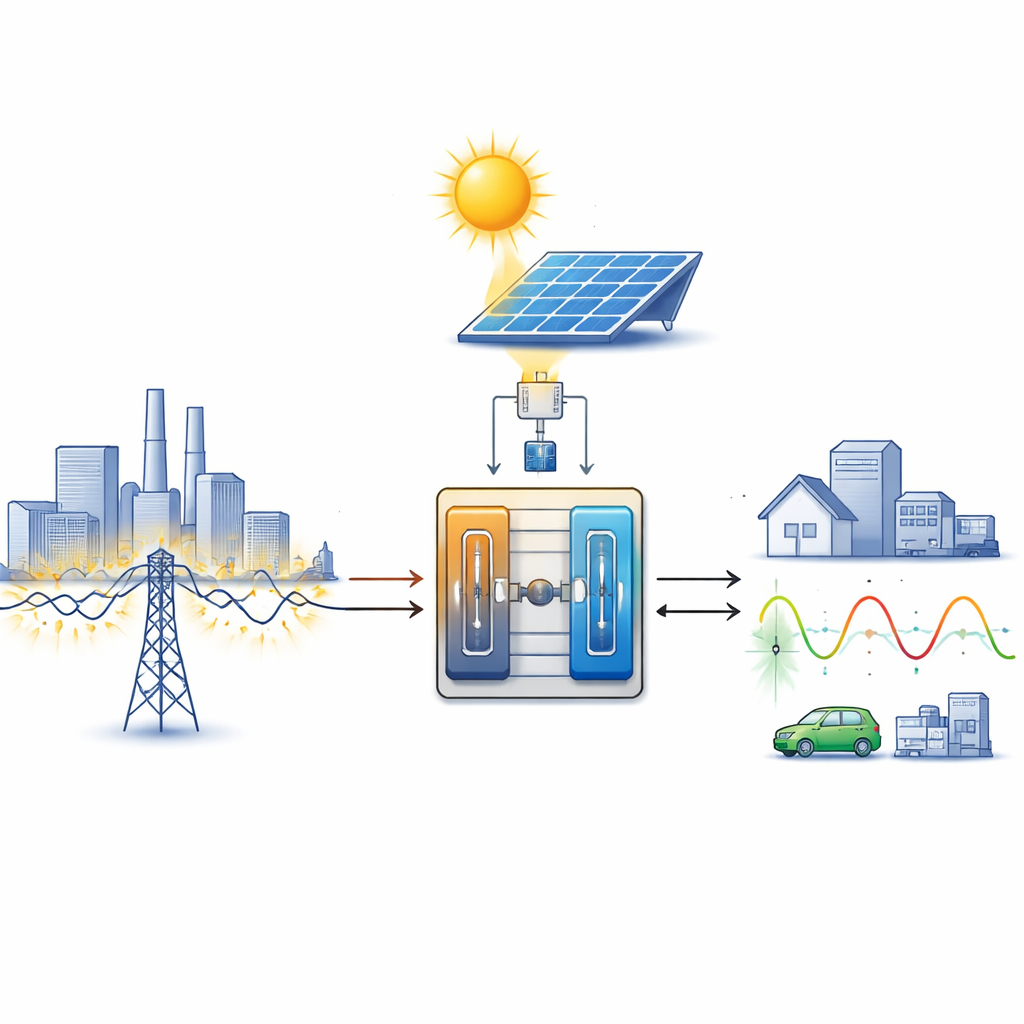
From laptops to factory robots, almost everything we use today depends on electricity that is steady and clean. Yet modern devices themselves often pollute the grid with electrical “noise,” causing flickering lights, overheating equipment, and even shutdowns in sensitive industries. This paper explores a smarter way to keep distribution-level power clean by combining solar panels with an advanced electronic guardian that constantly watches and corrects the quality of electricity delivered to homes and businesses.
Hidden problems in everyday power
Although wall sockets look simple, the electricity behind them can be surprisingly messy. Sudden drops in voltage (sags), brief spikes (swells), and distorted wave shapes filled with harmonics all fall under the umbrella of poor power quality. These problems are often created by nonlinear electronic loads such as computers, printers, and industrial drives that draw current in short, uneven bursts. Over time, this can stress transformers, trip protection devices, and reduce the efficiency and lifetime of connected equipment. Traditional solutions, like passive filters or basic control schemes, do not adapt well when the grid or loads change quickly.
A smart electronic shield for the grid
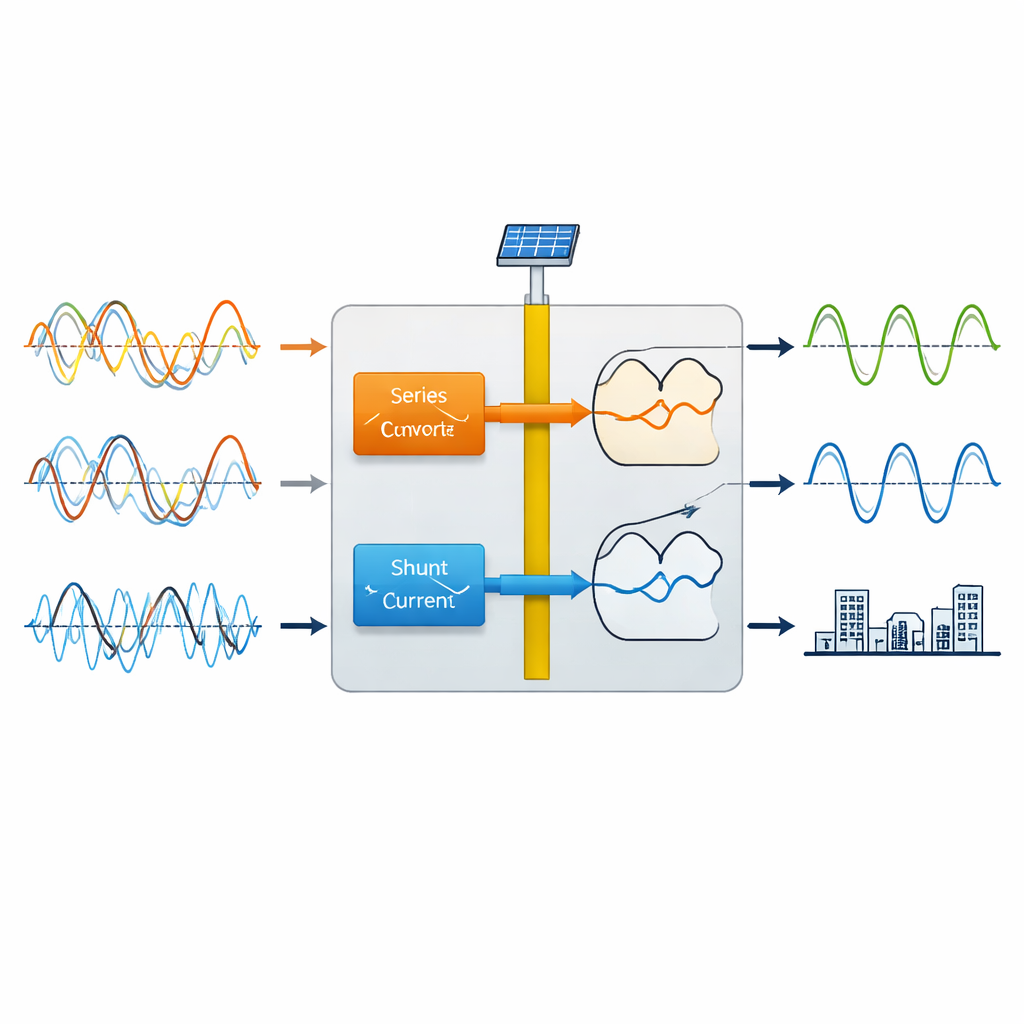
The study focuses on a device called a Unified Power Quality Conditioner (UPQC), which acts as a combined shield and shock absorber for the distribution system. A UPQC is built from two power converters: one connected in series with the line to correct voltage issues, and another connected in parallel (shunt) to fix current problems. Working together, they can inject or absorb just the right amount of voltage and current so that the grid side sees smooth, low-distortion waveforms even when the loads are harsh or unbalanced. In this work, the UPQC is fed by solar photovoltaic (PV) panels through a DC link, so the same hardware both cleans the power and makes use of renewable energy.
Blending fuzzy thinking with fast action
At the heart of the paper is a novel control method called a fuzzy logic sliding mode controller (FLSMC). Sliding mode control is known for driving a system quickly toward a desired behavior even when conditions change, but it can cause rapid switching, known as chattering, which is undesirable in power electronics. Fuzzy logic, on the other hand, mimics human decision-making with rules like “if the error is small, act gently; if it is large, act strongly.” The authors combine these ideas so that fuzzy rules continuously tune the otherwise rigid sliding mode law. This hybrid brain generates stable switching signals for both the series and shunt converters, suppressing chattering while keeping the response fast and robust.
How the new controller cleans up the waves
Using detailed simulations in MATLAB/Simulink, the researchers subject the solar-fed UPQC to a variety of realistic disturbances: voltage sags and swells at defined time intervals, severe harmonic currents, and unbalanced loads. They compare five different control strategies: a conventional proportional–integral controller, a basic fuzzy controller, an adaptive neuro-fuzzy system, a fractional-order fuzzy controller, and the proposed FLSMC. The key measure is total harmonic distortion (THD), which indicates how far the voltage or current deviates from a perfect sine wave. With FLSMC, the source voltage THD is reduced to about 0.38% and the source current THD to about 2.01%, significantly better than the other methods. The controller also regulates the DC-link voltage more quickly, with lower overshoot, meaning it can ride through sags and swells while keeping the system stable.
What this means for future power grids
The results show that combining solar power with an FLSMC-controlled UPQC can greatly enhance the dynamic performance and cleanliness of electricity on distribution networks, even under highly variable and nonlinear loading. In simple terms, the device acts like a smart, solar-assisted filter that instantly reshapes unhealthy waveforms into clean, balanced power with very low distortion. As more renewable sources and power electronics connect to the grid, this kind of intelligent conditioning could help utilities and large consumers maintain reliability and protect equipment without relying on oversized hardware or constant manual tuning.
Citation: Sravanthi, G., Rosalina, K.M. & Reddy, T.R.S. Fuzzy logic sliding mode controller based solar PV fed UPQC for improvement of dynamic performance and power quality enhancement in distribution power system. Sci Rep 16, 13319 (2026). https://doi.org/10.1038/s41598-026-43465-0
Keywords: power quality, solar PV, fuzzy control, distribution grid, harmonic reduction