Clear Sky Science · en
Strengthening RC beams and columns with CFRP, GFRP and KFRP laminates
Why stronger concrete matters
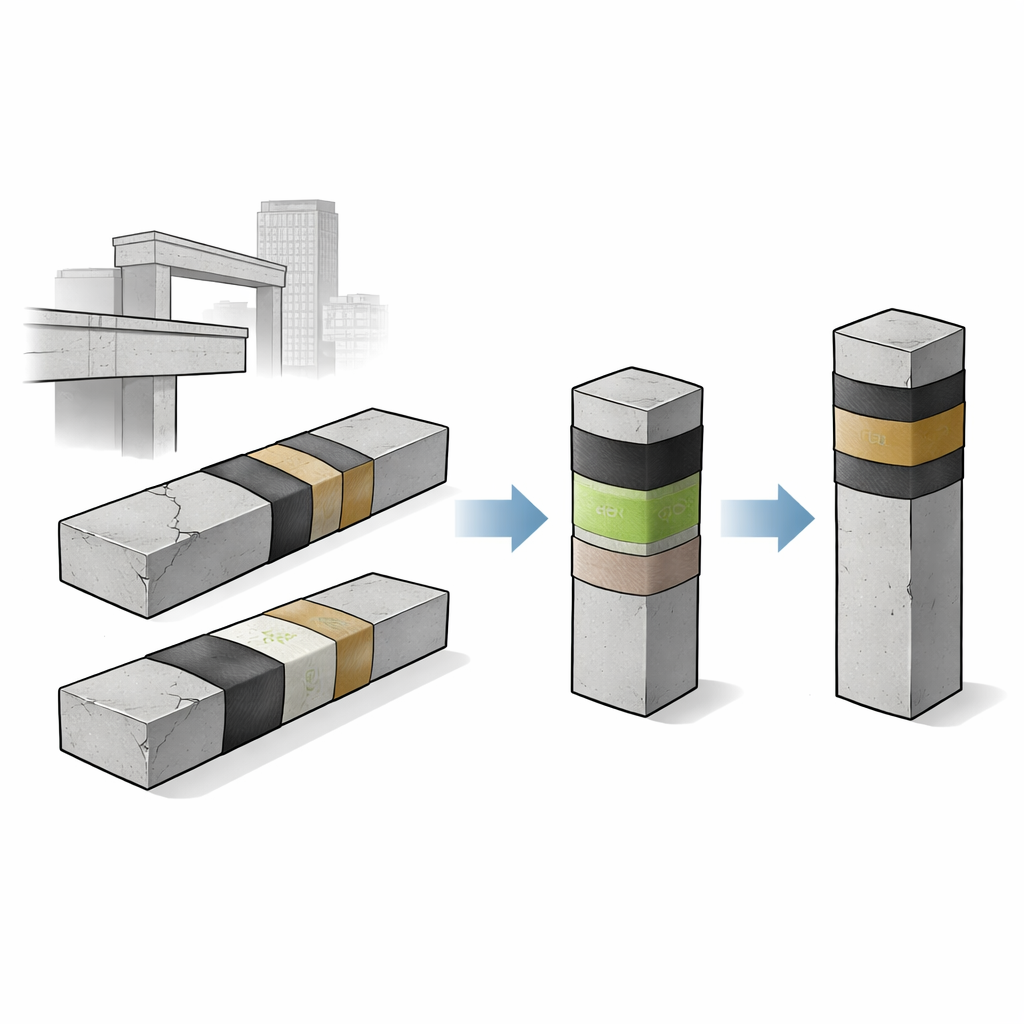
Bridges, parking garages, and building frames are all built from reinforced concrete—steel bars encased in concrete. Over decades, harsh weather, heavy traffic, earthquakes, and even fire slowly weaken these structures. Tearing them down and rebuilding is costly and carbon-intensive. This study explores a smarter option: wrapping existing concrete beams and columns with thin composite jackets made from carbon, glass, or plant-based kenaf fibers to boost strength, extend service life, and potentially cut environmental impact.
Lightweight jackets for tired structures
The authors focus on fiber-reinforced polymer (FRP) laminates—very thin, strong sheets that can be bonded to the outside of concrete. Carbon FRP (CFRP) is the strongest and stiffest but also the most expensive; glass FRP (GFRP) is cheaper and widely used for moderate upgrades. Kenaf FRP (KFRP), made from fibers of the fast-growing Hibiscus cannabinus plant, is lighter and greener, with lower production emissions. Because most previous work concentrated on synthetic fibers, this study asks how a natural fiber system like kenaf really compares, and whether wrapping beams and columns offers similar benefits.
Testing designs inside a computer
Instead of building dozens of real beams and columns, the researchers created detailed computer models using finite element analysis, a method that divides each concrete member into many small blocks to track stresses and cracks. They first reproduced an earlier laboratory beam test to make sure their virtual model behaved like a real structure, matching load capacity and deformation within less than 2 percent. The concrete in the model could crack and crush, the steel bars could yield, and the thin FRP jackets could gradually lose stiffness as damage accumulated—providing a realistic picture of how strengthening would play out from first loading to final failure.
How wraps change beam and column behavior
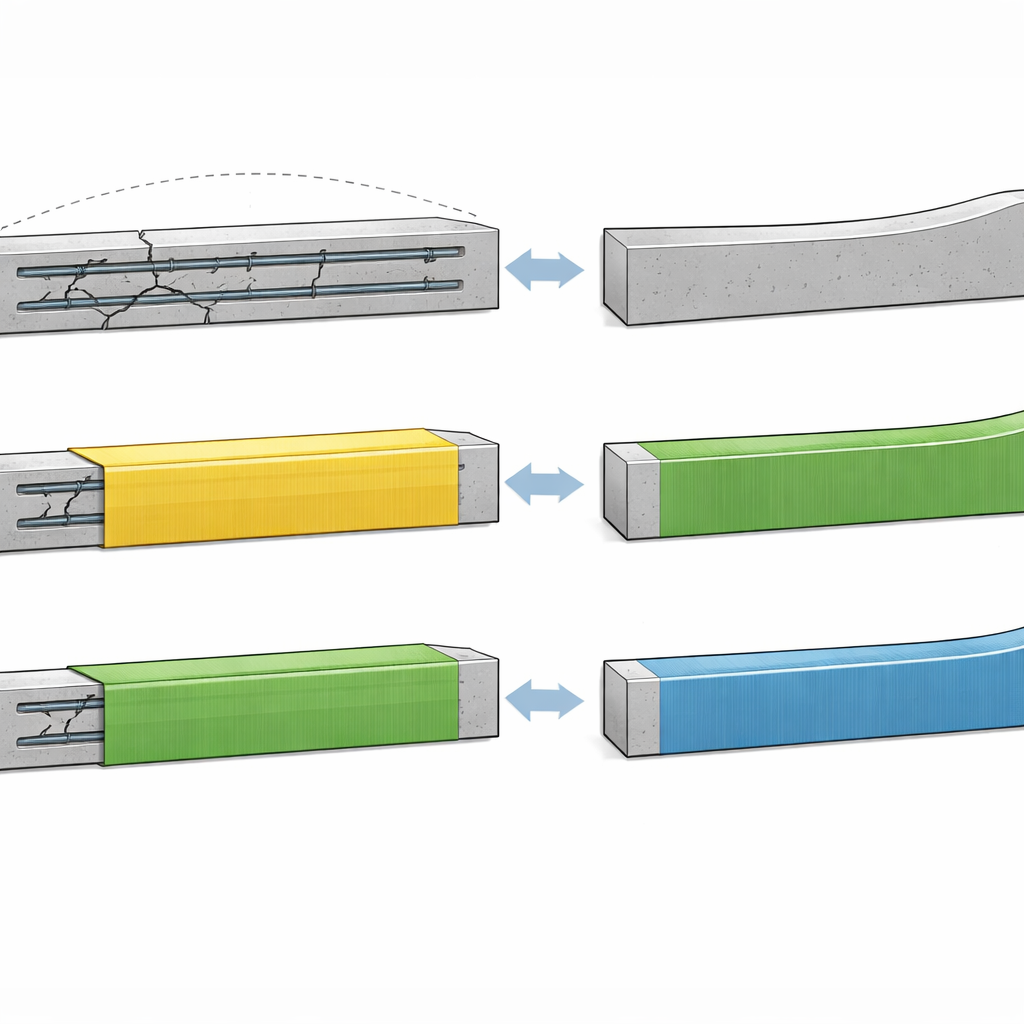
With the model validated, the team compared four versions of a simply supported beam and four versions of a short column: one unwrapped "control" and three wrapped with kenaf, glass, or carbon FRP, all with the same jacket thickness. For beams, the effect was dramatic. Wrapping increased the maximum load the beam could carry by about 14 percent with KFRP, 24 percent with GFRP, and a striking 66 percent with CFRP. Beams also bent less under the same load and absorbed more energy before failing—a measure of ductility that rose by roughly 19, 43, and 72 percent for kenaf, glass, and carbon wraps, respectively. In contrast, wrapped columns, which mainly carry straight-down compression, saw only modest gains in capacity: about 2 percent for KFRP, 3 percent for GFRP, and 6 percent for CFRP.
Why beams gain more than columns
The difference comes down to how these members work. Beams are bending elements; their bottom fibers stretch in tension, where plain concrete is weak. External FRP jackets are excellent in tension, so they help take over that role, delay cracking, and shift more demand to the strong fibers. Columns in this study were square, short, and already very strong in compression. Wrapping them mainly adds a confining effect around the concrete core rather than a new load path. For square shapes, that confinement is uneven—strongest at the corners and weaker along the flat sides—so much of the potential of the fiber jacket is not fully used. The result is a noticeable but comparatively small boost in column strength.
Balancing strength with sustainability
Overall, carbon-fiber wraps provided the largest performance jump and remain the best technical choice where maximum strength and ductility are critical, such as heavily loaded beams in key parts of a bridge or building. Glass-fiber wraps offered solid, mid-range improvement. Kenaf-fiber wraps did less to increase capacity but still meaningfully strengthened beams while offering advantages in weight, cost, and environmental footprint. For many everyday upgrades—where moderate strengthening is enough and sustainability goals matter—kenaf laminates could be a sensible option. The study shows that with well-calibrated computer models, engineers can compare such materials side by side and design retrofits that trade a small loss in mechanical performance for significant gains in climate and resource benefits.
Citation: Adel, K., Abdelazeem, M., Sherif, A. et al. Strengthening RC beams and columns with CFRP, GFRP and KFRP laminates. Sci Rep 16, 11004 (2026). https://doi.org/10.1038/s41598-026-43464-1
Keywords: reinforced concrete strengthening, fiber-reinforced polymer, carbon and glass fibers, natural kenaf fibers, finite element modeling