Clear Sky Science · en
The prediction of the progressive deformation mode based on active waveguide-generated acoustic emission
Why listening to hillsides can protect homes
Hillsides that slowly creep and then suddenly give way threaten homes, roads, and factories around the world. Cracks in walls or tilted foundations often appear only after a slope is already in danger. This study explores a different way to “listen” to a slope from the inside, long before a visible landslide occurs, by tracking tiny sound pulses created as soil particles grind and rearrange. Understanding these hidden signals could make early warning systems more reliable and give communities more time to act.
Hidden sounds inside a moving slope
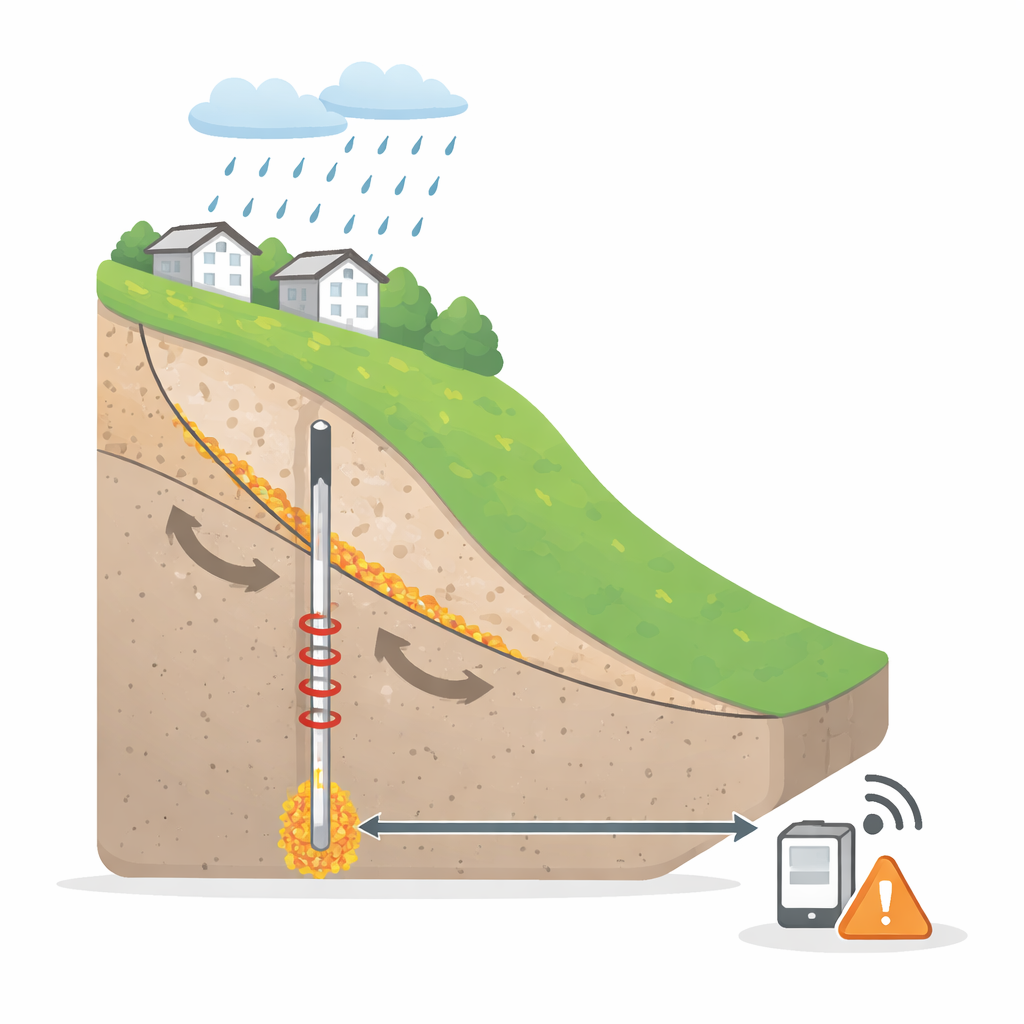
When a slope begins to move, soil and rock do not fail all at once. Instead, a thin sliding zone deep below the surface slowly deforms, then speeds up, and finally breaks. Each small shift makes high-frequency sound waves, known as acoustic emissions, that travel through the ground. The authors focus on a common type of failure called progressive deformation, where movement starts gently and then accelerates. Their goal is to show how the pattern of these tiny sounds changes through time, and how those changes can reveal when a slope is approaching a dangerous state that could damage nearby buildings.
A laboratory hillside with a built-in “stethoscope”
To study this safely and precisely, the team built a scaled-down slope in the lab. Two steel boxes filled with model soil were arranged so that one could be pulled sideways, mimicking a shear surface inside a real hillside. Through the soil they installed a vertical steel tube, known as a waveguide, surrounded by carefully chosen glass sand backfill. As the soil was sheared, the soil mass squeezed and rubbed the glass particles around the tube, generating abundant acoustic signals that traveled efficiently up the metal rod to a sensitive sensor. A servo-controlled machine pulled the upper box at a programmed rate, allowing the researchers to reproduce a slow, then accelerating sliding motion while recording soil displacement and acoustic data at every moment.
Distinct sound patterns as failure approaches
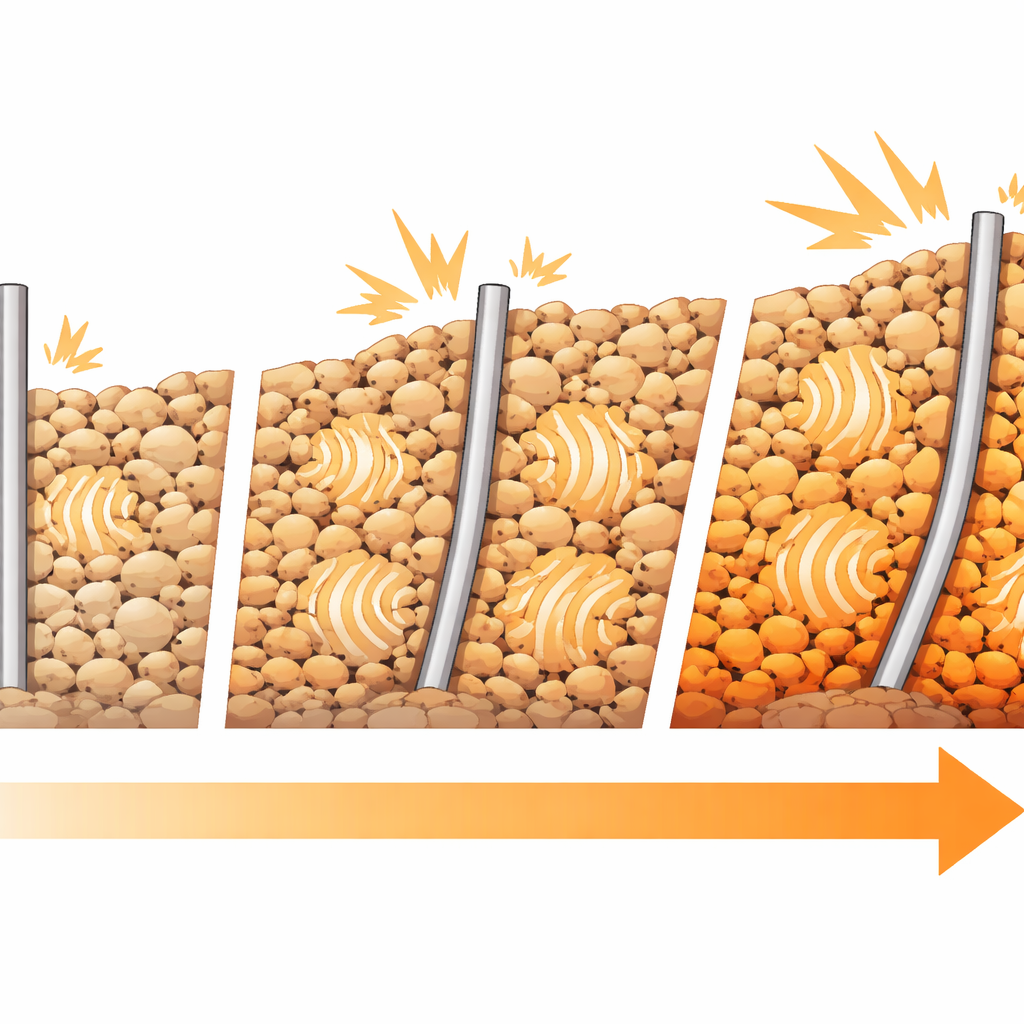
The recordings show that the slope’s “soundtrack” follows a clear three-stage pattern. Early on, when deformation is slow, acoustic activity is low: only a few weak sound bursts occur, and the total number of signals rises gently. As movement becomes steadier, the activity grows more lively. Finally, once the sliding speeds up, the acoustic counts spike sharply, and the cumulative curve bends upward in a steep sweep, mirroring the rapid increase in displacement. Scatter plots that link how long signals last with how strong they are, and how big their amplitudes are with how much energy they carry, also change character. At first, points cluster in a tight, low-value patch; later, they spread over a much larger area, reflecting more intense and varied internal movement. In the frequency domain, the signals shift from mostly low tones to a mix that includes persistent high-frequency components, especially during the fast deformation stage, marking a transition from gentle particle adjustments to vigorous friction and even grain breakage.
Turning noisy data into clear warnings
Beyond describing these patterns, the authors test a mathematical approach to prediction known as a grey-catastrophe model. They apply a grey forecasting method to smooth and extrapolate the acoustic count data, then feed the result into a catastrophe framework designed to detect when a system is about to jump from a stable to an unstable state. In their experiment, this model correctly flags a critical moment around the time when deformation in the lab slope begins to accelerate rapidly. This agreement between theory and measurement suggests that such combined analysis could form the basis of an automatic warning rule: when the acoustic signals reach a particular pattern and the model crosses a threshold, the slope may be entering a high-risk phase.
What this means for real-world slopes
For engineers and planners, the message is that listening carefully to the right acoustic features—how often signals occur, how their strength and duration grow, how their frequencies shift, and how these trends evolve together—can provide early clues that a slope is moving from harmless creep toward dangerous acceleration. The study’s lab setup is simpler and quieter than any natural hillside, so more field work is needed to deal with complex geology and environmental noise. Even so, the results show that an active waveguide system, combined with multi-feature acoustic analysis and suitable prediction models, could become a powerful tool to monitor slopes beneath buildings and give earlier, more confident landslide warnings.
Citation: Wu, Z., Sun, Y., Dong, J. et al. The prediction of the progressive deformation mode based on active waveguide-generated acoustic emission. Sci Rep 16, 12981 (2026). https://doi.org/10.1038/s41598-026-43457-0
Keywords: landslide early warning, acoustic emission monitoring, slope stability, geotechnical hazards, progressive deformation