Clear Sky Science · en
Comparative analysis of ANFIS, ANN, and BBD for enhanced prediction of methyl orange adsorption in water treatment
Turning Fruit Waste into Clean Water
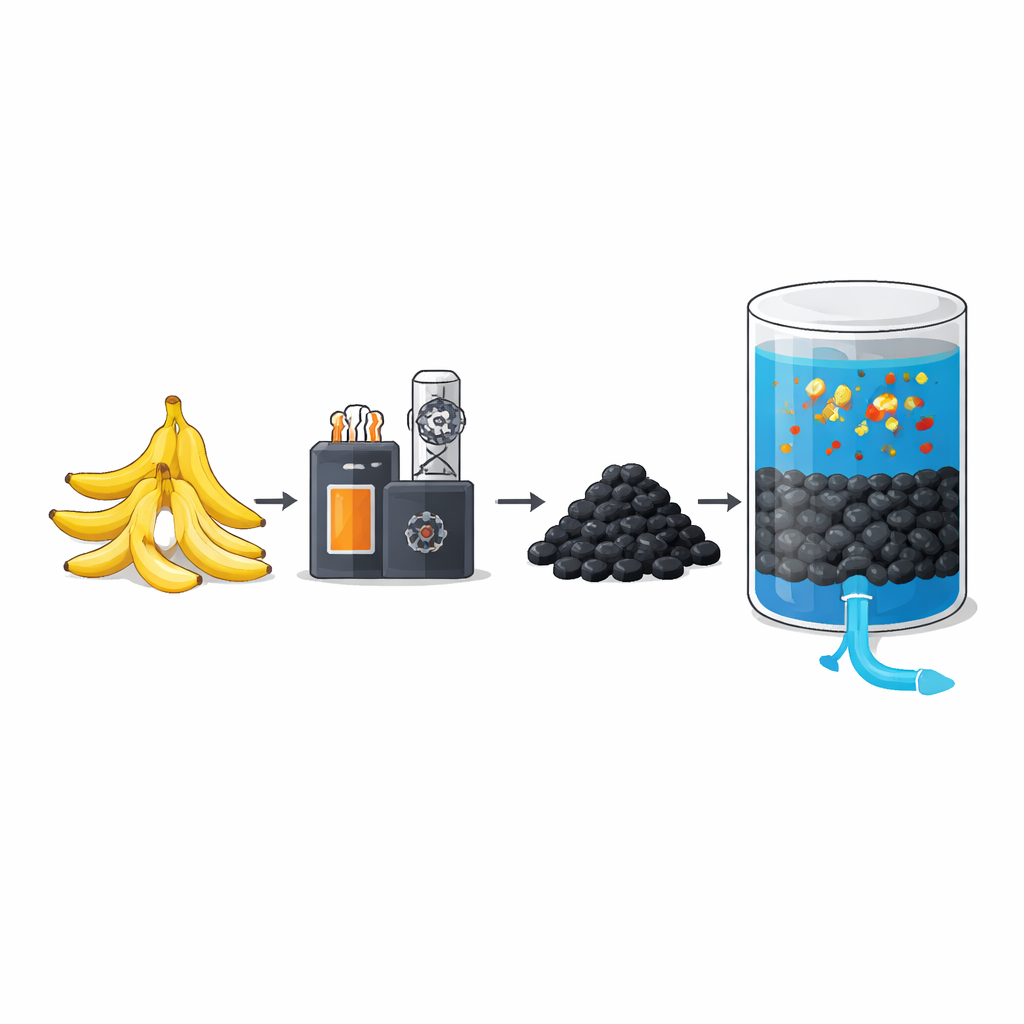
Imagine if the peels from your daily bananas could help clean up polluted rivers. This study explores exactly that idea. The researchers turned discarded banana peels into a special form of charcoal, known as activated carbon, and used it to pull a stubborn orange dye pollutant out of water. They then compared several advanced computer tools to see which one could best predict and fine‑tune how well this cleanup process works, with the goal of making water treatment cheaper, greener, and more efficient.
The Problem of Stubborn Dyes in Water
Across the world, textile factories and other industries release brightly colored dyes into waterways. One of these, methyl orange, is a common representative of a larger family of long‑lasting “azo” dyes. Even at low levels, such dyes can block sunlight in rivers and lakes, harm aquatic life, and pose health risks to people by irritating skin and eyes or stressing internal organs. Many existing treatment methods—such as membrane filtration, chemical precipitation, or advanced oxidation—either cost a lot of energy and money, generate extra waste, or require expensive materials. That is why scientists are turning to adsorption, a process where pollutants stick to the surface of a solid, as a simple and effective option.
Banana Peels as a Low‑Cost Cleaning Material
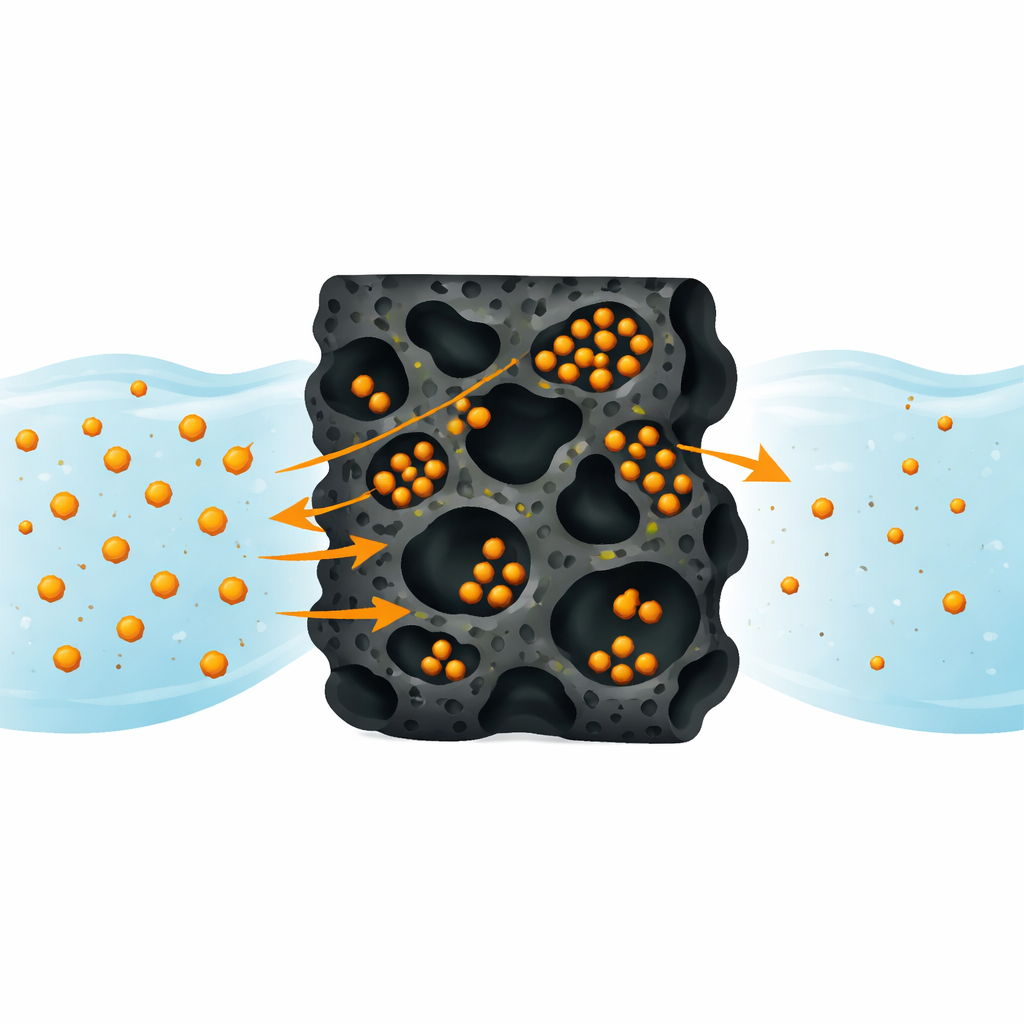
Banana peels are abundant agricultural waste, especially in regions like Uganda where bananas are a staple food. Instead of throwing them away or using them only as animal feed, this study transforms peels into activated carbon by heating and treating them with an acid. The resulting material is highly porous, with a large internal surface area and many chemical “handles” that can grab onto dye molecules. Using several laboratory techniques—microscopy to look at surface texture, spectroscopy to identify chemical groups, and gas adsorption to measure pore structure—the authors show that the prepared material has rough, sponge‑like surfaces, tiny channels, and helpful chemical groups such as hydroxyl and carboxyl, all of which support strong dye uptake.
Finding the Best Conditions for Dye Removal
To see how well the banana‑based carbon removes methyl orange, the team varied three key conditions: how long the water stayed in contact with the carbon, the temperature, and the pH (how acidic or basic the water was). Rather than testing every possible combination blindly, they used a statistical scheme called a Box–Behnken design to plan just 17 targeted experiments. From this, they identified near‑ideal conditions: slightly warm water (around 42 °C), close‑to‑neutral pH (about 7), and a contact time of roughly half an hour. Under these conditions, the carbon could hold over 140 milligrams of dye per gram of material, a capacity that compares favorably with many other low‑cost adsorbents reported in the literature.
Smart Models That Learn How the System Behaves
Because real‑world wastewater treatment is complex and often non‑linear, the authors tested three different modeling approaches to predict how much dye would be removed under various conditions. The first, response surface methodology, fits a curved mathematical surface through the data. The second, an artificial neural network, mimics how connected “neurons” in a computer can learn patterns from examples. The third, an adaptive neuro‑fuzzy inference system, blends neural networks with fuzzy logic, a way of handling gradual changes instead of simple yes‑or‑no rules. All three models matched the experimental data very closely, but the hybrid neuro‑fuzzy approach delivered the most accurate predictions and the lowest errors, especially when capturing subtle interactions among pH, time, and temperature.
How the Dye Sticks and How Well It Lasts
To understand what is happening at a deeper level, the researchers analyzed how quickly the dye is taken up and how it spreads over the carbon surface. They found that the process followed a so‑called pseudo‑second‑order pattern, which points to strong chemical‑type bonding between dye molecules and the carbon surface, rather than just weak physical attraction. Another set of tests, called isotherm studies, showed that the dye forms multiple layers on an uneven surface, which agrees with the highly varied pore structure seen in the microscopy images. Practical trials with real water samples—tap water, sewage, industrial water, and distilled water—showed removal efficiencies above 90% in all cases, though complex waste streams with many competing substances performed slightly worse. The carbon could be reused several times with only a gradual drop in performance, suggesting good but not unlimited reusability.
Why This Work Matters for Everyday Life
In simple terms, this study shows that something as ordinary as banana peels can be turned into a high‑performing material to help clean dyed wastewater, and that advanced “learning” models can reliably guide how to run the process for the best results. The banana‑based carbon can grab large amounts of a persistent dye under realistic conditions, and the adaptive neuro‑fuzzy model is especially powerful for predicting and optimizing that performance. Together, these advances bring us closer to affordable, sustainable water purification technologies that make use of local agricultural waste while protecting rivers, lakes, and human health.
Citation: Bbumba, S., Karume, I. Comparative analysis of ANFIS, ANN, and BBD for enhanced prediction of methyl orange adsorption in water treatment. Sci Rep 16, 12822 (2026). https://doi.org/10.1038/s41598-026-43445-4
Keywords: banana peel activated carbon, methyl orange removal, wastewater treatment, adsorption modeling, neuro fuzzy systems