Clear Sky Science · en
Experimental and mechanistic analysis of deformation modulus enhancement in soilbag
Building Stronger Ground with Simple Bags of Dirt
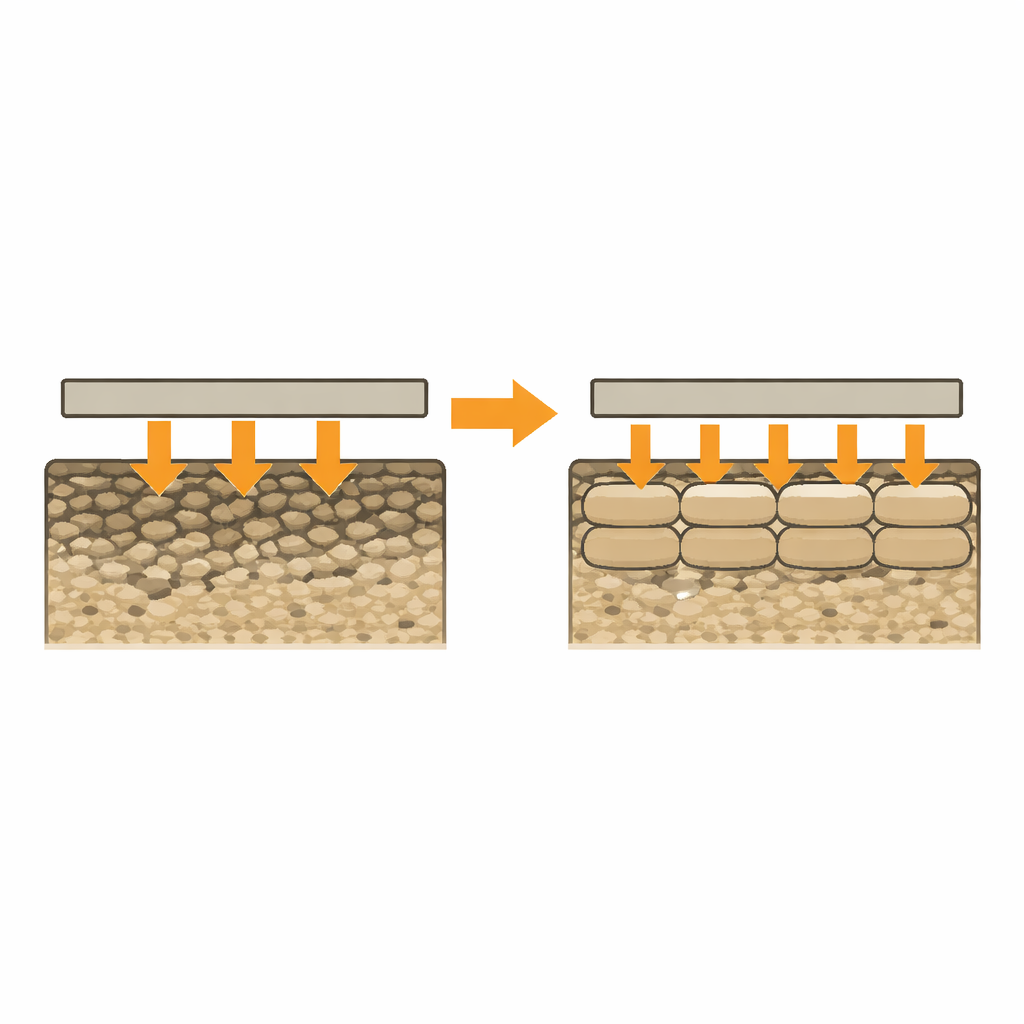
When engineers build dams, roads, or reservoirs on weak or mixed ground, they worry that the soil will slowly squish and sink under the weight. A relatively simple technology—strong fabric bags filled with local soil and rock, called soilbags—can make the ground behave more like a firm mattress than a soft cushion. This study explains not just that soilbags work, but why they make the ground stiffer and more reliable, using full‑scale field tests, lab experiments, and a unifying mechanical model.
What Are Soilbags and Why They Matter
Soilbags are tough woven fabric bags, typically made of geotextile, that are filled with soil, sand, or soil–rock mixtures and stacked or laid in a layer. Unlike flat reinforcement sheets that mainly act in one plane, each bag wraps soil on all sides, forming a three‑dimensional “cell” that can confine loose materials. Because the bags can be filled with local excavated material—even what is often treated as construction waste—they promise cheaper and more sustainable foundations. Earlier research showed that soilbags increase how much load the ground can carry before failing, but engineers also need to know how they control everyday deformation: how much the ground compresses under normal service loads.
Real‑World Test on a Hydropower Reservoir
The authors first tested soilbags at a pumped storage power station in Jiangsu, China, where the reservoir bottom is built from highly variable soil–rock mixtures. Two neighboring test areas were prepared under almost identical conditions: one with a single layer of large soilbags placed on the compacted base, and one without bags. After careful compaction, steel plates were used to press down step‑by‑step on each area while measuring how much the ground settled. Using standard engineering formulas, they found that the section with soilbags had a deformation modulus—essentially a measure of how resistant the ground is to squashing—that was about 23 percent higher than the unreinforced section. This confirmed that even a single soilbag layer can noticeably stiffen a troublesome foundation while making use of on‑site materials.
Peeking Inside the Bag: A Unified Mechanical Picture
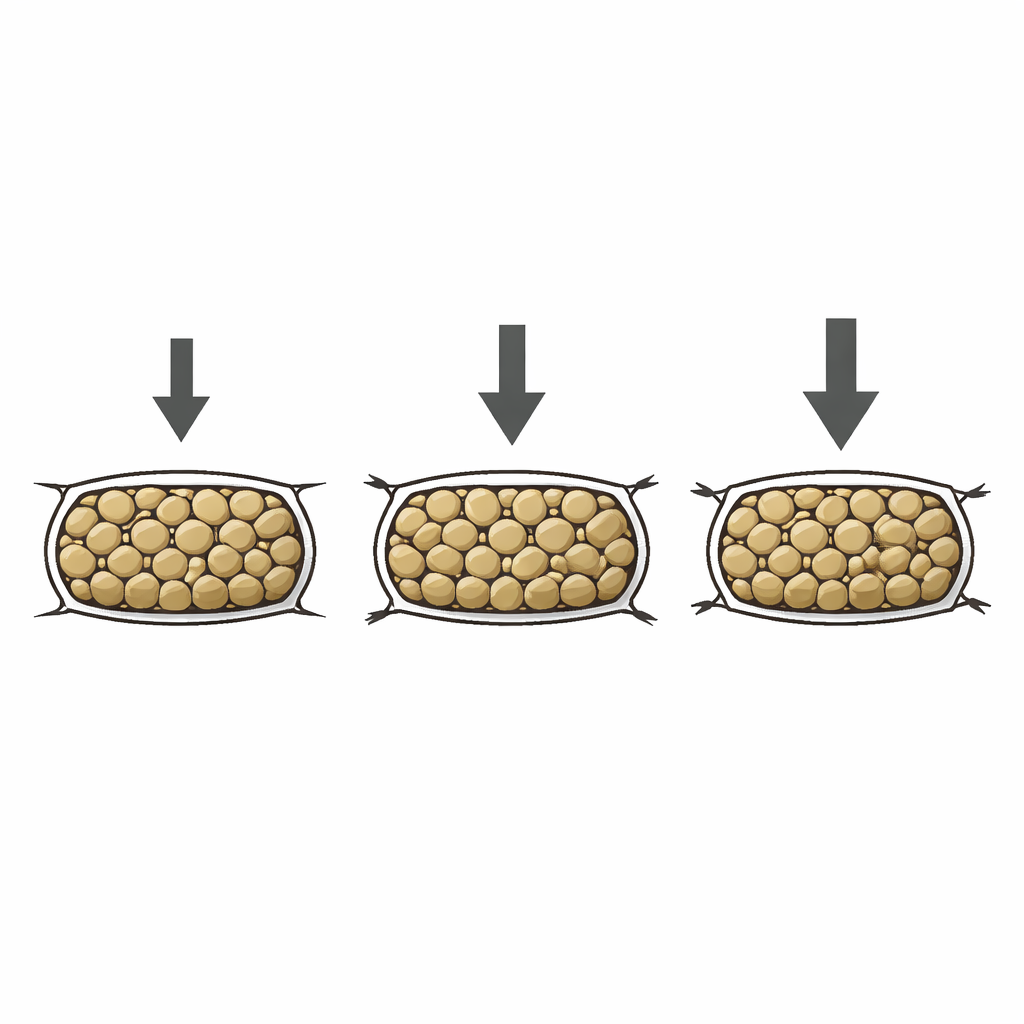
To understand what happens inside each bag, the team developed a stress–strain framework that treats the soil and the fabric as a coupled system. As vertical load pushes down on the bag, the soil tries to bulge sideways. The geotextile stretches and develops tension, which in turn squeezes the soil laterally. In mechanical terms, the total stress inside the soil is the sum of the external load and this extra confining stress from the bag’s tension. By tracking how these stresses evolve, the model shows that soil inside a bag follows a different path in stress space than unreinforced soil: it experiences higher overall confinement and a more favorable balance between shear and normal forces. This shift moves the soil away from premature failure and into a “hardened” state where it can carry more load with less deformation.
Clay, Sand, and How the Bag Changes Their Behavior
Laboratory compression tests on smaller soilbags filled with either clay or sand helped validate the model and reveal how different soils respond. For clay‑filled bags, tension in the geotextile climbed rapidly at low loads as the soft clay deformed and the bag ballooned, then increased more slowly as the clay and bag became denser and stiffer. When the researchers compared clay inside a bag with clay confined in a rigid cylinder under the same vertical pressure, the bagged clay showed a higher “pre‑consolidation” stress level—evidence that the added confinement had pushed it into a stronger, more compact state. Sand‑filled bags behaved differently: because sand has little cohesion, its stress path initially ran close to failure, but friction between sand grains and the fabric, plus the sand’s tendency to dilate under shear, helped the bag mobilize strong lateral tension. This interaction allowed the sand to stay intact and gain stiffness instead of quickly shearing.
How Much of the Stiffening Comes from the Bag
The study separates the stiffening into two parts: natural soil densification under compression, and extra stiffening caused by the fabric’s tension. For clay‑filled bags, the fabric confinement contributed more than one‑third of the total deformation modulus of the soil inside the bag, especially at lower loads when deformation is larger. For sand‑filled bags, the added modulus from the bag was smaller—about 15 percent—but still crucial to prevent shear failure and to let the sand reach high strength under conditions that would otherwise be unstable. The authors also outline practical design tips: use an elongated bag shape (length at least four times its height), choose fabric with adequate tensile strength for the bag size, and leave small gaps during pre‑compaction so bags can expand and fully mobilize tension before the gaps are backfilled.
Why This Matters for Future Construction
In everyday terms, this research shows that soilbags let engineers turn loose or mixed earth into a stiffer, more dependable foundation “layer” without resorting to deep piles or expensive imported aggregates. The bags do more than just wrap soil—they actively squeeze it as loads increase, guiding the internal forces along safer paths and compacting the material from within. By quantifying both field performance and the internal mechanisms, the study gives designers a solid basis for using soilbags more confidently in dams, embankments, roads, and other infrastructure, making better use of local soils while controlling settlement and improving safety.
Citation: Liao, J., Song, Y., Tao, Y. et al. Experimental and mechanistic analysis of deformation modulus enhancement in soilbag. Sci Rep 16, 12646 (2026). https://doi.org/10.1038/s41598-026-43444-5
Keywords: soilbags, ground reinforcement, geotextile foundations, soil–rock mixtures, civil infrastructure