Clear Sky Science · en
An ultra-compact and high isolated 8 × 8 MIMO antenna system for 5G NR-n46 and n79 band applications
Why this tiny square matters to your phone
As our phones, routers, and cars juggle video calls, streaming, and smart-city data, they need antennas that can move huge amounts of information without taking up much space or interfering with each other. This paper describes a new, very compact antenna “tile” that fits eight antennas into a small square while still delivering strong, clean signals for 5G networks in the popular sub‑6 GHz bands used for Wi‑Fi and cellular links.

Fitting more lanes on the wireless highway
Next‑generation wireless systems such as 5G and future 6G are built on the idea of using many antennas at once, a technique known as MIMO. Instead of one antenna carrying all the traffic, several antennas share the job, like extra lanes on a highway. This approach boosts data rates, improves reliability in crowded cities, and lets networks serve thousands of devices at the same time. The catch is that packing many antennas into the tight space of a smartphone or access point makes them prone to “talking over” one another, which wastes power and muddies the signal.
A small square packed with eight antennas
The authors designed an eight‑port MIMO antenna that fits onto a 60 × 60 mm board—roughly a 1.02‑by‑1.02‑wavelength square at its operating frequency near 5.2 GHz. Two slim, rectangular antenna pieces sit at each corner of the board, arranged at right angles so they respond to differently oriented waves and support both diversity and high data throughput. This layout is tuned to work across 4.75–5.45 GHz, a 700 MHz slice that conveniently covers two important 5G New Radio bands, known as n79 (licensed mid‑band) and n46 (often used in unlicensed, Wi‑Fi‑like fashion), as well as licensed assisted access, where operators blend licensed and unlicensed spectrum.
Shaping the hidden side to cut interference
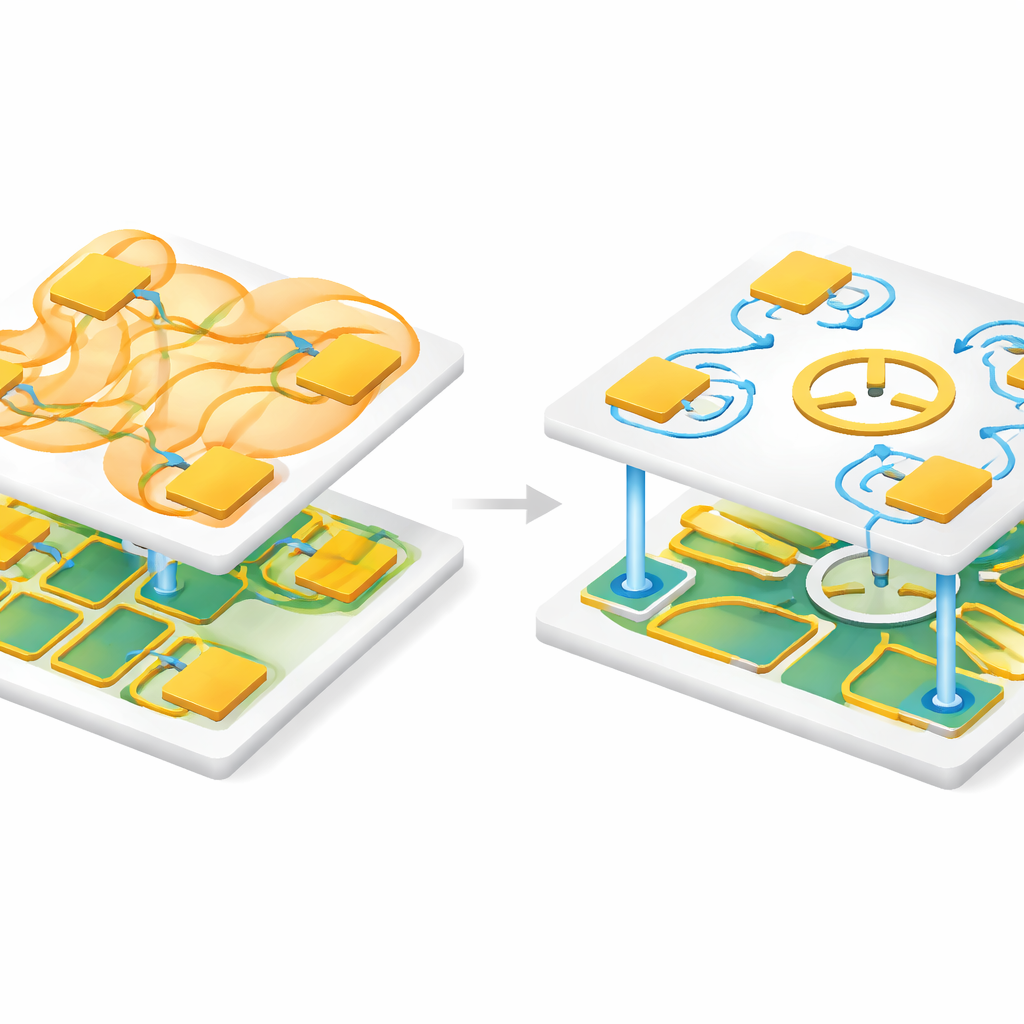
The real trick lies not in the visible antenna pieces, but in the shaped metal on the back of the board. The researchers etched four rectangular loops under the corners, along with a circular ring and a plus‑shaped opening in the center. These cuts act like carefully placed roadblocks and detours for the currents that usually spread across the surface and cause nearby antennas to couple energy into one another. By changing how these currents flow, the pattern of stored electric and magnetic energy shifts in a way that strongly reduces unwanted cross‑talk while keeping the desired signal path well matched to standard circuitry.
Proving the design in theory and in the lab
To understand and fine‑tune their design, the team first created and compared several intermediate antenna layouts, then chose the best candidate as the building block for the full eight‑port system. They modeled the antenna using both full‑wave electromagnetic simulation and a simplified circuit made from resistors, inductors, and capacitors, showing that the two viewpoints agreed closely. After fabricating a prototype on a low‑loss microwave circuit board, they measured its performance in the lab with precision network analyzers and in an anechoic chamber. The finished antenna covers the target band with strong signal strength (up to 4.7 dB gain), very high radiation efficiency (about 92.5%), and excellent separation between ports—up to 33 dB of isolation, meaning only a tiny fraction of power leaks from one antenna into another.
What the results mean for real devices
Beyond raw numbers, the researchers examined how well the eight antennas behave as a team, using figures of merit that capture independence between paths, resilience in cluttered environments, and potential data throughput. All of these indicators fell within widely accepted limits for high‑quality MIMO, with correlation between elements approaching zero and channel capacity loss kept very low. The outcome is a compact, efficient antenna tile that can be built into smartphones, Wi‑Fi 5 and Wi‑Fi 6 routers, vehicle‑to‑everything units, and wireless backhaul links. In simple terms, the study shows how careful shaping of an antenna’s hidden ground plane can unlock more reliable, higher‑capacity 5G connections without needing larger devices or extra spectrum.
Citation: Mishra, B., Sethumadhavi, R., Singh, S. et al. An ultra-compact and high isolated 8 × 8 MIMO antenna system for 5G NR-n46 and n79 band applications. Sci Rep 16, 12523 (2026). https://doi.org/10.1038/s41598-026-43426-7
Keywords: 5G MIMO antenna, sub-6 GHz, antenna isolation, compact antenna design, licensed assisted access