Clear Sky Science · en
Engineered cementitious composites with nano calcium carbonate and corona waste mask fibers for sustainable 3D printing applications
Turning Pandemic Waste into Stronger Buildings
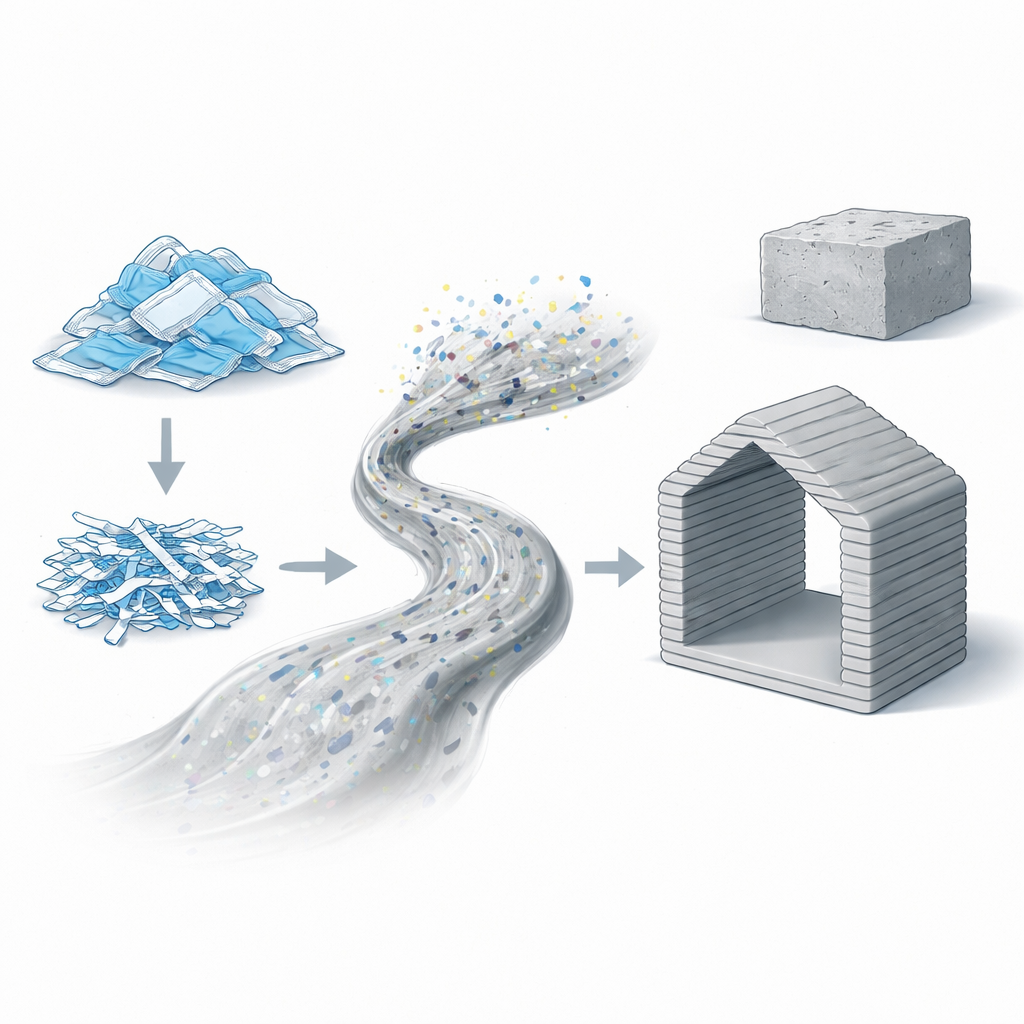
What if the billions of disposable masks used during the COVID-19 pandemic could help us build better, greener homes? This study explores exactly that idea. By shredding mask material into tiny fibers and combining it with nano-sized mineral particles, the researchers created a 3D-printable building mix that is stronger, denser, and more durable than ordinary concrete. Their work shows how yesterday’s medical waste and today’s advanced materials could together shape the buildings of tomorrow.
Why Concrete Needs an Upgrade
Concrete is the backbone of modern construction, but it has a major weakness: it resists squeezing forces very well, yet it cracks easily when pulled or bent. Engineered cementitious composites (ECC) were developed to fix this by mixing in a small amount of short fibers so that, instead of one big crack, many tiny cracks form and the material can stretch a bit without failing. At the same time, construction is searching for cleaner methods, and 3D printing of concrete has emerged as a way to reduce waste, cut labor, and enable more flexible designs by extruding layers of mortar like icing on a cake. The challenge is to develop a printable mix that flows through a nozzle yet quickly stiffens into a stable, crack-resistant structure.
From Face Masks and Nanoparticles to Printable Mix
The team tackled this challenge using two key ingredients. First, they used fibers cut from unused medical face masks made of polypropylene, a common plastic. These so-called corona waste mask fibers were treated with an electrical "corona" process to roughen their surface and make them more compatible with the cement paste, helping them grip better and bridge tiny cracks. Second, they added nano calcium carbonate, an extremely fine powder whose grains are tens of nanometers across—thousands of times smaller than sand. These nanoparticles act as micro-fillers, slipping into tiny gaps between cement grains and providing extra surfaces where cement can harden more quickly. The researchers prepared a series of 3D-printable mortars containing a constant amount of mask fibers but different doses of nano calcium carbonate ranging from 0 to 4 percent of the cement mass.
Getting the Right Flow and Shape
For 3D printing, the mix must behave like thick toothpaste: fluid enough to be pumped and shaped, but stiff enough to hold its form as layers build up. The team measured how far small samples spread under their own weight, how easily they flowed on a shaking table, and how many layers could be stacked before collapse. As more nano calcium carbonate was added, the mixtures became less fluid but more stable. The finest particles absorbed part of the mixing water and increased internal cohesion, so the printed strands kept their shape and the number of buildable layers rose from about 31 without nanoparticles to 55 at the highest dose. However, if too much nano calcium carbonate was used, the particles began to clump, making the material overly stiff and harder to work with.
Stronger, Denser, and Less Absorbent at the Sweet Spot
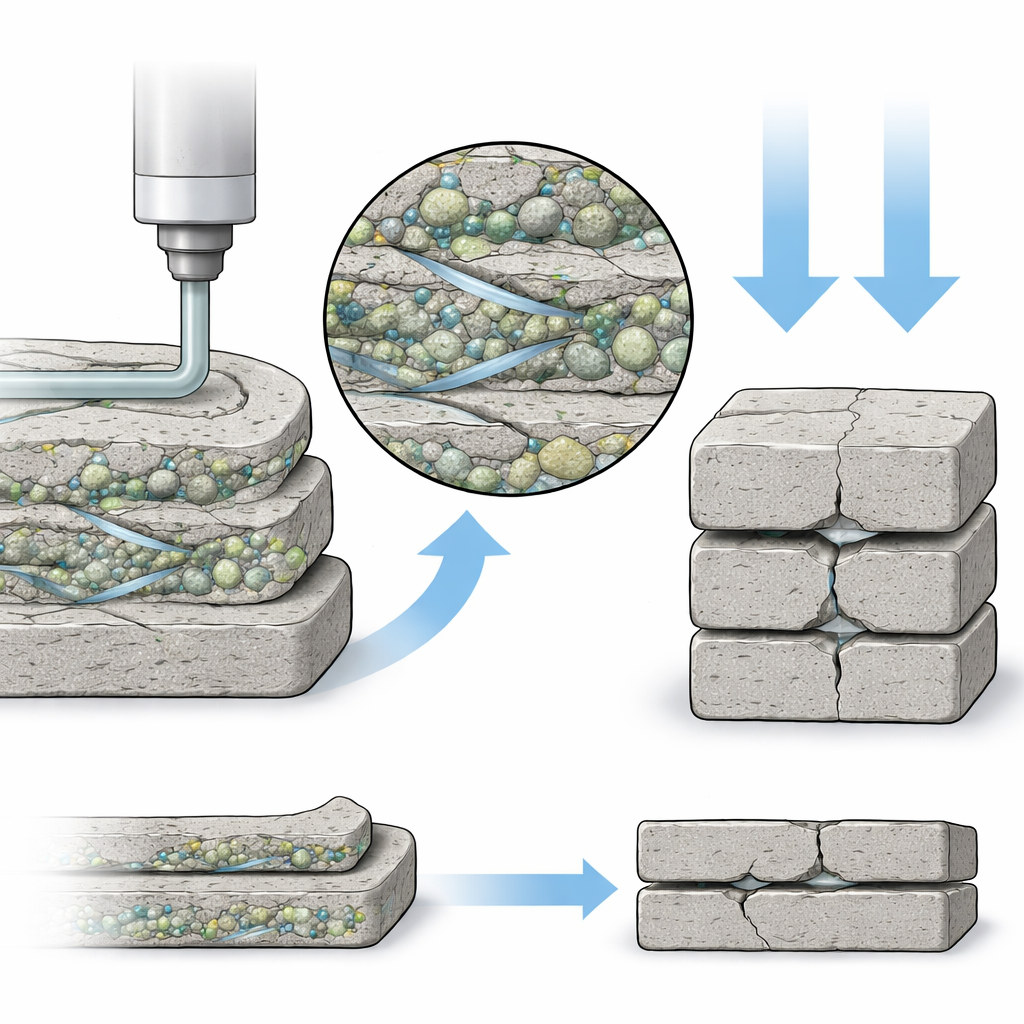
The key question was how these changes affected the finished material. The researchers dried and weighed printed and traditionally cast samples to determine density, soaked them to measure water uptake, and tested their resistance to squeezing, bending, and pulling apart. They found a clear sweet spot at around 3 percent nano calcium carbonate. At this level, printed specimens were denser and absorbed less water than those without nanoparticles, a sign of fewer internal pores. Their compressive, flexural, and splitting tensile strengths all peaked, and the 3D-printed samples outperformed their conventionally cast counterparts. Microscopic images supported these results: with 3 percent nanoparticles, the internal structure looked compact, with pores filled by hardened gel and fibers well bonded to the surrounding paste. At 4 percent, clumping of nanoparticles created new voids, and both density and strength dropped.
What This Means for Greener 3D-Printed Construction
In plain terms, the study shows that carefully dosed nano calcium carbonate, combined with recycled mask fibers, can turn a printable cement mix into a tougher, more durable building material. Around 2–3 percent nano calcium carbonate by cement weight provided the best balance between easy printing, layer stability, strength, and reduced water absorption. The treated mask fibers help control cracking, while the nanoparticles fill gaps and speed hardening, especially in 3D-printed layers. Beyond the engineering gains, this approach points to a way of giving pandemic-era plastic waste a second life in sustainable construction, hinting at a future where advanced materials and recycling are built into the walls around us.
Citation: Krishnaraja, A.R., Kulanthaivel, P., Manoharan, A. et al. Engineered cementitious composites with nano calcium carbonate and corona waste mask fibers for sustainable 3D printing applications. Sci Rep 16, 13458 (2026). https://doi.org/10.1038/s41598-026-43424-9
Keywords: 3D concrete printing, nano calcium carbonate, recycled mask fibers, engineered cementitious composites, sustainable construction