Clear Sky Science · en
Modelling and optimization of operating parameters of an electronic cell type metering mechanism for urea super granules (USG) using EDEM-RSM approach
Why smarter fertilizer delivery matters
Rice farmers around the world rely on nitrogen fertilizer to keep yields high, but much of that fertilizer is wasted, washing away into water or escaping as powerful greenhouse gases. One way to cut these losses is to place compact urea super granules, or USGs, deep in the soil near rice roots. This paper describes a new electronic device that can drop these granules precisely where they are needed, while using computer simulation to fine‑tune the design before it ever reaches the field.
From hand work to smart machines
Deep placement of USGs has already been shown to boost rice yields by up to 40 percent and nearly double how efficiently plants use nitrogen. The problem is that placing each granule by hand is slow, tiring work, so many farmers avoid it. Earlier tools for USG placement required manual effort and did not always give uniform spacing. The authors set out to design an electronic metering system that could be attached to a rice transplanter, automatically feeding USGs into the soil at the right locations with minimal human effort.
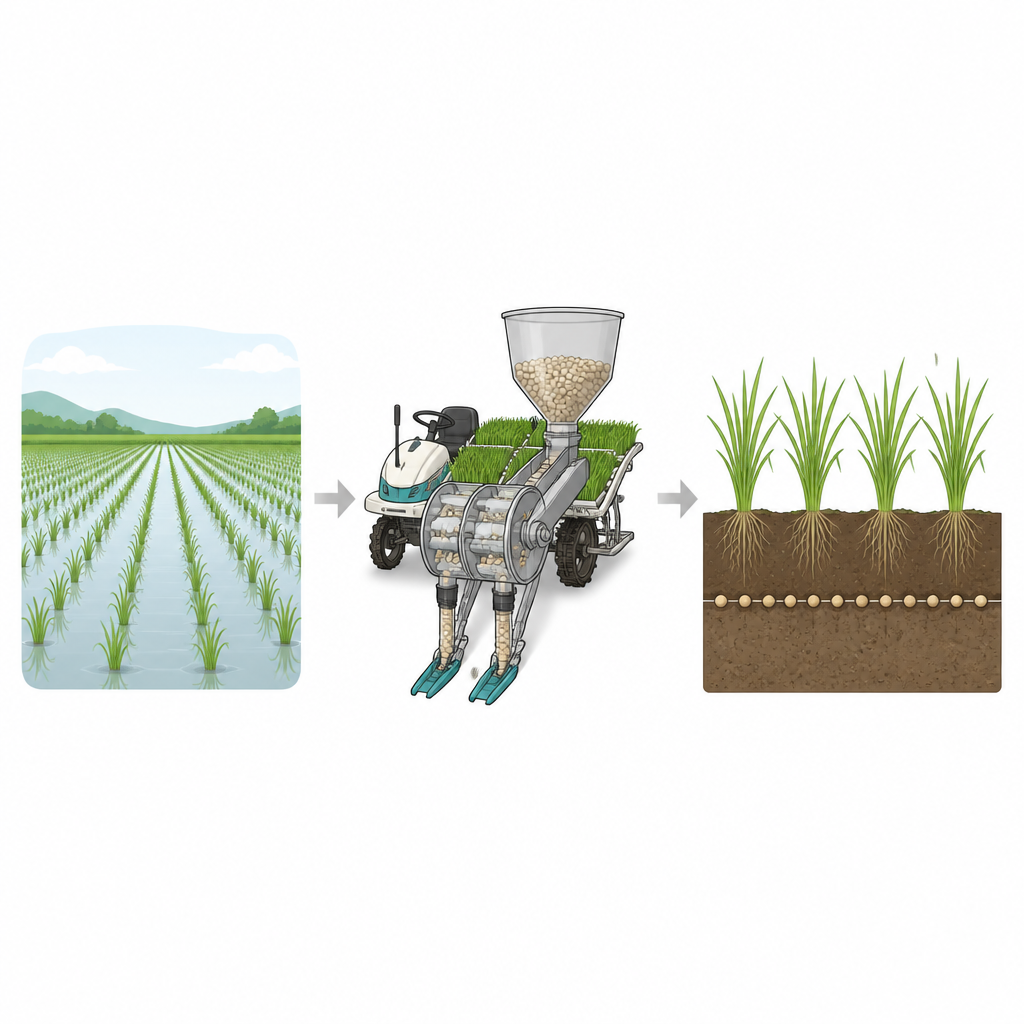
How the new device delivers each granule
The heart of the system is a rotating roller with four small pockets, or cells, around its rim. Above it sits a hopper full of USGs. As the roller turns, each cell should ideally capture exactly one granule and then release it into a delivery tube that carries it into the furrow between four rice hills. A stepper motor, controlled by an Arduino microcontroller and synchronized with the transplanter through a rotary encoder, makes sure the roller turns the right fraction of a revolution for every set of rice seedlings placed. The team could change pocket size using 3D‑printed rollers and adjust the roller speed and hopper fill level to study how these factors affect performance.
Using virtual granules to tune the design
Instead of relying only on trial and error in the lab, the researchers built a detailed computer model of the system using the discrete element method, a technique that simulates how thousands of individual particles move and collide. They recreated the shape and physical properties of USG granules, the geometry of the hopper and roller, and the contact between plastic parts and fertilizer. Sensors inside the simulation counted how many granules entered each cell, how often a cell was empty, and how often it carried more than one granule. They then applied a statistical technique called response surface methodology to explore combinations of pocket area, roller speed, and hopper fill level, searching for settings that provided full cells with mostly single granules and very few misses or doubles.
Finding the sweet spot for uniform feeding
The simulations showed clear patterns. Larger pockets increased the chance that cells filled, but also raised the risk of capturing more than one granule. Smaller pockets and very fast roller speeds tended to leave cells empty, because there was not enough time for granules to settle into place. A fuller hopper helped cells fill but had little effect on whether a cell carried one or multiple granules. By balancing these effects, optimization suggested an ideal pocket area of about 1088 square millimeters, a roller speed around a quarter of a meter per second, and a hopper filled to three quarters of its capacity. Under these conditions the model predicted perfect cell fill, a high share of single‑granule cells, and very low rates of missing and multiple drops.
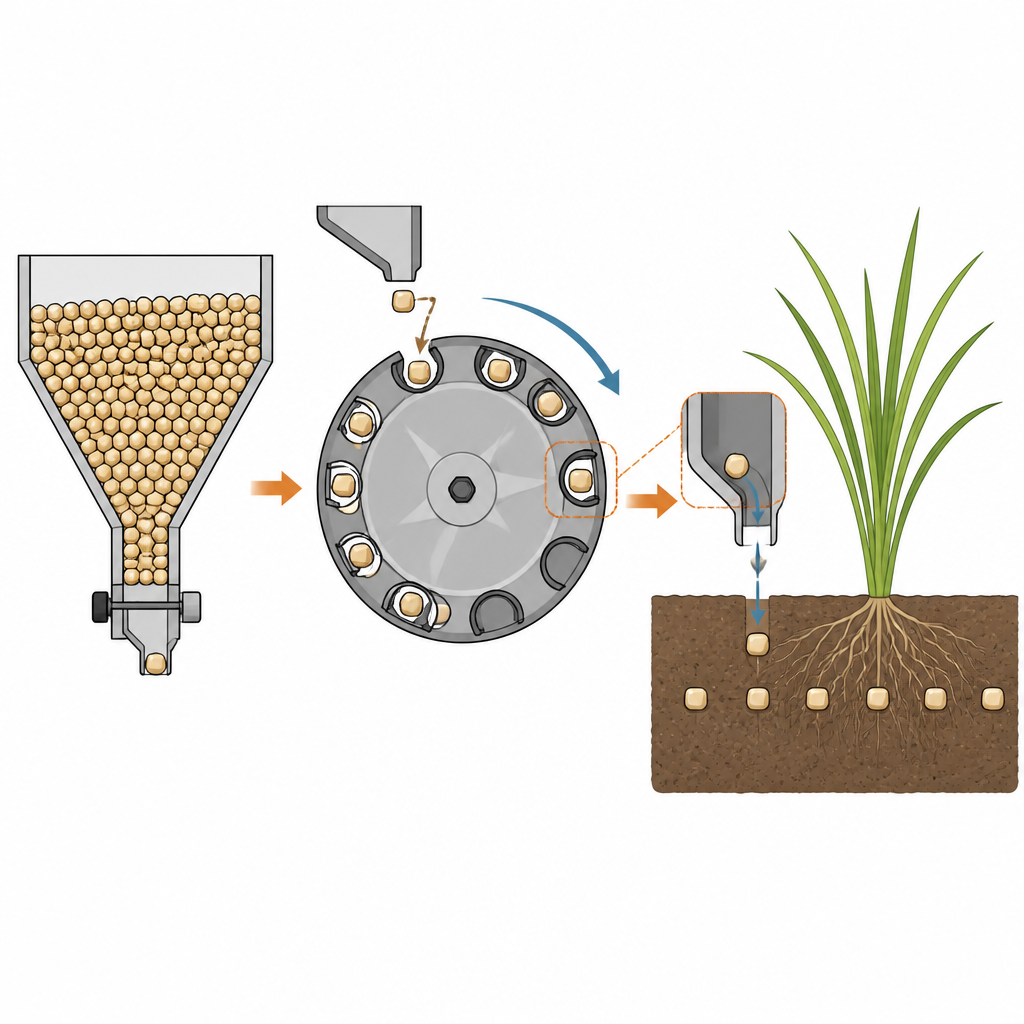
Putting the model to the test
To check the virtual findings, the team built a physical metering unit with the optimized pocket size and mounted it on a test rig in a soil bin. With the roller speed and hopper fill set to the chosen values, they measured how often cells were filled, how many carried exactly one USG, and how evenly granules were spaced along the furrow. The real‑world results matched the simulation closely: 97 percent of cells were filled, 91 percent delivered a single granule, and only a few cells were empty or doubled. Over a 10‑meter run, the pattern of granules in the soil met accepted standards for good uniformity. A simple cost analysis suggested that, when paired with a transplanter, the applicator could pay for itself in about one and a half years of use.
What this means for farmers and the climate
In plain terms, the study shows that it is possible to design an add‑on device that lets a rice transplanter place USG fertilizer granules almost perfectly, with much less human labor than hand placement. By combining detailed particle simulations with lab tests, the authors identified operating settings that give nearly one granule per pocket, at regular intervals in the soil. If adopted widely, such systems could help farmers apply less nitrogen while maintaining or increasing yields, cutting both costs and emissions of greenhouse gases from flooded rice fields.
Citation: Swain, S.S., Khura, T.K., Arjun, P. et al. Modelling and optimization of operating parameters of an electronic cell type metering mechanism for urea super granules (USG) using EDEM-RSM approach. Sci Rep 16, 15622 (2026). https://doi.org/10.1038/s41598-026-43407-w
Keywords: urea super granules, rice fertilizer, precision agriculture, fertilizer applicator, discrete element method