Clear Sky Science · en
A photovoltaic maximum power point tracking strategy based on the IRBMO-VP&O algorithm
Why squeezing more power from solar panels matters
Solar panels are becoming a cornerstone of clean energy, but they do not always work at their best. When clouds, trees, or nearby buildings cast uneven shadows on a solar array, its power output can drop sharply and behave in complex, unpredictable ways. This paper presents a smarter control method that helps solar systems automatically find and hold their true best operating point, even when sunlight is patchy and changing, so each panel field can deliver more usable electricity.
The challenge of uneven sunlight
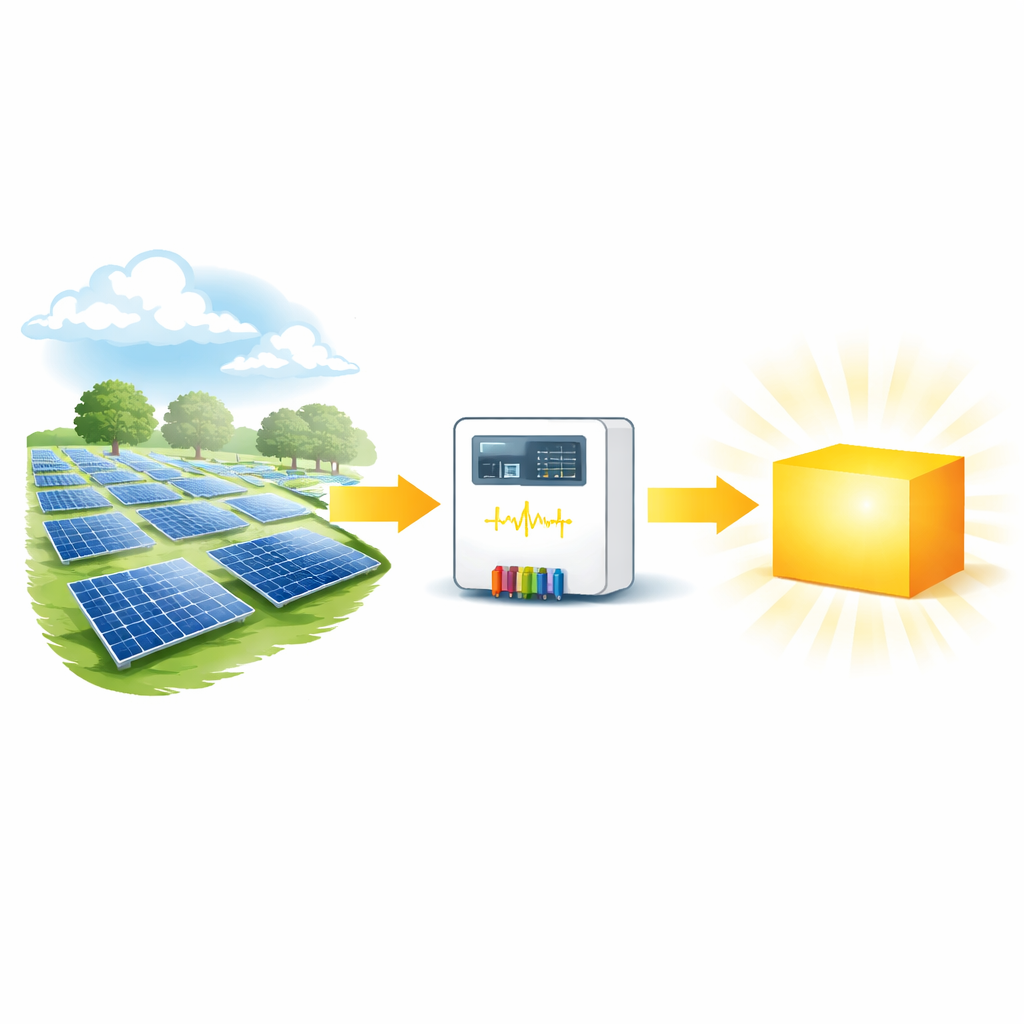
In an ideal world, every solar panel in an array would receive the same bright sunlight, and the relationship between voltage and power would form a smooth curve with a single clear peak. Reality is messier. Under partial shading, some modules receive strong light while others are dimmed. Protective components inside the array switch on in uneven patterns, breaking the smooth curve into several peaks. Only one of these is the global maximum power point—the spot where the whole array delivers the most power. Traditional control methods often mistake a smaller local peak for the true best point, leaving significant energy untapped.
From simple rules to nature-inspired search
Conventional maximum power point tracking methods, such as simple hill-climbing or “perturb and observe,” work by nudging the operating voltage up and down and watching how power changes. These techniques are easy to implement but can get stuck on the wrong peak when the power curve has multiple bumps, especially under rapid shifts in sunlight. To overcome this, researchers have turned to nature-inspired search strategies that mimic animal swarms, flocks, or other collective behaviors. These approaches send many candidate solutions exploring the landscape at once, improving the chance of finding the global peak but sometimes at the cost of speed or stability.
A bird-inspired hybrid strategy
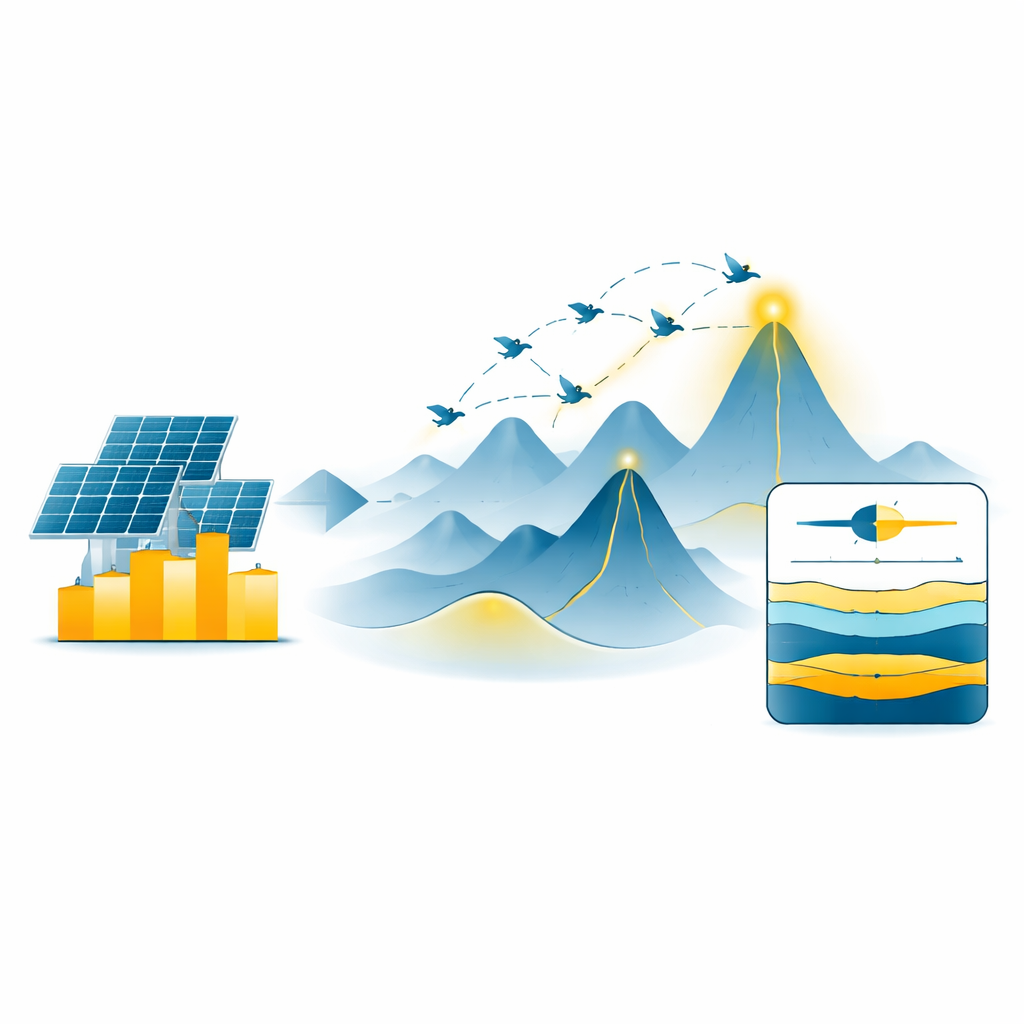
The study introduces a hybrid method called IRBMO-VP&O that blends a new swarm algorithm, based on the hunting habits of red-billed blue magpies, with an improved version of the familiar perturb-and-observe technique. In the first phase, a virtual flock of “magpies” searches widely over the possible operating points of the solar array. Extra features—such as occasional long “flights” and a mechanism that encourages variety within the flock—help the search escape small, misleading peaks and home in on the region of the true global maximum. Once the algorithm gets close enough, control switches to a more careful local adjustment phase that fine-tunes the operating point.
Fine-tuning the final steps
The second part of the hybrid strategy refines the classic perturb-and-observe method. Instead of using a fixed step size when it adjusts the converter that links the panels to the load, it uses a step that shrinks automatically as the system approaches the best operating point. This “exponential decay” in step size allows fast movement at first but gentle nudging near the top of the power hill, reducing the small oscillations that can waste energy. A built-in restart mechanism watches for sudden changes in power that signal a shift in weather or shading; when that happens, the algorithm jumps back into wide exploration mode to locate the new global maximum.
Proving the gains in simulations
The researchers tested their hybrid controller in detailed computer simulations of a medium-size solar array under five different static shading layouts and three dynamic scenarios with abrupt irradiance changes. They compared it with ten competing techniques, including several popular swarm algorithms and widely used traditional methods. Across all static cases, the new approach reached the optimal region in roughly half the time of the other methods on average, while also improving tracking accuracy. In the most complex partial shading pattern, it avoided traps that caught even advanced swarm-based controllers and delivered several hundred watts more power. Under rapidly changing sunlight, it consistently locked onto the new best point in just a few hundredths of a second while maintaining almost perfect accuracy.
What this means for real-world solar power
For non-specialists, the key takeaway is simple: this work shows that smarter, nature-inspired control methods can help solar arrays automatically adjust to patchy and changing light, pulling more energy from the same hardware. By combining a broad, bird-like search with a careful, shrinking-step fine-tune and an automatic restart trigger, the IRBMO-VP&O strategy keeps solar systems close to their true sweet spot instead of settling for second-best. If implemented in real devices, such algorithms could make rooftop and utility-scale solar installations more efficient and reliable, especially in environments where clouds, trees, or buildings frequently cast uneven shadows.
Citation: Wang, X. A photovoltaic maximum power point tracking strategy based on the IRBMO-VP&O algorithm. Sci Rep 16, 12910 (2026). https://doi.org/10.1038/s41598-026-43400-3
Keywords: solar photovoltaics, maximum power point tracking, partial shading, metaheuristic optimization, renewable energy control