Clear Sky Science · en
Hybrid intelligent RSM–ANN modeling and optimization of precision turning of CK45 steel for calibration devices
Sharper Metal for More Reliable Measurements
Whenever a jet engine, medical scanner, or factory robot is checked for accuracy, hidden inside the test setup are metal shafts that must be almost perfectly round and smooth. This study looks at how to machine one such common material, CK45 steel, so that these calibration shafts last longer and give more trustworthy measurements. The researchers combine smart statistics with artificial intelligence to tune the cutting process, squeezing the best possible performance out of both the steel and the cutting tools.

Why This Steel Is So Tricky to Shape
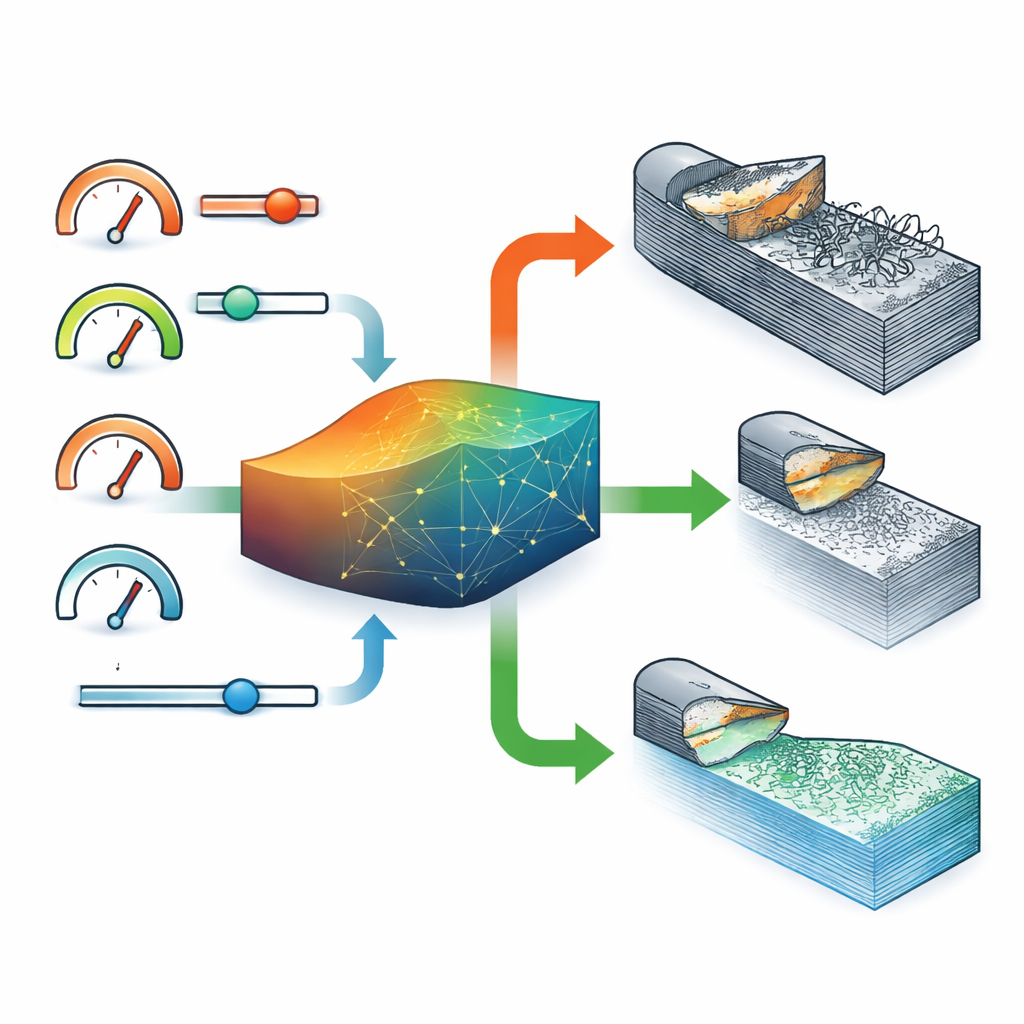
CK45 is a medium‑carbon steel prized for strength and ease of use in many machines, but it becomes challenging when you demand extreme precision. Cutting it with conventional tools can lead to fast tool wear, rough surfaces, and tiny shape errors in the finished shaft. For calibration devices, even micrometer‑scale defects can matter. The team focuses on four knobs a machinist can turn: how fast the workpiece spins, how quickly the tool feeds along the surface, how deep the cut is, and how rounded the tool tip is. Together these control how quickly metal is removed, how rough or smooth the surface becomes, how round the shaft stays, and how much the tool wears away.
Blending Statistics and Artificial Intelligence
To tame this complex problem, the researchers use a hybrid “brains and numbers” strategy. First they apply a statistical approach called response surface methodology, which designs a compact set of experiments and fits smooth mathematical surfaces that relate the four process knobs to outcomes such as material removal rate, surface roughness, tool wear, roundness error, and hardness. On top of this, they train artificial neural networks—computer models inspired by learning in the brain—to capture more tangled, non‑linear behavior that simple equations can miss. The steel shafts are turned on a computer‑controlled lathe using cubic boron nitride cutting inserts, and every trial is carefully measured with microscopes and precision gauges to feed accurate data into both types of models.
Finding the Sweet Spot for Speed, Quality, and Tool Life
Armed with these models, the team searches for cutting conditions that balance several goals at once: remove metal efficiently, keep the surface smooth and round, harden the outer skin of the steel just enough, and minimize tool wear. They discover that spindle speed is the dominant lever: raising it initially improves material removal and surface finish, but pushing it too high overheats the tool and workpiece, increasing wear and roughness. Feed rate and depth of cut have similarly nuanced effects—moderate values help, while extremes cause vibration, unstable chip flow, and shape errors. By combining all responses into a single "desirability" score, they identify an optimal setting: about 3000 revolutions per minute, a medium feed, and a moderate cut depth with a modestly rounded tool tip.
What Happens Inside the Metal and the Tool
The study does not stop at numbers. Under poor cutting conditions, electron microscope images show the steel surface pitted with irregular, coarse dendritic patterns—frozen evidence of uneven heating and deformation. The tool tips accumulate stuck chips and deep grooves, a sign that they are wearing out quickly. Under the optimized conditions, by contrast, the steel’s surface microstructure becomes much more uniform, with fine, evenly spaced dendritic features and no cracks or craters. The cutting inserts remain sharp, showing only tiny, smooth wear marks. The neural‑network models predict these improvements with errors typically under 6%, and the statistical models confirm that the trends are robust rather than random.
Better Shafts, Better Measurements
In plain terms, the authors show that a carefully tuned mix of traditional statistics and machine learning can tell machinists exactly how to cut CK45 steel so that calibration shafts are smoother, rounder, and more durable, while the cutting tools themselves last longer. By tying external performance (how fast metal is removed and how smooth it looks) to internal structure (how the steel’s grains arrange themselves and how the tool erodes), the work provides a recipe for making high‑precision parts that support more reliable measurements in industry and research.
Citation: Farouk, W.M., Ahmed, A.G., Gamil, M. et al. Hybrid intelligent RSM–ANN modeling and optimization of precision turning of CK45 steel for calibration devices. Sci Rep 16, 11358 (2026). https://doi.org/10.1038/s41598-026-43388-w
Keywords: precision turning, CK45 steel, tool wear, surface roughness, neural network optimization