Clear Sky Science · en
Multi-scale experimental and computational assessment of heat transfer behavior in compact short fin structures
Why cooling fins matter in everyday machines
From laptop processors and phone chargers to car engines and power transformers, countless devices quietly rely on metal "fins" to stay cool. These simple-looking protrusions act like heat-radiating fingers, pulling warmth away from hot parts and releasing it into the surrounding air. This study takes a close look at how the shape and material of short, compact fins influence their ability to shed heat, offering practical guidance for designing smaller, more efficient cooling systems used across modern technology. 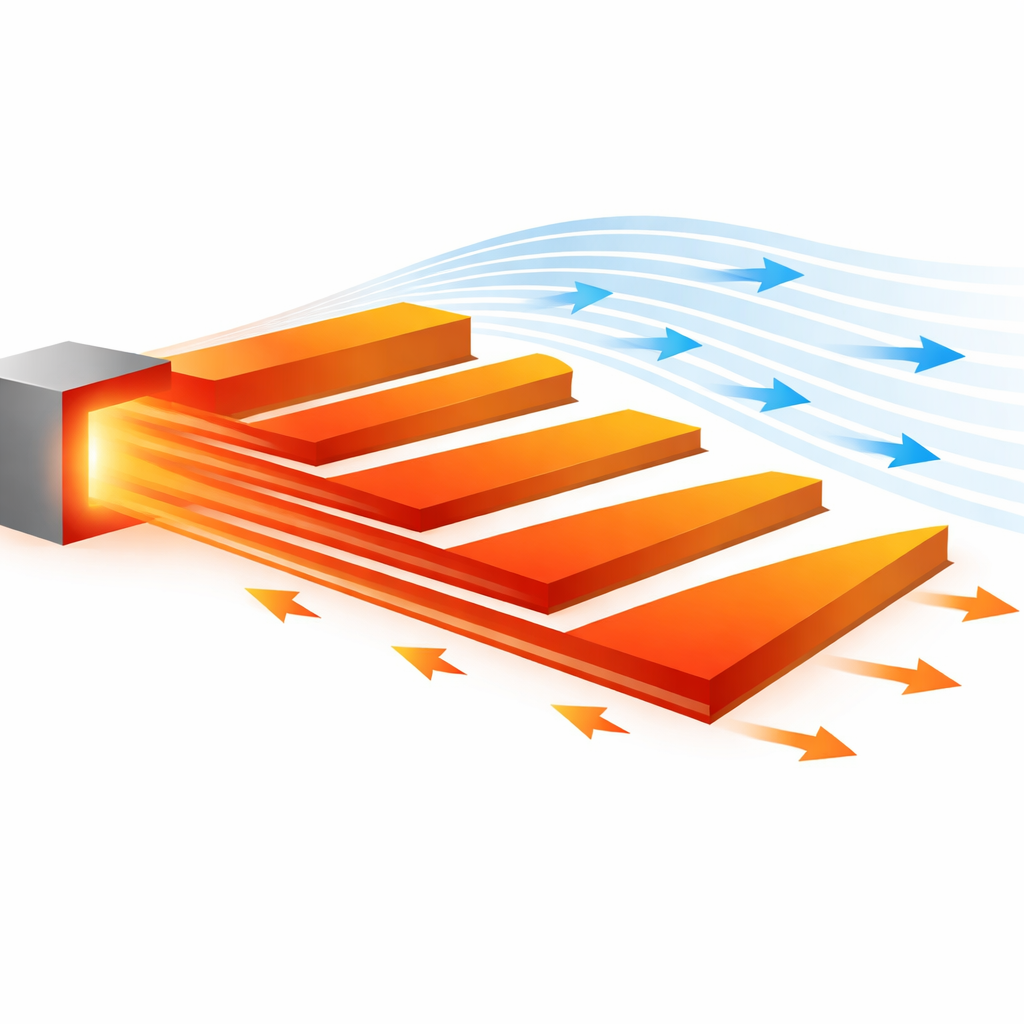
Testing different shapes under the same conditions
The researchers set out to compare how several basic fin shapes perform when everything else is kept the same. They examined short fins with square, circular (round rod), rectangular, trapezoidal, and triangular cross-sections, all attached to a small heat source delivering 30 watts of power. The fins were exposed to still room air, representing natural cooling without fans. Using a combination of experiments, computer simulations, and standard heat-transfer calculations, the team measured how temperature changed from the hot base to the cooler tip, and how much heat each fin could actually remove from the source. This multi-pronged approach allowed them to cross-check results and capture both overall performance and local details of temperature and airflow.
How the fins were built, measured, and modeled
To mimic real-world components, the team constructed a simple test rig: a wooden frame supporting metal fins heated at one end by a small electric soldering iron. Tiny temperature sensors were embedded along the length of the fins to track how quickly they cooled from base to tip. At the same time, engineers built three-dimensional computer models and used finite element analysis to simulate heat conduction through the metal and heat loss to the air. By comparing measured temperatures with those predicted by formulas and simulations, they showed that all three methods agreed within about 15 percent. This gave them confidence to extend the calculations to fin shapes and materials that were not all physically tested in the lab. 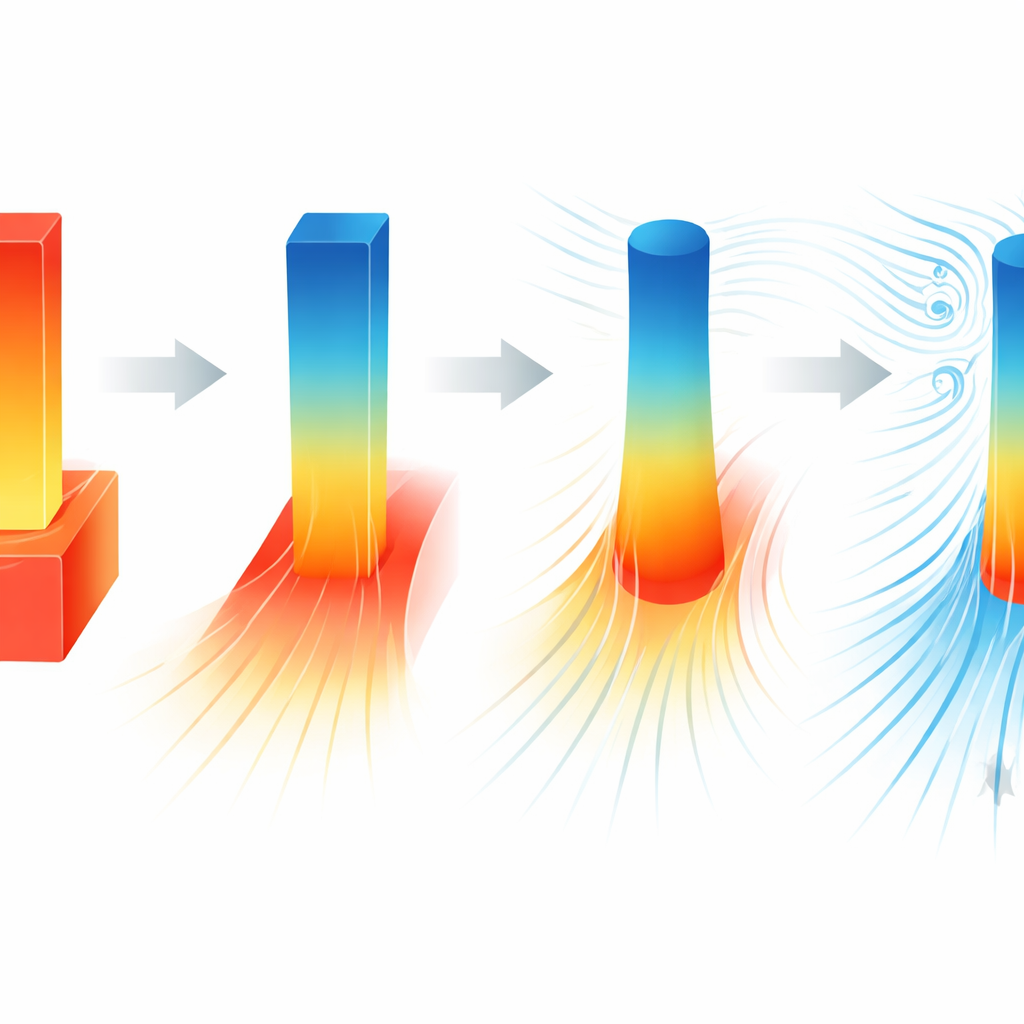
Which shapes and materials cool best
Even though all the fins shared the same length and volume, their outlines strongly affected performance. Square fins showed the highest heat removal and efficiency, closely followed by circular fins. When more shapes were added through theory and simulation, rectangular fins with mild steel emerged as the top performers overall: they provided the greatest heat transfer and effectiveness, meaning they removed much more heat than a flat, un-finned surface of the same base area. Triangular fins, with the least surface area and less favorable airflow, performed worst. The choice of metal mattered as much as shape. Mild steel, with relatively high thermal conductivity among the tested alloys, consistently outperformed stainless steel, cast iron, and titanium. Fins made of mild steel exhibited the lowest thermal resistance—an indicator of how easily heat can flow through the material—while titanium fins resisted heat flow and removed only about half as much heat under the same conditions.
Balancing cooling power with mechanical strength
The study also examined how heat creates internal stresses in the fins as they expand unevenly from base to tip. Square fins cooled well but experienced higher thermal stress, especially at their sharp corners, where expansion is constrained. Circular fins, with smooth, rounded surfaces, showed lower stress and a higher mechanical safety margin, even though they were slightly less effective at shedding heat. The airflow patterns around the fins helped explain these trade-offs. Square and rectangular shapes disturbed the air more strongly, encouraging local mixing and better cooling, but this came at the cost of higher stresses. Circular fins produced smoother airflow and lower stress, making them more robust over repeated heating and cooling cycles, even if they gave up some thermal performance. The researchers also noted that as the surrounding air becomes better at carrying heat away—for example, at higher air speeds—the efficiency and relative advantage of fins diminish because the entire system is already cooling more quickly.
What this means for real devices
In simple terms, this work shows that not all fins are created equal. For compact devices cooled mainly by still air, choosing the right combination of fin shape and metal can make a small heat sink behave like a much larger one. Square and rectangular fins made of mild steel offer the strongest cooling but face higher internal stress, while round fins offer a safer, slightly less powerful alternative. By carefully weighing shape, material, and airflow together, engineers can design smaller, lighter, and more reliable heat sinks for electronics, energy storage systems, and other equipment—keeping everyday technology cooler and more dependable without the need for bulky fans or complex cooling hardware.
Citation: Salins, S.S., Kuttiatoor, A.P., Pramod, G. et al. Multi-scale experimental and computational assessment of heat transfer behavior in compact short fin structures. Sci Rep 16, 13119 (2026). https://doi.org/10.1038/s41598-026-43375-1
Keywords: heat sinks, cooling fins, thermal management, natural convection, electronics cooling