Clear Sky Science · en
Novel soluble bazedoxifene formulation gains antiproliferative and migrastatic effect in squamous cell carcinoma cells
Why a bone drug might help stop skin cancer spread
Drugs do not always stay in the boxes they were first designed for. This study takes bazedoxifene, a medicine originally used to protect bones after menopause, and reshapes it into a new, water‑soluble form aimed at slowing a dangerous type of skin cancer called squamous cell carcinoma. By making the drug easier to dissolve and deliver, the researchers show it can strongly curb tumor cell growth and movement in the lab, hinting at a new way to keep cancers from spreading.

A key alarm signal that cancers learn to exploit
Our bodies use a messenger molecule called IL‑6 to rally the immune system and coordinate responses to injury and infection. Many tumors, including squamous cell carcinomas of the skin and head and neck, hijack this same signal to fuel their own survival. Cancer cells and their surrounding support cells can bathe the tumor in IL‑6, which switches on an internal relay protein called STAT3 that boosts cell division, keeps cells in a less mature state, and encourages them to invade nearby tissue and form metastases. High IL‑6 levels in patients often track with more advanced disease and poorer outcomes, making this pathway an attractive—but so far frustrating—target for treatment.
Re‑engineering a familiar pill into a soluble cancer blocker
Bazedoxifene can latch onto part of the IL‑6 receptor machinery and dampen this growth signal, but it comes with a major practical drawback: it barely dissolves in water. That makes it hard to give by injection or infusion, which are often needed for cancer therapy. The team solved this by tucking bazedoxifene into a donut‑shaped sugar molecule called SBECD, commonly used in medicines to help oily drugs dissolve. Using X‑ray diffraction, heat‑scanning techniques, and advanced NMR spectroscopy, they confirmed that bazedoxifene sits snugly inside the SBECD ring as a so‑called inclusion complex. This new powder, named BAZE‑X1, increased the drug’s solubility about 70‑fold, turning an almost insoluble compound into something readily dissolved in water.
Dialing down the cancer growth switch without killing healthy cells
The researchers then tested how BAZE‑X1 behaved in human cancer cell lines from squamous cell carcinomas and in non‑cancerous skin cells. At doses relevant for treatment, the new formulation did not show outright toxicity: standard metabolic tests and a live/dead staining method revealed that most cells remained alive after exposure, especially in the first day. Yet the same doses significantly slowed cell division over several days. Looking inside the cells, the team found that BAZE‑X1 reduced the amount of STAT3 that entered the nucleus in a switched‑on, phosphorylated form, even when extra IL‑6 was added. This indicates that the drug is successfully interrupting the IL‑6 signal rather than simply poisoning the cells. When compared with tocilizumab, an antibody drug already used in the clinic to block IL‑6 receptors, BAZE‑X1 was more effective at restraining cancer cell proliferation under the same conditions.
Stopping cancer cells from wandering and forming new colonies
Cancer becomes truly life‑threatening when cells loosen from the main tumor, migrate through tissue, and seed new growths elsewhere. To probe this, the team measured how squamous cancer cells moved in flat “scratch” tests and within soft 3D gels that better resemble body tissue. In one cell line, low doses of BAZE‑X1 cut surface migration roughly in half, especially when IL‑6 was present. More strikingly, in 3D gels all tested cancer types showed much less outward spread when treated, even at modest concentrations. BAZE‑X1 also sharply reduced the ability of SCC13 cancer cells to form colonies from single cells—a laboratory stand‑in for the capacity to establish new metastatic sites. At higher doses, colony formation was almost completely abolished, and adding extra IL‑6 could no longer rescue it.
A potential new class of “migration‑stopping” cancer medicines
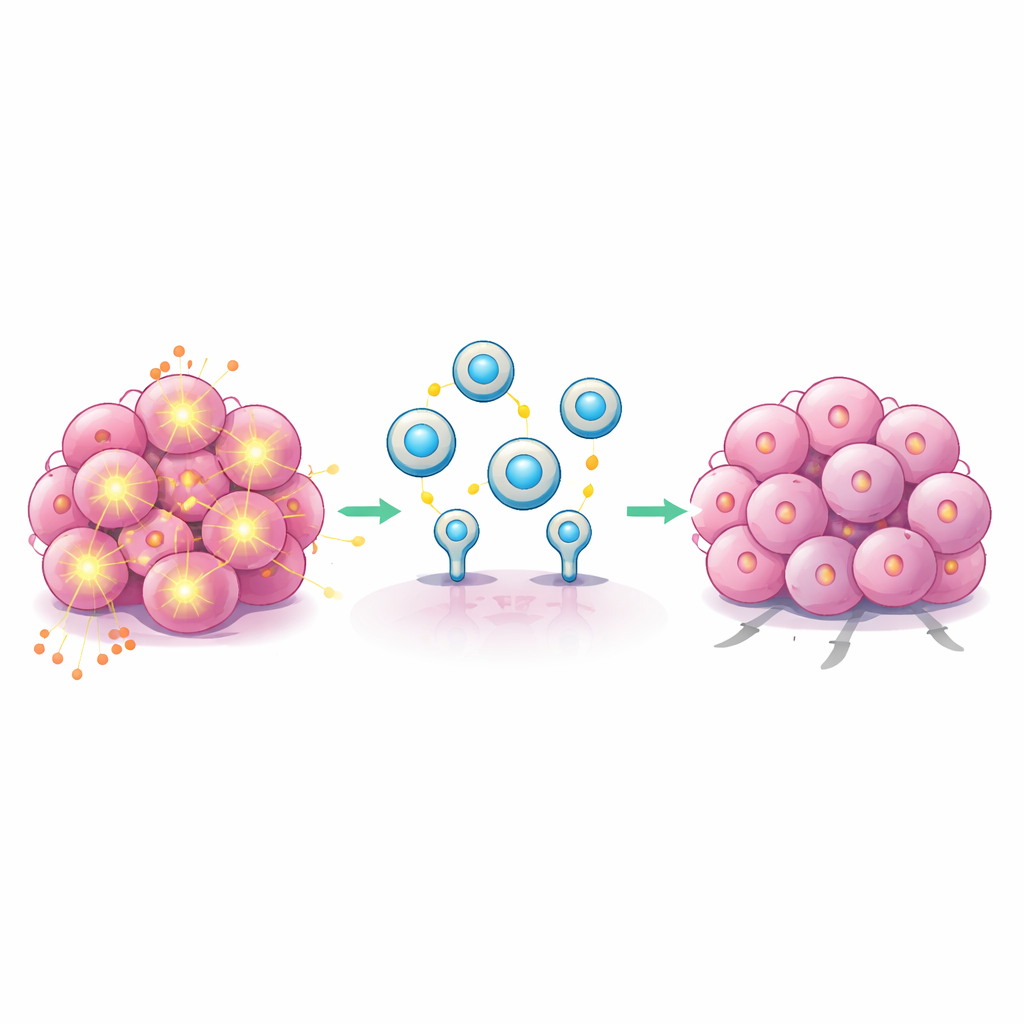
Taken together, the results paint BAZE‑X1 as a promising “migrastatic” candidate—a drug that aims not just to shrink tumors, but to stop cancer cells from spreading in the first place. By marrying a known molecule that interferes with IL‑6 signaling to a clever solubility‑boosting carrier, the researchers created a formulation that is potent against squamous cell carcinoma cells, gentler on normal skin cells, and far more practical for injection. While these findings come from laboratory systems and will need to be tested in animals and eventually people, they suggest that a repurposed, reformulated bone drug could one day help keep aggressive skin cancers from growing and metastasizing.
Citation: Lacina, L., Kejík, Z., Pacák, T. et al. Novel soluble bazedoxifene formulation gains antiproliferative and migrastatic effect in squamous cell carcinoma cells. Sci Rep 16, 13743 (2026). https://doi.org/10.1038/s41598-026-43364-4
Keywords: squamous cell carcinoma, IL-6 signaling, bazedoxifene, drug repurposing, cancer cell migration