Clear Sky Science · en
A dual-band four-port MIMO antenna with a partial ground plane for n257/n260/n261 band applications
Why faster wireless needs smarter antennas
Streaming high‑resolution video, immersive virtual reality, and swarms of tiny sensors all depend on next‑generation 5G networks, especially at millimeter‑wave frequencies where vast new slices of spectrum are available. But using these very high radio frequencies reliably is tricky: signals fade quickly and antennas must be both compact and capable of handling many data streams at once. This paper presents a new antenna design that tackles these challenges, aiming to make future phones, gadgets, and connected machines talk to each other faster and more reliably.

A small antenna built for big 5G demands
The researchers introduce a compact antenna module, only 28 millimeters on a side and thinner than a credit card, tailored for 5G "FR2" millimeter‑wave bands around 28 and 38 gigahertz. These two bands—known in standards language as n257/n261 and n260—are especially attractive because they offer wide bandwidth and relatively low atmospheric loss compared with even higher‑frequency channels. Instead of a single antenna, the module contains four tiny radiating elements working together as a multiple‑input multiple‑output (MIMO) system. This arrangement supports several independent data streams at once, boosting capacity and reliability without increasing the device’s footprint.
How the building block antenna works
Each of the four elements starts from a simple metal rectangle that radiates radio waves. To make this single piece work efficiently at two distinct frequency bands, the authors carve specific slot shapes into it—one shaped like an "H" and another like an upside‑down "T"—and pair it with a ground conductor that covers only part of the back of the circuit board. The partial backing changes how electrical currents flow, letting one path dominate at the lower band and another at the higher band, while the slots fine‑tune the two resonances. Through step‑by‑step computer simulations, the team shows how these modifications shift and split the antenna’s natural frequencies until it operates cleanly around both 28 and 38 gigahertz.
Arranging four elements without letting them fight
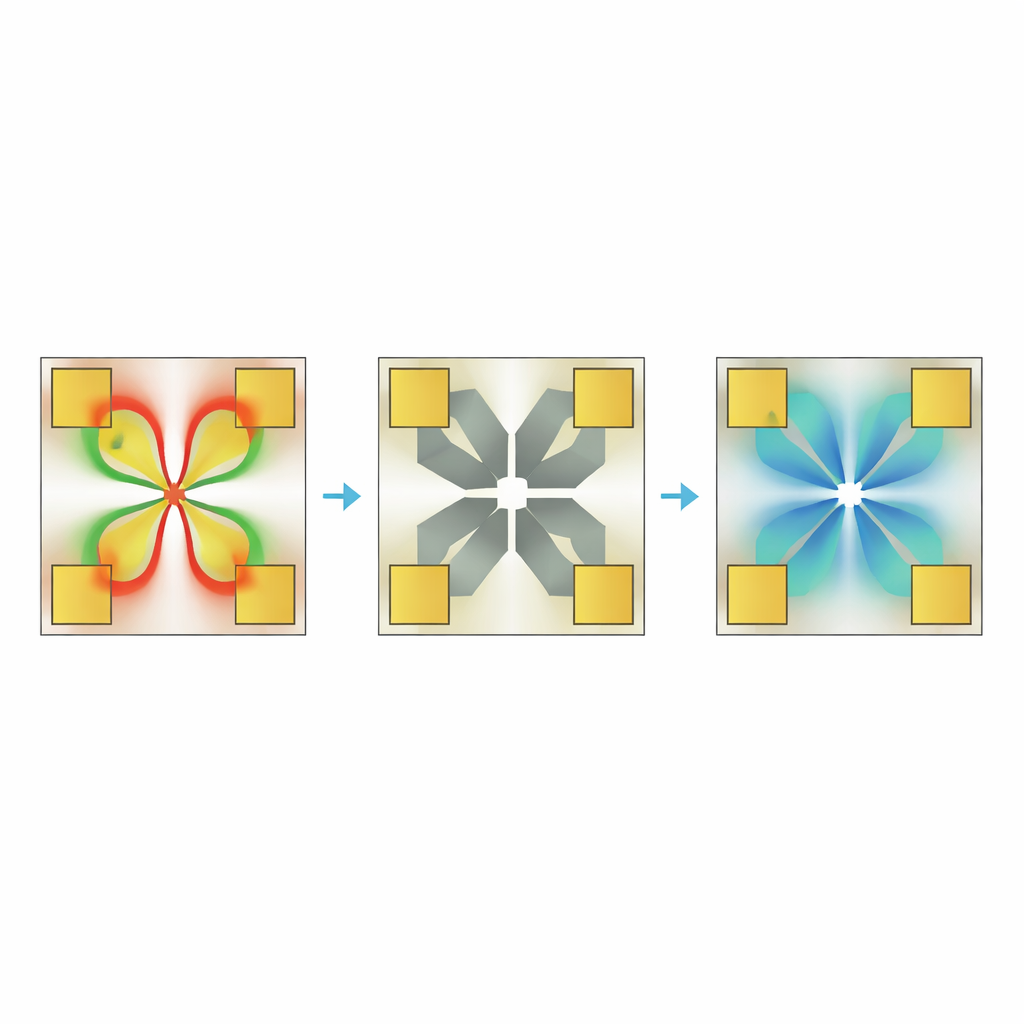
To form the full module, the four dual‑band elements are rotated so that they face different directions and placed around the center of the square board. This orthogonal arrangement already helps keep them from interfering with one another, a key requirement for MIMO systems. However, when one element transmits, currents can still leak through the shared ground area and disturb its neighbors. To counter this, the designers connect the partial ground regions and extend thin metal strips inward from each side, creating a central plus‑shaped structure. This shape redirects and cancels some of the unwanted currents, raising the electrical "firewall" between ports while preserving the desired radiation in free space.
Putting the design to the test
After optimizing dimensions in simulation, the team fabricates the antenna on a low‑loss microwave circuit material and measures it using precision instruments and anechoic test chambers. The prototype covers about 2.6 to 2.9 gigahertz of bandwidth around 28 gigahertz and a similar spread around 38 gigahertz—wider than many comparable designs—while keeping the signal leakage between any pair of ports typically better than 23 to 27 decibels. Radiation tests show peak gains of about 6.4 and 8.5 decibels in the lower and upper bands, with efficiencies over 75 percent. Additional analyses of key MIMO metrics, such as how independent the antenna signals are and how much overall data capacity is lost, confirm that the module behaves almost ideally across both bands.
What this means for everyday connectivity
In simple terms, the authors have engineered a very small, dual‑band antenna module that can send and receive several high‑frequency data streams at once without those streams getting in each other’s way. By cleverly shaping both the radiating metal and the shared backing, especially through the central plus‑shaped feature, they achieve strong isolation, wide usable bandwidth, and good efficiency at two key 5G millimeter‑wave bands. This kind of compact, high‑performance building block is well suited for future smartphones, vehicles, and IoT devices, helping 5G networks deliver the high data rates and low delays that advanced applications demand.
Citation: Gautam, P.K., Srivastava, G., Jhariya, D.K. et al. A dual-band four-port MIMO antenna with a partial ground plane for n257/n260/n261 band applications. Sci Rep 16, 13122 (2026). https://doi.org/10.1038/s41598-026-43355-5
Keywords: 5G millimeter-wave, MIMO antenna, dual-band, millimeter-wave isolation, wireless communication hardware
See more on the researcher's website: https://sites.google.com/view/sachink/home?authuser=3