Clear Sky Science · en
Deep learning analysis for enhanced prediction of heat transfer in Maxwell hybrid nanofluids with non-Fourier law and radiation effects
Turning Fluids into Smarter Heat Carriers
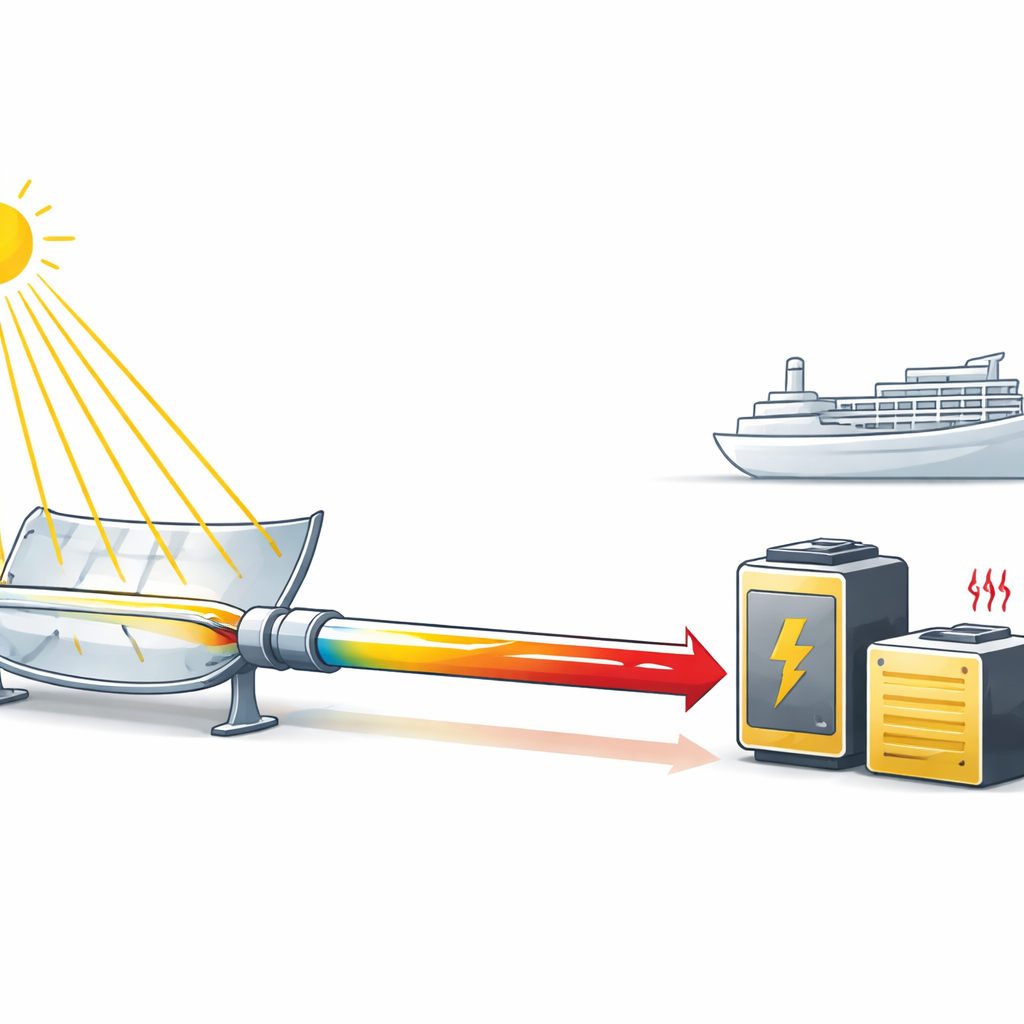
Modern technologies—from solar-powered ships to compact electronics—depend on moving heat quickly and safely. Conventional oils and coolants often struggle to keep up as systems become smaller and more powerful. This paper explores how mixing tiny solid particles into ordinary engine oil, and then using artificial intelligence to predict their behavior, can create smarter fluids that move heat more efficiently while being fast to model on a computer.
What Makes These Fluids Special
The study focuses on so‑called hybrid nanofluids: ordinary engine oil enriched with two kinds of carbon nanotubes and magnetic oxide particles. These nanoscale additives act like heat highways embedded in the liquid, giving it much better ability to conduct heat than the base oil alone. The authors consider these fluids flowing over a surface that either stretches or shrinks, a standard way to model how liquids behave near hot walls, coatings, or solar-collector tubes. They also include the influence of a magnetic field and thermal radiation, both of which can be important in high-temperature and electrically conducting environments such as solar receivers and marine energy systems.
A More Realistic View of Heat Travel
Most heat-transfer calculations assume that changes in temperature spread instantly through a material, an approximation known as Fourier’s law. While convenient, this implies that heat moves at infinite speed—physically impossible, especially when dealing with very fast processes or structured materials like nanofluids. To fix this, the authors adopt the Cattaneo–Christov heat flux model, which builds in a small but finite delay between a temperature change and the resulting heat flow. This leads to wave‑like propagation of heat rather than instantaneous smoothing, and it can significantly alter temperature distributions in the boundary layer of fluid near a hot surface.
Simulating a Complex Flow
To describe the motion and heating of the hybrid nanofluid, the team starts from the standard conservation equations for mass, momentum, and energy, then tailors them to a special kind of viscoelastic liquid known as a Maxwell fluid. Similarity transformations reduce the original partial differential equations to a set of ordinary differential equations, which are solved numerically with a high-accuracy boundary‑value solver in MATLAB. The authors systematically vary key dimensionless parameters, including magnetic field strength, thermal radiation, Biot number (which compares internal to surface heat flow), velocity slip at the wall, suction or blowing through the surface, and strength of internal heat sources or sinks. They find that stronger magnetic fields slow the fluid down, thermal radiation and larger Biot numbers thicken the thermal boundary layer and enhance heat uptake, and hybrid nanofluids consistently outperform single‑particle nanofluids in moving heat.
Letting a Neural Network Learn the Physics
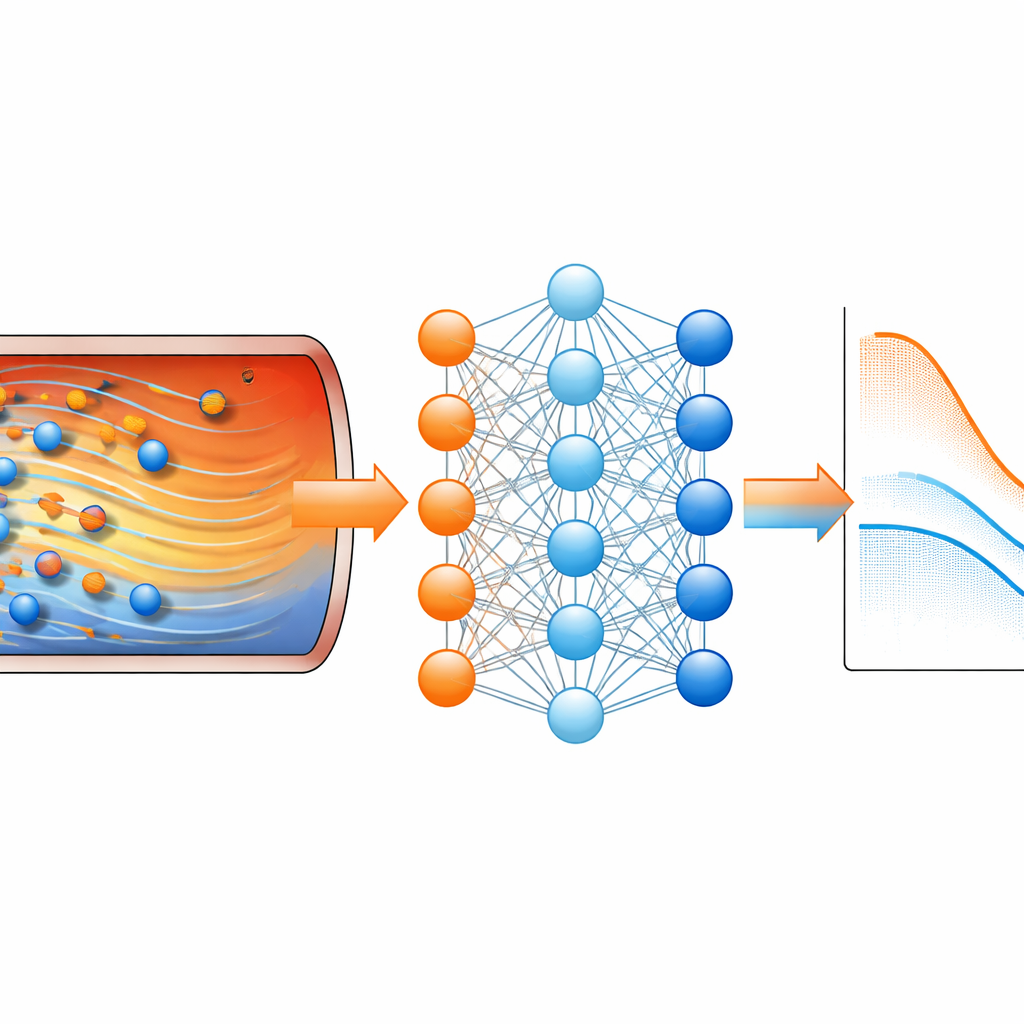
Solving these equations repeatedly for many parameter combinations is computationally demanding, especially if engineers want to explore designs or run real‑time controls. To address this, the authors train an artificial neural network to act as a surrogate model. They feed the network with thousands of high‑fidelity solutions from the numerical solver, using the dimensionless position in the boundary layer and physical parameters as inputs, and the resulting velocity gradient and temperature profile as outputs. A multilayer perceptron with two hidden layers is trained using the Levenberg–Marquardt optimization algorithm. The network reproduces the numerical results with extremely small errors—mean squared errors around 10⁻¹¹–10⁻¹² and correlation coefficients effectively equal to one—indicating that it has captured the underlying nonlinear relationships very accurately.
Why the Results Matter
For practical systems such as solar‑powered marine vessels, parabolic trough solar collectors, or advanced lubricants in engines, these findings point toward fluids that can both absorb more heat and be predicted rapidly by compact AI models. The hybrid nanofluids studied here show stronger thermal performance than simpler mixtures, while the non‑Fourier model gives a more realistic picture of how heat actually propagates. By demonstrating that a trained neural network can stand in for heavy numerical calculations without losing accuracy, the work offers a pathway to quicker design, optimization, and control of complex thermal systems in which every degree of temperature and every watt of wasted energy counts.
Citation: Alsaiar, N.S., Imran, M., Rukhsar, M. et al. Deep learning analysis for enhanced prediction of heat transfer in Maxwell hybrid nanofluids with non-Fourier law and radiation effects. Sci Rep 16, 13926 (2026). https://doi.org/10.1038/s41598-026-43327-9
Keywords: hybrid nanofluid, heat transfer, solar thermal systems, artificial neural network, non-Fourier conduction