Clear Sky Science · en
Modified protein selection strategy based on Escherichia coli’s Hitchhiker transport and validation through selection of nanobodies targeting bovine interferon gamma
Why tiny antibodies and cow health matter
Bovine tuberculosis is a contagious disease that threatens both cattle herds and the people who depend on them for food and income. Detecting infection early is crucial, but current blood tests rely on conventional antibodies and imported kits that are expensive and slow to obtain in many countries. This study describes a way to discover a newer class of “mini-antibodies,” called nanobodies, using bacteria and yeast instead of animals or costly equipment. The work not only delivers nanobodies that recognize a key immune signal from cows, bovine interferon gamma, but also upgrades a bacterial selection method so it becomes more accurate, scalable, and suitable for laboratories with limited resources.
From traditional antibodies to tiny workhorses
Conventional antibodies are powerful tools for diagnostics and therapy, but they are large, complex molecules that usually must be raised in animals. That makes them expensive, time-consuming, and dependent on specialized animal facilities. Nanobodies, which come from the unusual heavy-chain antibodies of camels and llamas, shrink the binding part of an antibody down to a single, compact domain. Despite their small size, nanobodies can be highly specific and stable, are easier to engineer, and can be produced cheaply in bacteria. The challenge is how to sift through huge numbers of potential nanobody sequences to find those that bind tightly and specifically to a chosen target protein.
Building a smarter bacterial selection engine
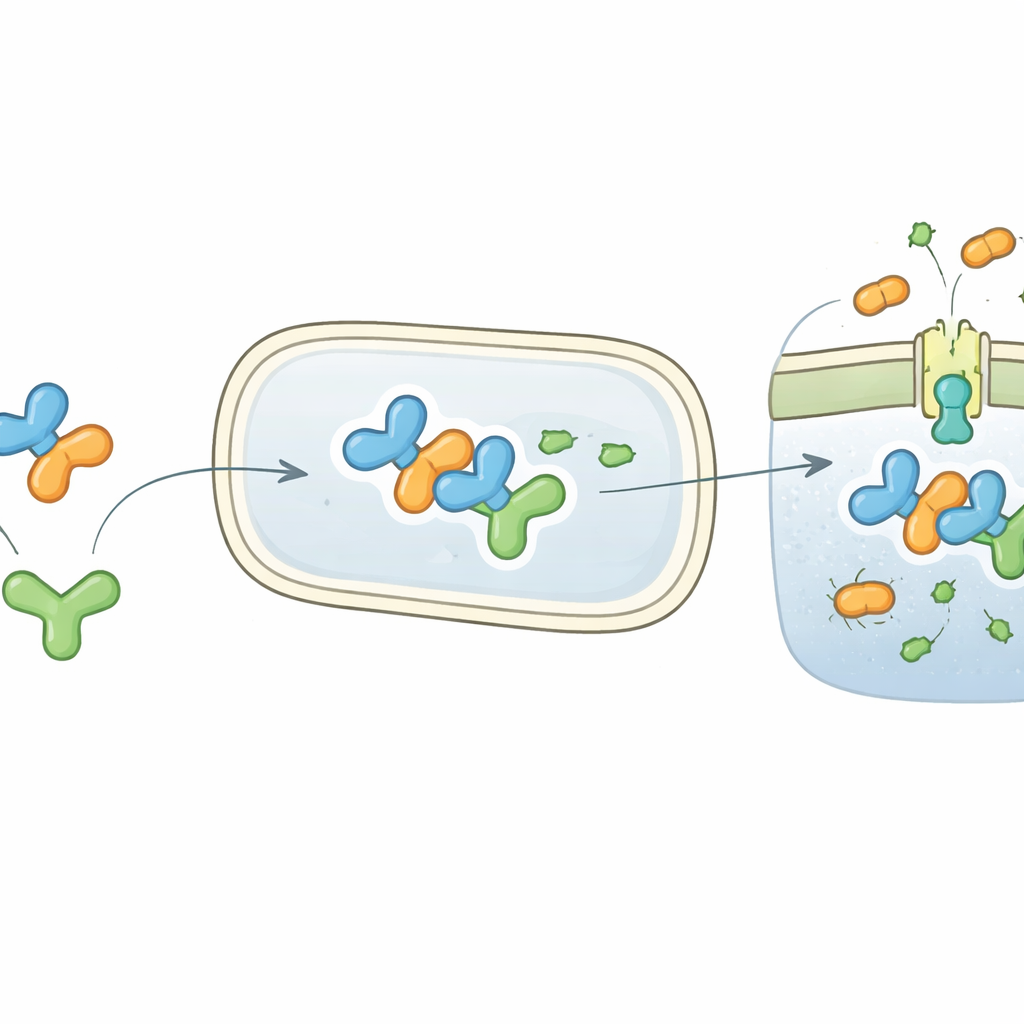
The authors improved an existing system called FLI-TRAP, which turns the natural “hitchhiker” transport pathway of Escherichia coli into a live screening platform for binding proteins. In FLI-TRAP, a candidate nanobody is fused to a signal peptide that can drag along any binding partner as it is moved from the bacterial cytoplasm to the periplasm, a compartment just outside the inner membrane. The target protein is fused to a β-lactamase enzyme that destroys β-lactam antibiotics. When a nanobody binds its target, the pair is co-transported, the enzyme reaches the periplasm, and the cell survives on antibiotic-containing plates. The stronger and more soluble the interaction, the better the survival. Earlier versions of FLI-TRAP either produced too little target protein or were vulnerable to “false positives,” where cloning errors created shortcut fusions that conferred antibiotic resistance even without real nanobody–target binding.
Cleaning up false positives and boosting real binders
To solve these issues, the team redesigned the “bicistronic” plasmid that expresses both the nanobody and the target-enzyme fusion. They reversed the order of the protein genes and adjusted ribosome binding sites so that the bovine interferon gamma–β-lactamase fusion is made efficiently from the first position, while the nanobody fusion is made from the second. This layout makes it far less likely that simple DNA insertions or deletions will create a direct signal peptide–enzyme fusion that bypasses the need for nanobody binding. The authors confirmed that the new construct produces abundant, soluble target fusion, unlike the low-yield monocistronic version. When they compared the original and improved systems, only the new design successfully yielded true nanobody binders to bovine interferon gamma rather than artifacts arising from genetic mishaps.
Finding and testing nanobodies against a key tuberculosis marker
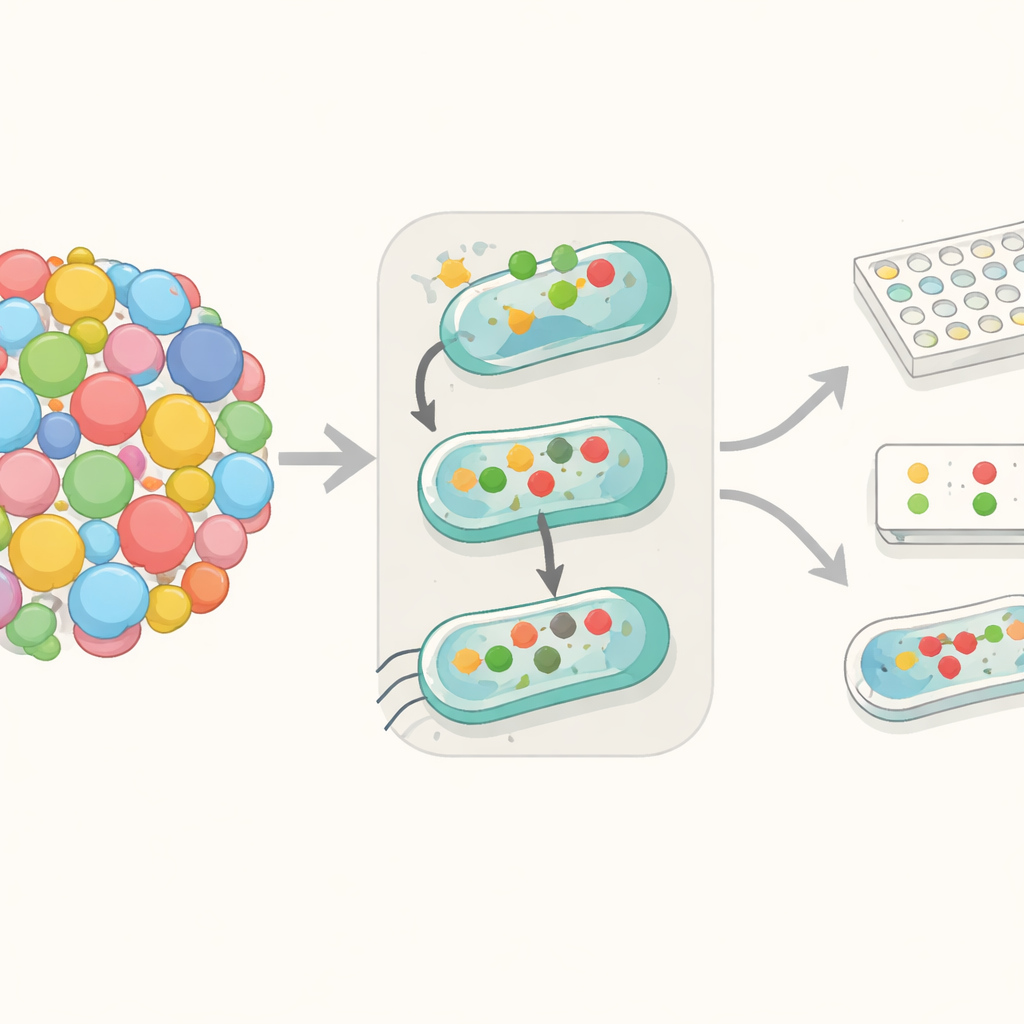
As a real-world test, the researchers set their sights on bovine interferon gamma, an immune messenger routinely measured in blood-based assays for bovine tuberculosis. They began with a large, fully synthetic nanobody library displayed on the surface of yeast cells, where only the antigen-binding loops vary while the structural framework is conserved. A single round of magnetic-activated cell sorting enriched yeast cells whose displayed nanobodies could latch onto bovine interferon gamma, trimming the library down to a smaller, focused set. The genes from this enriched pool were then moved into E. coli and subjected to selection with the improved FLI-TRAP system on antibiotic plates. Out of the resulting colonies, the team identified four distinct, full-length nanobodies. Two of them, named B7 and N5, showed particularly strong and specific binding in enzyme-linked assays under optimized pH conditions and exhibited low cross-reactivity with unrelated proteins.
Toward affordable tests for farmers and vets
Detailed biophysical measurements revealed that B7 binds bovine interferon gamma with nanomolar affinity, while N5 shows somewhat weaker binding but still falls within a useful range for diagnostics. Importantly, B7 also demonstrated very low “polyreactivity,” meaning it is unlikely to stick nonspecifically to other components in blood, and it performed nearly as well as the commercial antibody reagent used in the widely adopted BOVIGAM tuberculosis test when detecting interferon gamma in stimulated bovine plasma. Together, these results show that the upgraded FLI-TRAP platform, combined with an initial yeast-based enrichment step, can reliably deliver high-quality nanobodies using only microbial cultures, antibiotics, magnets, and standard molecular biology tools. For a lay audience, the take-home message is that the authors have refined a bacterial selection engine that turns living cells into tiny test benches for antibody discovery, opening the door to cheaper, locally produced diagnostic kits for diseases like bovine tuberculosis, especially in regions where cost and infrastructure are major barriers.
Citation: Sirimanakul, S., Hurley, J.D., Thaiprayoon, A. et al. Modified protein selection strategy based on Escherichia coli’s Hitchhiker transport and validation through selection of nanobodies targeting bovine interferon gamma. Sci Rep 16, 13450 (2026). https://doi.org/10.1038/s41598-026-43280-7
Keywords: nanobodies, bovine tuberculosis, bovine interferon gamma, E. coli hitchhiker transport, low-cost diagnostics