Clear Sky Science · en
Intrinsic capacity trajectory and hip fracture risk in Chinese middle-aged and older adults: a 10-year retrospective cohort study
Why staying strong inside matters as we age
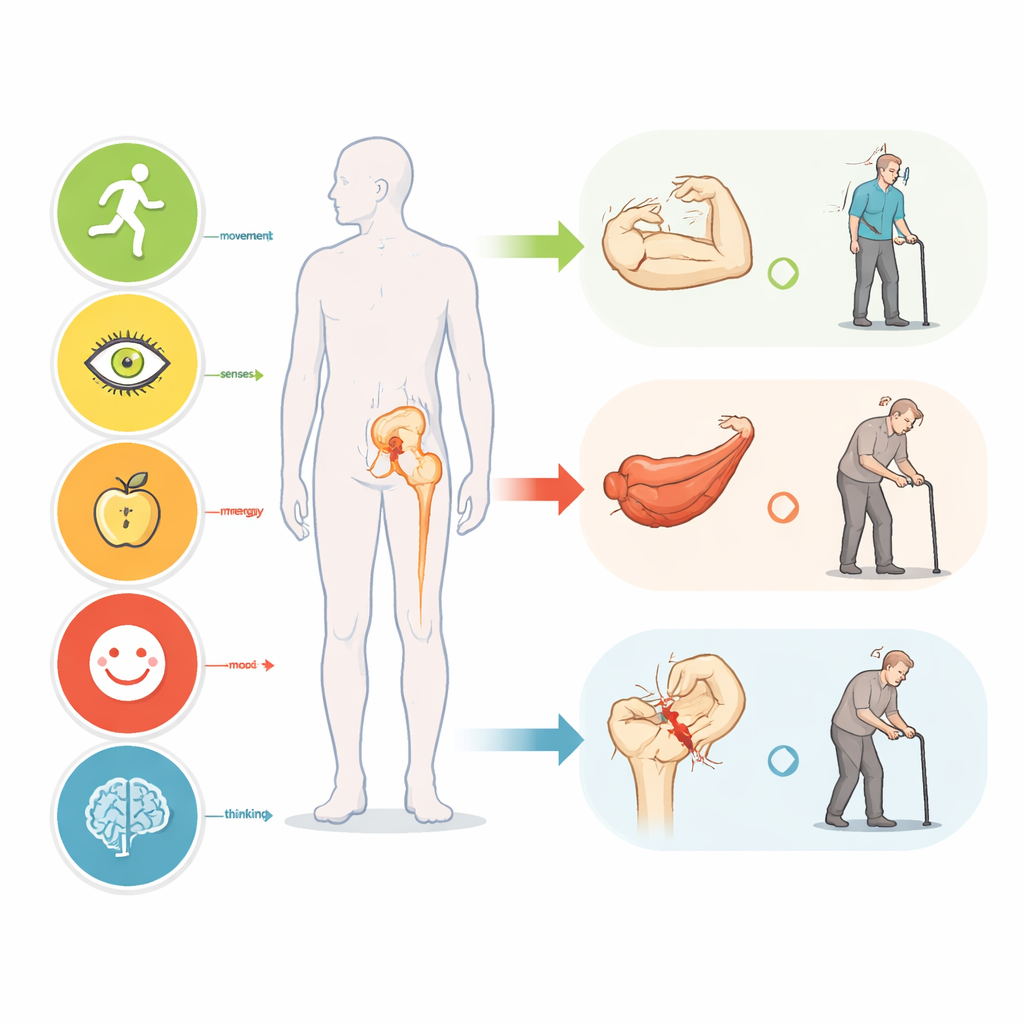
As people grow older, staying independent often depends on more than just strong bones. This study followed over ten thousand middle-aged and older adults in China for a decade to explore how their overall physical and mental abilities, taken together, shaped their chances of suffering a hip fracture—a serious injury that can rob people of mobility and even shorten life. Instead of looking at a single risk factor like bone density, the researchers examined a broader idea called "intrinsic capacity," which bundles movement, senses, energy, mood, and thinking into one picture of how well the body and mind are holding up over time.
A growing problem for older adults worldwide
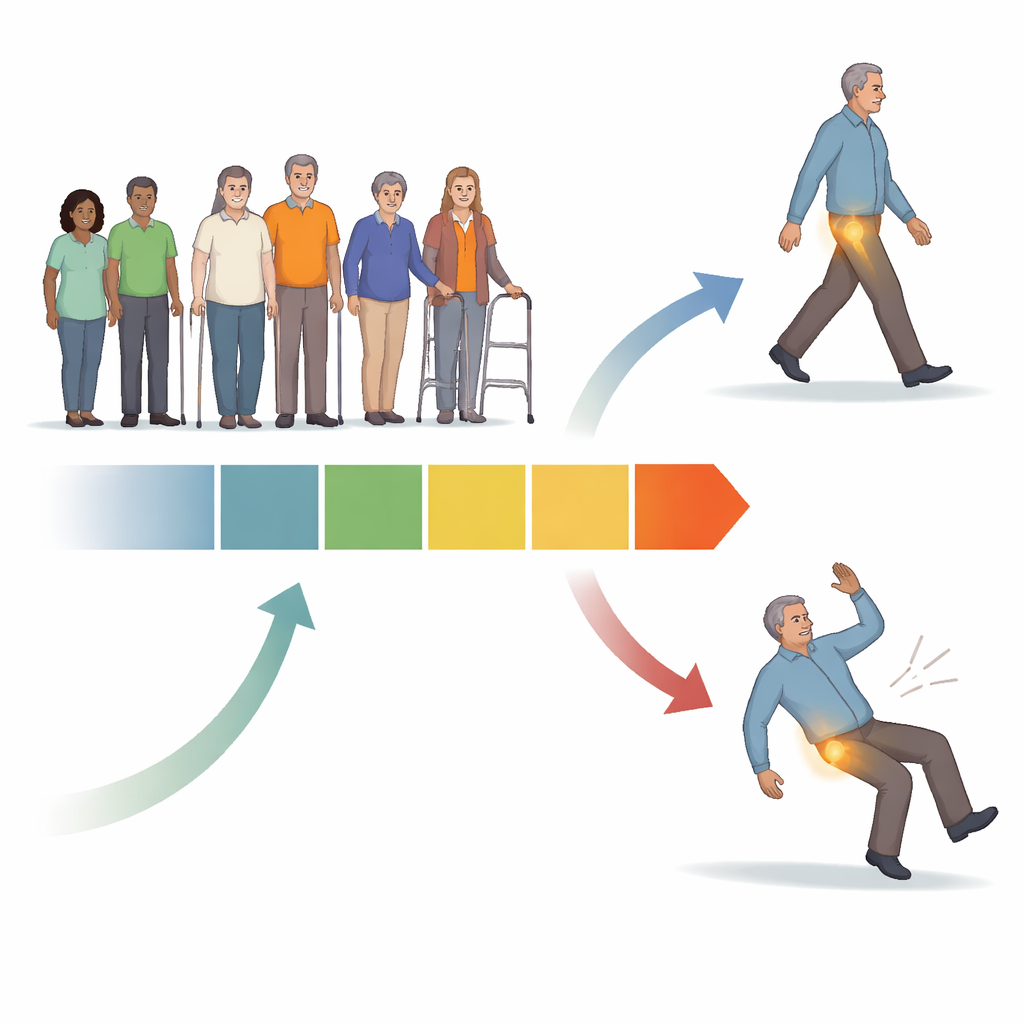
Hip fractures are already a major global health burden and are expected to rise sharply as populations age. They cause pain, disability, loss of independence, and high medical costs. Most research has focused on specific pieces of the puzzle—such as weak muscles, poor balance, or low bone density. The World Health Organization has proposed a more holistic view of healthy aging, centered on intrinsic capacity: the sum of what a person can do physically and mentally at any given time. This study asked whether people’s long-term patterns of intrinsic capacity could help explain who is most likely to suffer a hip fracture, and whether tracking those patterns could guide earlier, more tailored prevention.
Taking the long view of body and mind
The researchers used data from the China Health and Retirement Longitudinal Study, which regularly interviews and tests adults aged 45 and older all over China. More than 10,000 participants without a previous fracture were followed from 2011 to 2020. Intrinsic capacity was scored from 0 to 10 by combining five areas: how well people could move, how good their vision and hearing were, their physical energy and strength, their mood, and their thinking skills. These scores were measured at three time points between 2011 and 2015. The team then tracked who reported a hip fracture up to 2020 and used statistical models to link different capacity patterns to later fracture risk, while taking into account age, sex, education, smoking, drinking, chronic illness, and self-rated health.
Four paths of aging and their fracture risks
When the scientists grouped people by how their intrinsic capacity changed over time, four clear paths emerged. One group, about 15 percent of participants, started with relatively high capacity and stayed stable. Nearly half of the sample had a moderate but stable level. About one-third began at a moderate level but declined over time, and a small group—around 4 percent—started low and declined further. Over roughly eight years of follow-up, 4 percent of all participants experienced a hip fracture. Each single-point increase in baseline capacity score was linked to a 14 percent lower risk of fracture. Compared with the high-stable group, those in the moderate-stable, moderate-declining, and low-declining paths all had substantially higher risks—roughly two-and-a-half to three-and-a-half times as likely to fracture a hip, even after adjusting for other factors.
What ties inner reserves to broken bones
The study suggests that intrinsic capacity captures the combined “reserve” of many body systems that together influence falls and fracture risk. Good movement skills and muscle strength help people avoid falls; clear vision and hearing make it easier to detect hazards; energy and good nutrition support strong muscles and bones; sound thinking aids judgment and safe navigation; and stable mood encourages physical activity and self-care. When several of these areas falter at once or gradually worsen, people become more likely to fall, less able to protect themselves, and more vulnerable to serious breaks when they do. The findings held across many subgroups—men and women, younger and older participants, rural and urban residents—suggesting the pattern is robust.
Turning early warning into prevention
For a layperson, the key message is that hip fractures are not just about brittle bones; they reflect a broader weakening of the whole person over time. People who maintain stronger abilities across movement, senses, energy, mood, and thinking—and keep those abilities from slipping—are much less likely to break a hip. The authors argue that simple, repeated checks of intrinsic capacity in clinics or community screenings could flag older adults whose abilities are drifting downward long before a fracture occurs. Those individuals could then be offered targeted help, such as exercise programs, vision or hearing care, nutrition support, mood and memory care, and fall-proofing of the home. Although this study cannot prove cause and effect, it strongly supports the idea that protecting our overall inner reserves may be one of the most powerful ways to prevent devastating hip fractures in later life.
Citation: Yuan, Y., Wang, Y., Xu, H. et al. Intrinsic capacity trajectory and hip fracture risk in Chinese middle-aged and older adults: a 10-year retrospective cohort study. Sci Rep 16, 13750 (2026). https://doi.org/10.1038/s41598-026-43255-8
Keywords: healthy aging, hip fractures, intrinsic capacity, fall prevention, older adults