Clear Sky Science · en
Structure and air permeability of polyamide and polyester parachute fabrics
Why the Fabric Above Your Head Matters
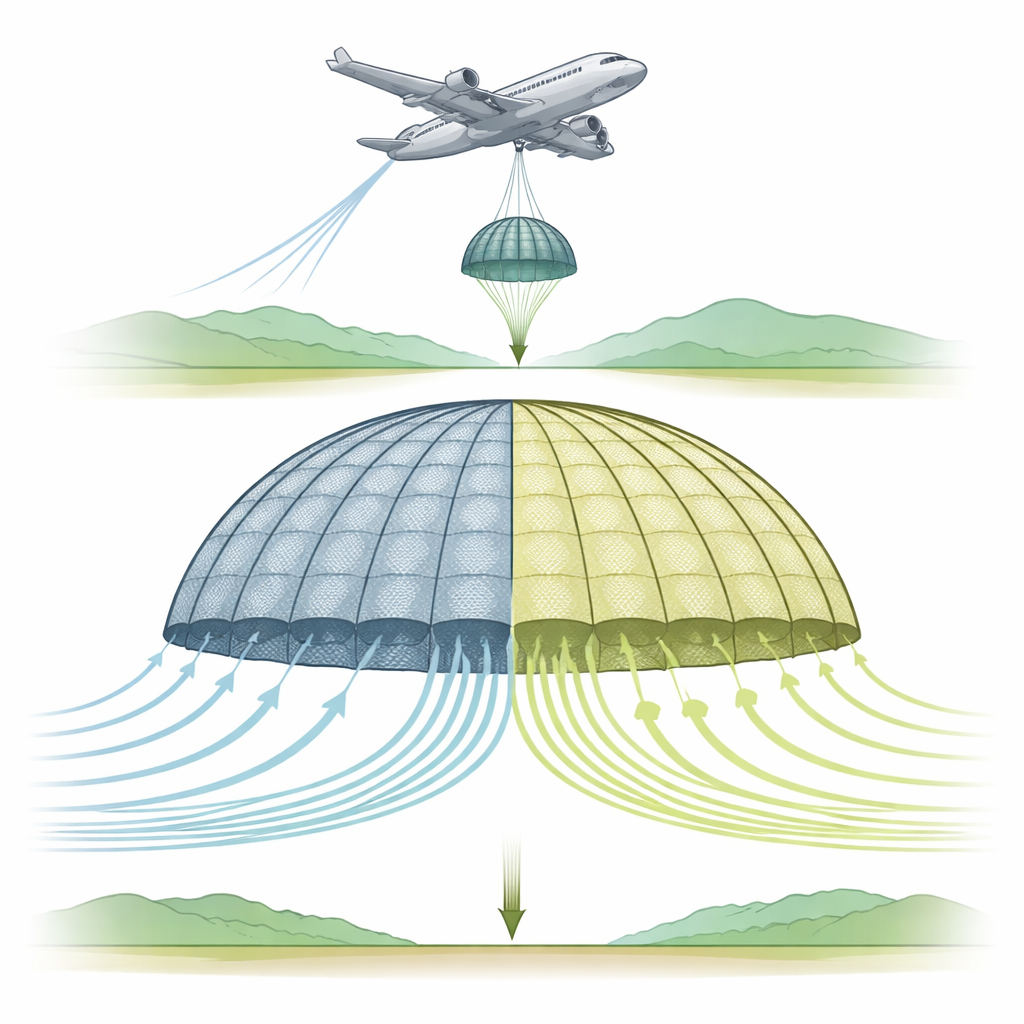
When a parachute opens, your life literally hangs by a web of ultrathin threads. Those threads must unfold in a split second, survive violent forces, and still let just the right amount of air leak through so the canopy stays stable instead of fluttering or collapsing. This study looks closely at the special fabrics used in modern sport and rescue parachutes, comparing two common fiber types—nylon-like polyamide and polyester—and asking a practical question: how does the fine internal structure of these fabrics control how air flows through them, and how can we predict that behavior before anyone ever jumps?
From Silk to High-Tech Threads
Parachute cloth has come a long way from silk. Today, many canopies are made from polyamide 6,6 (often called nylon) or from polyester (PET). Polyamide is strong, soft, and copes well with repeated high-speed openings, which is why it replaced silk in the 1970s. But it also has drawbacks: it can heat up from friction when the parachute lines drag across the fabric, it absorbs moisture, and it is sensitive to sunlight and some chemicals. Polyester, by contrast, is stiffer, less stretchy, and less affected by humidity, which can improve long, steady glides. Yet that same stiffness makes parachute openings harsher on the jumper. Designers therefore need to balance these pros and cons, and that balance depends not only on the fiber type but on how thousands of tiny filaments are packed and flattened into the finished cloth.
How Many Tiny Gaps Make a Big Difference
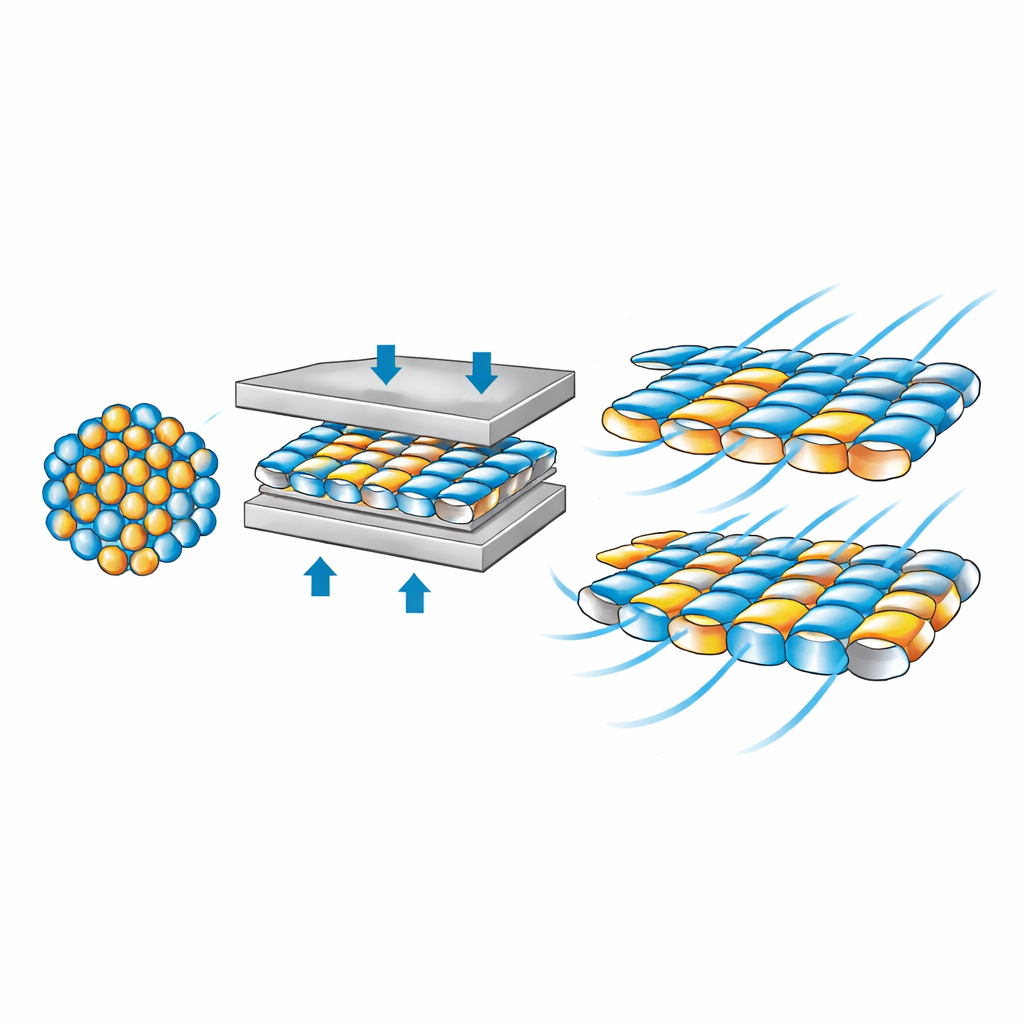
The authors build a geometric model that treats each yarn in the fabric as a bundle of many parallel filaments arranged in a dense honeycomb pattern—like tightly packed bubbles. As the fabric is woven, and especially when it is pressed between hot rollers in a process called calendering, these circular bundles are squeezed flatter where they cross. In the model, their cross-section changes from a round shape to a rounded rectangle, much like a slightly squashed capsule. By tracking how wide and how thick these bundles become, and how closely they sit next to one another in both warp and weft directions, the researchers can calculate how much of the fabric’s volume is solid fiber and how much is empty space. This “porosity” is the key to how easily air can seep through the canopy.
Real Parachute Cloth Under the Microscope
The team tested commercial Ortex parachute fabrics made from polyamide and polyester yarns supplied by a Czech manufacturer. They measured fiber fineness, strength, stretch, and stiffness, and examined the woven structures using optical and electron microscopes. The polyester bundles turned out to be slightly smaller in diameter because polyester is denser than polyamide; this means more bundles can be packed into the same area. In calendered fabrics, the polyamide filaments flattened much more than the polyester ones, producing a tighter structure. As a result, the finished polyamide fabric had lower porosity—about 31% empty space—while comparable polyester fabrics remained much more open, at around 49% porosity, even after repeated calendering.
Linking Airflow to Fabric Design
To connect structure with performance, the researchers measured how much air passed through 20-square-centimeter fabric samples under different pressure drops using a specialized tester. Polyamide fabric consistently allowed the least air through, while unfinished polyester let the most, and calendered polyester fell in between, matching the porosity trends. The team then compared two mathematical descriptions of how air moves through porous materials. A simple linear rule known as Darcy’s law assumes that the pressure drop across the fabric rises in direct proportion to the air flow. A more complex, quadratic rule, often used for packed beds of particles, adds an extra term that grows with the square of the flow. When fitted to the measurements, the extra quadratic term offered no meaningful improvement: the data were well described by the straightforward linear law.
What This Means for Safer Falls
For parachute designers, the study offers a practical toolkit. By starting from fiber type and yarn construction, then accounting for how weaving and calendering flatten the filament bundles, they can estimate fabric thickness, density, porosity, and—most importantly—air permeability. The finding that a simple linear relationship accurately links pressure drop and airflow means that predicting performance across different conditions is easier than previously thought. Polyamide fabrics, which flatten more under calendering, naturally deliver tighter, less breathable canopies than polyester for the same yarn size. Polyester can still be used successfully, but it requires a slightly denser weave to reach the low air permeability that keeps a parachute stable. In short, the way millions of microscopic gaps are shaped and squeezed determines how gently—and how safely—someone returns to Earth.
Citation: Křemenáková, D., Militký, J. & Venkataraman, M. Structure and air permeability of polyamide and polyester parachute fabrics. Sci Rep 16, 12810 (2026). https://doi.org/10.1038/s41598-026-43221-4
Keywords: parachute fabrics, air permeability, polyamide nylon, polyester PET, porosity