Clear Sky Science · en
Biomechanical evaluation of X-ray permeable CF/PEEK composite versus conventional titanium alloy for tibial external fixation plates: a finite element analysis
Why a New Kind of Bone Plate Matters
When a major leg bone breaks, doctors must hold the pieces steady long enough for them to grow back together. That is hard to do when the surrounding muscles and skin are badly damaged and swollen, as often happens with serious tibial (shinbone) fractures. Traditional metal frames and plates can be bulky, uncomfortable, and make it difficult for surgeons to see how well the fracture is healing on X‑rays or MRI. This study asks whether a newer, X‑ray–friendly composite material called CF/PEEK can safely replace standard titanium plates placed on the outside of the leg bone, potentially making care gentler and healing easier to monitor.
Modern Splints on the Outside of the Bone
For severe tibial fractures, surgeons sometimes fix a long metal plate to the outside of the shinbone using screws, like a low‑profile splint that stays outside the damaged soft tissues. This approach combines some advantages of internal plates with the easier wound access of external frames. But titanium plates are much stiffer than bone and block X‑rays, which can hide early signs of healing or infection. CF/PEEK, a carbon‑fiber–reinforced plastic, is strong, lighter, and mostly invisible on imaging scans. The researchers wanted to know whether swapping the plate material from titanium to CF/PEEK would change how forces travel through the leg and the healing fracture.
Testing Plates in a Virtual Leg
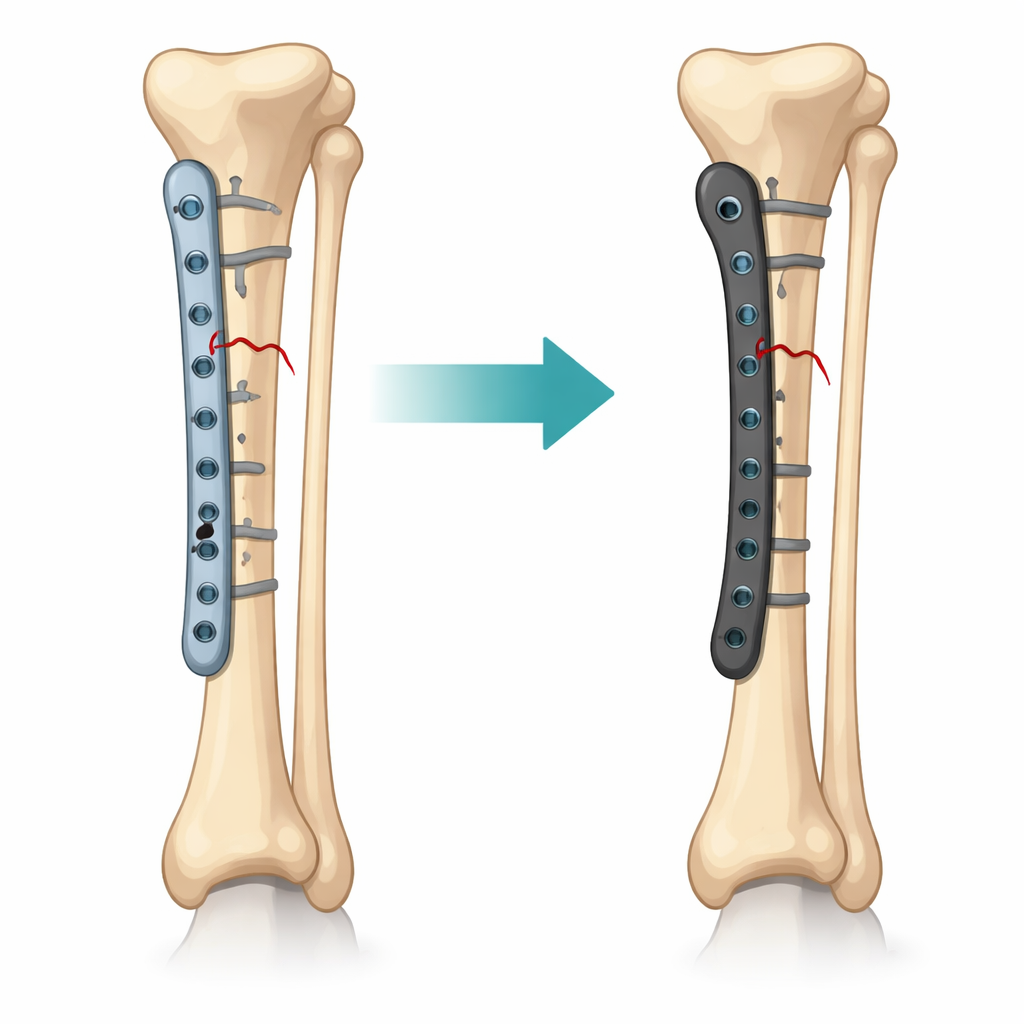
Instead of experimenting on patients, the team built a detailed computer model of a human tibia using high‑resolution CT scans of a healthy volunteer. They created a clean break high in the shaft and attached a plate on the inner side of the bone, held by six screws above the fracture and four below. Two screw layouts below the break were tested: one with screws lined up neatly, and one with them slightly staggered. Using finite element analysis—essentially a highly refined stress‑test simulation—they compared titanium and CF/PEEK plates under three demanding conditions that mimic weight‑bearing: straight downward load, and the same load combined with inward or outward twisting of the leg.
What Happens to the Plate, Screws, and Fracture
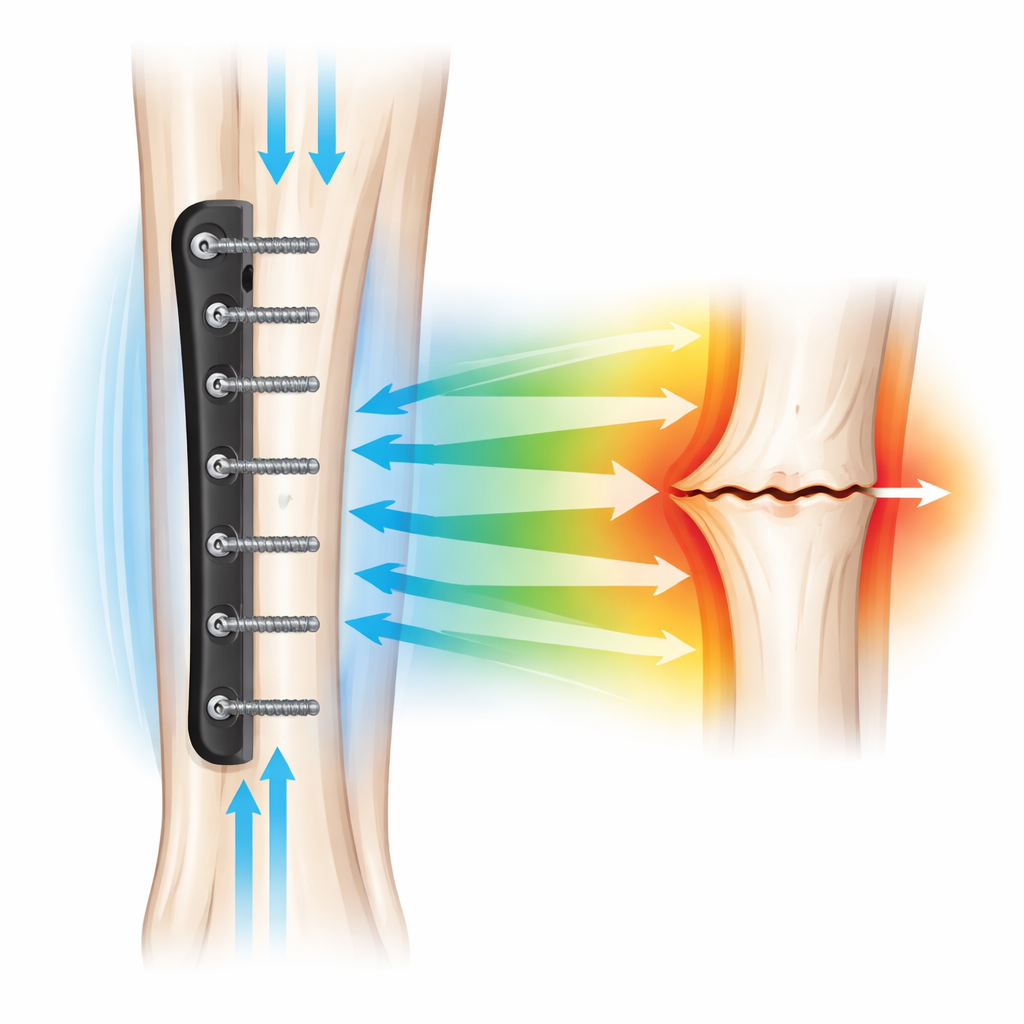
The simulations showed that when CF/PEEK replaced titanium, the whole construct—the bone, plate, and screws—flexed a bit more, by about 8 to 12 percent. This extra movement was small, on the order of a few tenths of a millimeter, but enough to change where the stresses went. In the titanium setup, high stresses concentrated in the plate and around a few screws, especially under twisting. In the CF/PEEK setup, those stresses dropped sharply in the hardware—plate stresses fell by roughly half to four‑fifths, and screw stresses by about one‑quarter to one‑third—while more stress shifted to the region of the fracture line. The contact between the bone ends also moved slightly more, but still within a range that is thought to encourage normal healing rather than cause instability.
How Screw Patterns and Stress Sharing Behave
The two screw patterns, straight and staggered, behaved almost the same when the plate was made of CF/PEEK. Both layouts produced similar displacements and stress levels, suggesting that in this specific configuration, the material of the plate matters more than fine‑tuning the screw alignment. Close‑up views of the simulated fracture showed that titanium tended to spread stress around the screw holes at the plate edges, while CF/PEEK concentrated stress more directly at the break itself. The pattern of bone motion near the gap suggested a steeper gradient across the fracture with CF/PEEK, consistent with controlled “micromotion” that can stimulate bone to rebuild. Because the stresses in the CF/PEEK plate itself stayed far below the material’s yield point, the model did not indicate any obvious risk of the composite plate failing under the tested loads.
What This Could Mean for Patients
To a patient, these engineering details translate into a promising possibility: an external plate that is strong enough to hold the bone, flexible enough to share load with the healing fracture, and clear enough on scans for doctors to see what is happening underneath. The study suggests that CF/PEEK plates can match titanium in overall stability while reducing stress on the hardware and increasing helpful stress at the fracture site—conditions that may lessen “stress shielding” and support earlier biological healing. While this work is based on computer models and needs confirmation in lab and clinical studies, it points toward lighter, imaging‑friendly, and potentially “smarter” fixation systems that could one day track healing in real time and guide safer, more personalized rehabilitation.
Citation: Wang, S., Zhao, Z., An, L. et al. Biomechanical evaluation of X-ray permeable CF/PEEK composite versus conventional titanium alloy for tibial external fixation plates: a finite element analysis. Sci Rep 16, 13506 (2026). https://doi.org/10.1038/s41598-026-43182-8
Keywords: tibial fracture, external fixation, CF/PEEK plate, finite element analysis, bone healing