Clear Sky Science · en
Shear behavior of high-strength reinforced concrete beams with circular openings under fire exposure
Why Holes in Concrete Beams Matter in a Fire
Modern buildings are crisscrossed with hidden pipes, cables, and ducts, many of which pass through holes cut in concrete beams. These openings save space and simplify services, but they also weaken the structure—especially in a fire, when concrete and steel are pushed to their limits. This study looks at how high-strength concrete beams with large circular holes behave under intense heat, and how two practical strengthening methods can help them survive and stay safe after a fire.
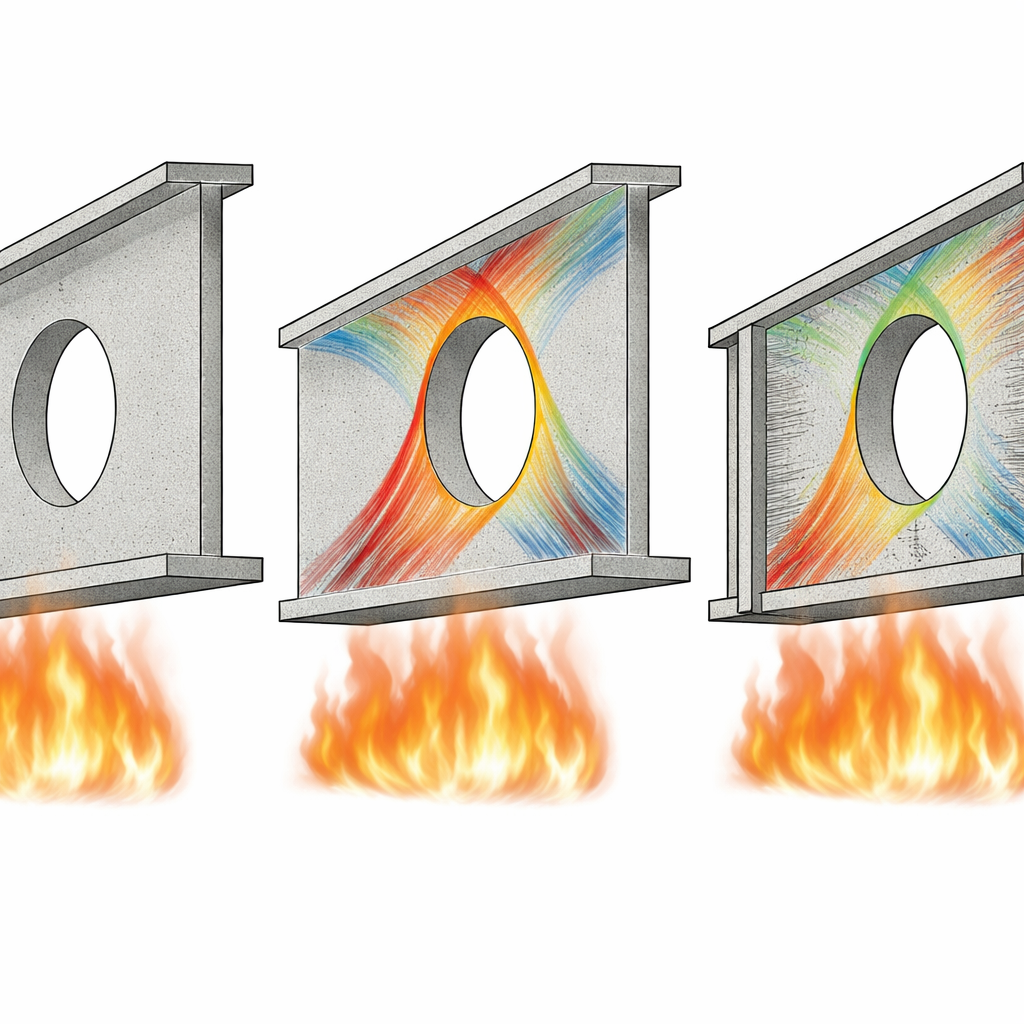
Beams, Fire, and Large Round Holes
The researchers focused on high-strength concrete, a material prized for its durability and compact structure. That same density, however, makes it more brittle and prone to explosive flaking when heated. In many real buildings, large round holes are formed in the web (the central part) of these beams to let services pass through. When the beam is loaded, forces must “flow” around the hole, concentrating stresses and encouraging cracks. In a fire, the outer layers of concrete heat up, lose strength, and crack, which further disrupts how forces move through the beam. Understanding this combined effect of openings and fire is essential for engineers who must judge whether a damaged beam can still carry loads—or how best to repair it.
How the Tests Were Carried Out
To tackle this problem, the team built and tested nine beams of identical size. One was a solid reference with no hole. The others had a single large circular opening in the web, about half the beam depth, placed in a shear-critical region near the support. Some beams were left unmodified, others had steel fibers mixed into the concrete, and a third group was wrapped locally with a thin outer jacket made of wire mesh and mortar, known as ferrocement. Selected beams were heated to 500 °C for an hour while carrying a modest load, then rapidly cooled with water to mimic sudden fire-fighting conditions before being loaded to failure in bending and shear.
What Fire and Strengthening Did to the Beams
The large circular openings had a dramatic impact. Compared with the solid reference beam, an un-strengthened beam with an opening carried only about one-third of the load before failing, and it deflected less at failure, signaling a more brittle response. When that same configuration was exposed to fire, its shear capacity dropped by as much as 68%, and cracks formed early and spread rapidly around the opening. Adding steel fibers inside the concrete helped: fibers at 0.5% and 1.0% by volume bridged cracks and delayed their growth, slightly raising the cracking load and boosting the ultimate load after fire by up to about 16%. Ferrocement jackets wrapped around the region of the opening also improved behavior. They held the cracked concrete together, produced many small cracks instead of a few wide ones, and reduced mid-span deflections. After fire exposure, these jackets restored up to roughly 14.5% of the lost shear capacity and cut deflections by about one-third compared with the damaged, un-strengthened beam.
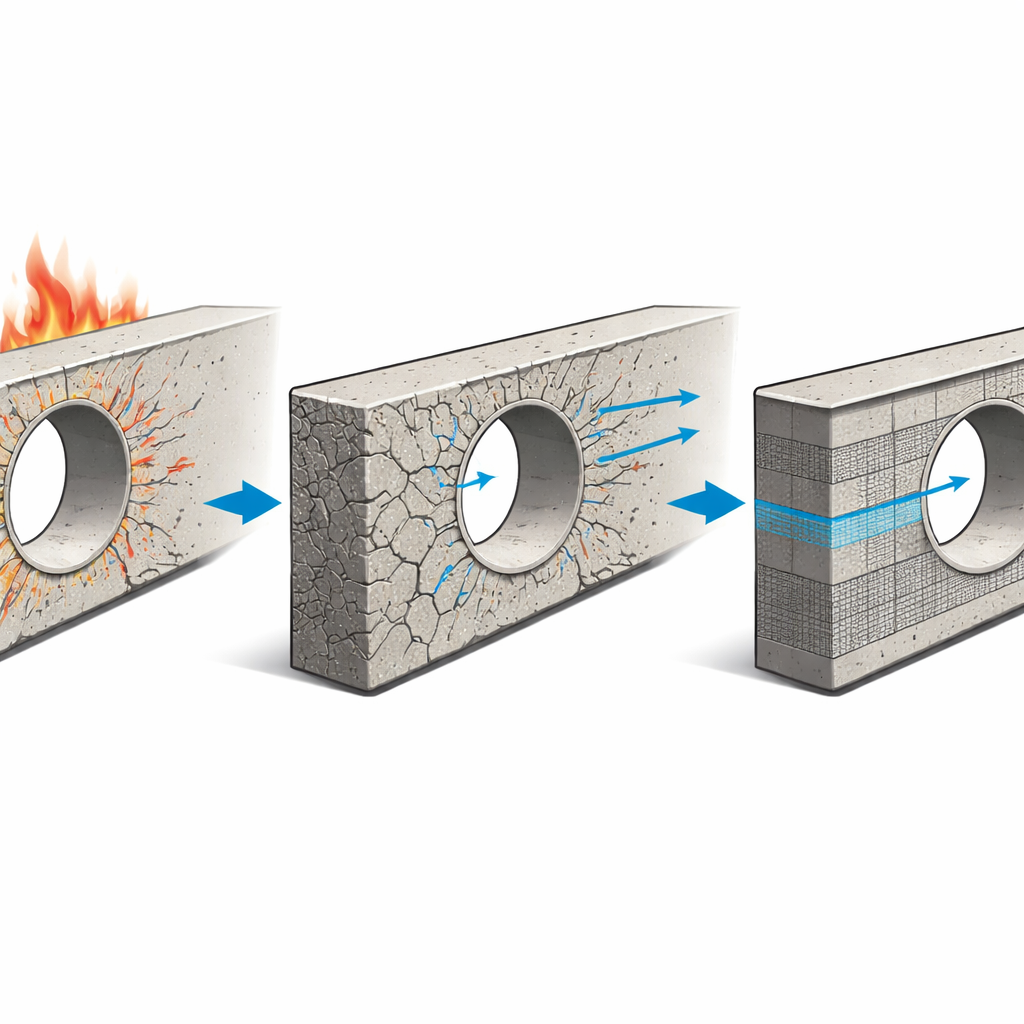
Digital Twin Checks and Design Insights
Beyond the laboratory, the authors created detailed computer models of the beams using finite element analysis, feeding in realistic temperature-dependent properties for concrete and steel. These models successfully reproduced how the beams deflected, when they cracked, and how they ultimately failed, with differences of only a few percent from the experiments. The virtual beams were then used to explore what happens when the openings are made smaller or larger and when fire temperatures rise from 400 to 600 °C. The simulations confirmed that bigger holes and hotter fires both sharply reduce shear strength, and that the benefits of strengthening are less pronounced when the opening becomes very large.
What This Means for Real Buildings
For non-specialists, the main message is straightforward: large round holes in high-strength concrete beams can become serious weak spots, especially after a severe fire. This study shows that mixing short steel fibers into the concrete can help the beam carry more load and absorb more energy after cracking, while thin ferrocement jackets are particularly effective at limiting bending and visible sag. Together with reliable computer models, these findings give engineers better tools to judge when fire-damaged beams with openings can be repaired, how effective different repair methods are likely to be, and when complete replacement is the safer choice.
Citation: Sedawy, A.E., Beshr, A.A.A. & Mahmoud, I.A. Shear behavior of high-strength reinforced concrete beams with circular openings under fire exposure. Sci Rep 16, 13138 (2026). https://doi.org/10.1038/s41598-026-43162-y
Keywords: structural fire safety, high-strength concrete, beam openings, steel fiber reinforcement, ferrocement retrofitting