Clear Sky Science · en
Patterned magnetic pole configurations in bonded magnets
Shaping Magnetic Fields Inside Everyday Plastics
Magnets are usually thought of as solid blocks that simply stick to metal. But many emerging devices—from compact motors to soft robotic grippers—need magnets whose strength and direction change from place to place inside a single part. This paper shows how to "print" such patterned magnets directly into plastic using a laser-based 3D printing process, opening the door to custom-shaped magnetic fields built right into everyday components.
Why Printed Magnets Matter
Traditional magnets are made in bulk and then cut and assembled into complex arrangements. That works for simple motors, but it becomes awkward, costly, and sometimes impossible when devices get smaller or shapes get more intricate. Additive manufacturing, or 3D printing, promises a different approach: mix magnetic particles into a plastic, print almost any shape, and let the plastic hold everything together. Previous work has already shown that magnets can be printed by several techniques, but the magnetic properties were usually uniform throughout the part. The goal here is more ambitious—to create magnets whose internal regions can be made stronger or weaker, and whose poles can point in different directions, all in one continuous print.
Building a Smarter 3D Printer
The researchers modified a selective laser sintering system, a form of 3D printing that uses a laser to fuse powder layer by layer. They began with a nylon powder as the base plastic and added carefully chosen magnetic powders: a "hard" magnet (NdFeB), which keeps its magnetisation, and two "soft" magnets (FeSi and FeCo), which respond strongly to a field but lose most of their magnetism when it is removed. Above the powder bed, the laser drew out each layer of the part. Below the bed, custom-built electromagnets applied controlled magnetic fields during and after the melting of the powders. On top of that, a set of miniature hoppers and a suction nozzle rode along the spreading blade so that small pockets of base powder could be removed and refilled with specific magnetic powders at precise locations. The result was a printed plastic bar with embedded "magnetic islands" made of different materials and exposed to different field directions.
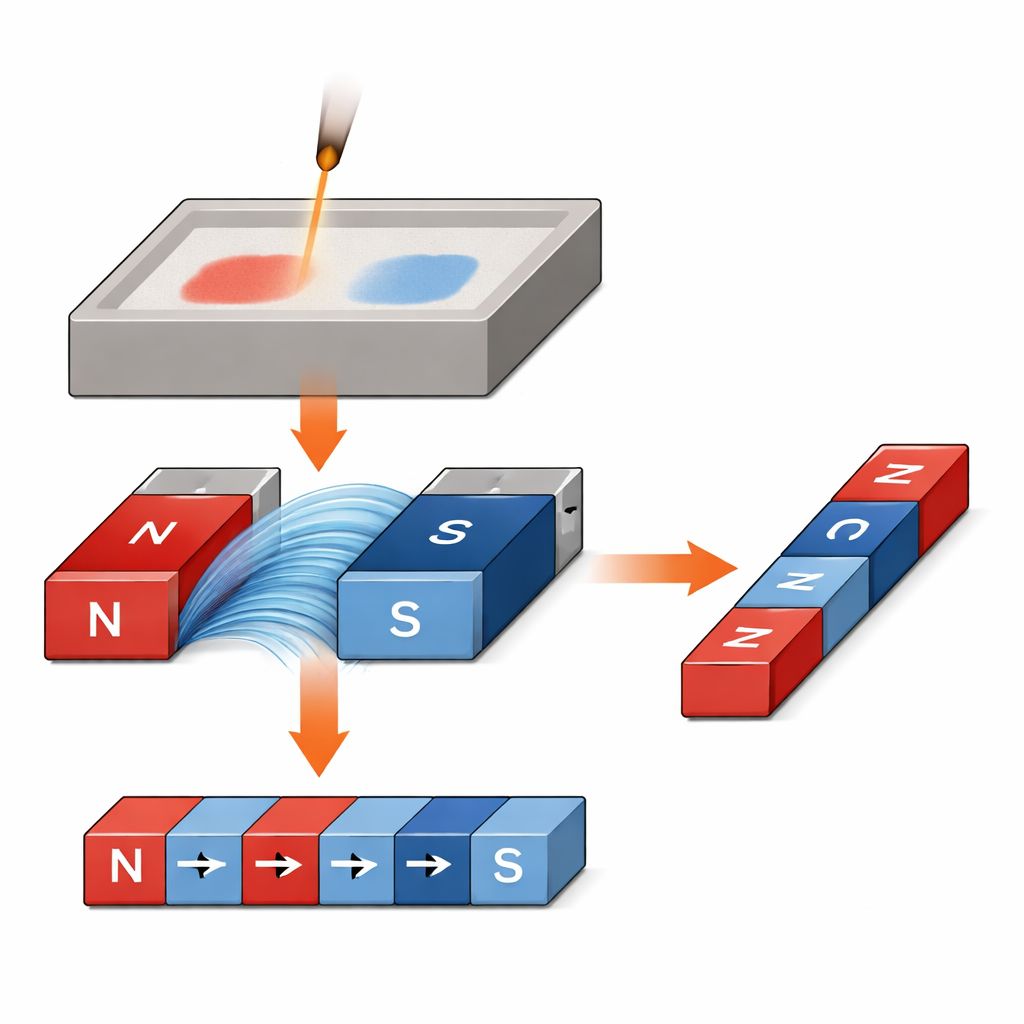
Seeing Patterns in the Magnetic Landscape
To find out how well this strategy worked, the team produced simple bars containing two magnetic islands at either end, sometimes using the same hard magnet on both sides, and sometimes pairing the hard magnet with one of the soft materials. They then measured the magnetic field across the surface using a probe and used a thin layer of ferrofluid—a liquid that clings to magnetic regions—to visualise where field lines emerged or returned. Even in the as-printed state, without any strong post-treatment, the bars showed clear, non-uniform pole patterns. By simply switching the direction of the external field used during printing, the researchers could make one end of the bar favour a north-like region while the other favoured a south-like region, or split a region into more complex multi-pole arrangements.
Turning Up the Magnetic Strength
Printing alone created only weak fields, so the researchers next placed the parts in a strong external magnetiser, similar to how permanent magnets are usually activated. After magnetisation at field strengths around 1.5 to 1.9 tesla, the local magnetic flux values in the hard-magnet regions increased several-fold. For bars containing NdFeB with FeSi or FeCo, the north-facing regions reached up to roughly four to ten times their as-printed strength, while the soft-magnet regions still showed almost no permanent magnetism. When the samples were examined under an additional external field, both combinations produced strong, well-defined differences between north- and south-like zones—on the order of tens of millitesla—without losing the spatial patterns set during printing. Even when the direction of the external field was reversed, the bars retained a preferred "easy axis," a directional bias that had been imprinted during the laser consolidation step.
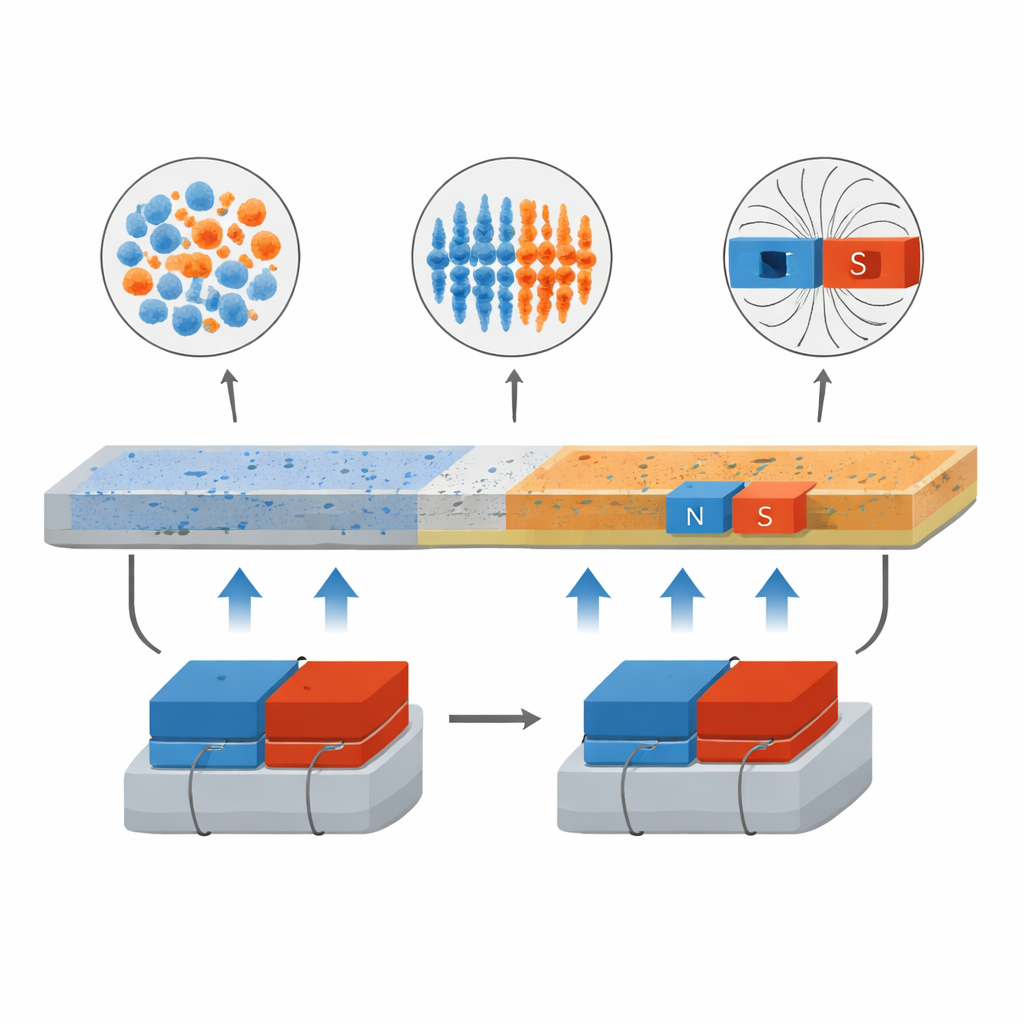
From Laboratory Bars to Future Machines
Taken together, the experiments confirm the central idea of the study: 3D printing can do more than merely shape the outside of a magnet; it can pattern its internal magnetic landscape as well. By combining on-the-fly control of which powders go where with finely timed external magnetic fields, the team demonstrated bonded magnets whose poles and strengths vary in a programmable way. Although the present samples are simple bars, the same method could be extended to more intricate shapes and multiple magnetic materials. For non-specialists, the key message is that magnets of the future may be printed like complex circuit boards, with regions that guide, concentrate, or cancel fields exactly where needed, enabling slimmer motors, more efficient magnetic levitation, and soft devices that bend or grip on command.
Citation: Behera, M.P., Lv, Y. & Singamneni, S. Patterned magnetic pole configurations in bonded magnets. Sci Rep 16, 13102 (2026). https://doi.org/10.1038/s41598-026-43131-5
Keywords: 3D printed magnets, selective laser sintering, magnetic field patterning, bonded magnetic composites, energy coupled manufacturing