Clear Sky Science · en
Evolution and dip effect of boundary spatial morphology of top-coal limit equilibrium zone in steeply dipping coal seam
Why roof coal matters for safe mining
Deep underground, miners often work beneath a layer of coal that stays above their heads while machines cut the seam below. In steeply tilted coal seams, this overlying “top coal” can break and slide in complex ways, threatening the steel supports that keep the roof from collapsing. This study asks a practical question with major safety and economic stakes: how does the shape of the broken top-coal zone evolve as mining moves forward, and how does the steepness of the seam change that behavior?
The challenge of mining on a slope
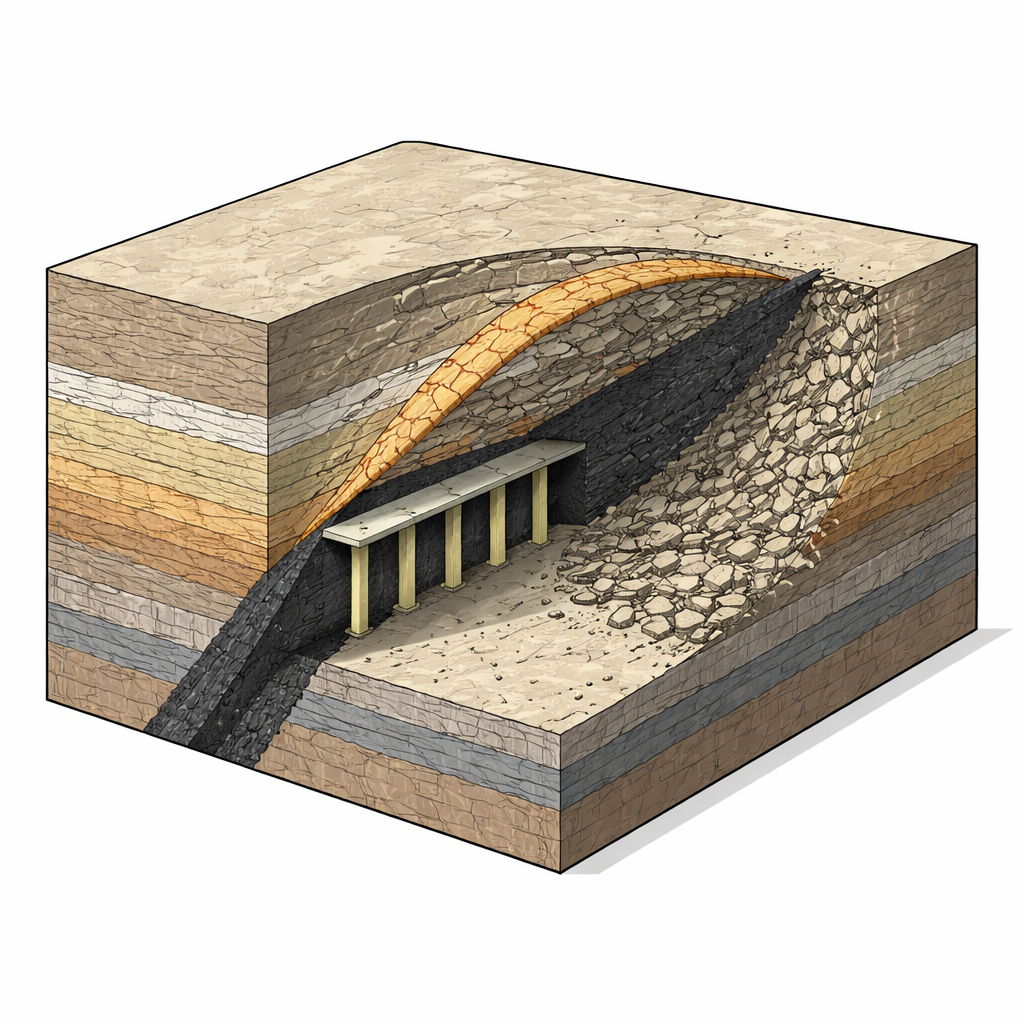
Most research on longwall coal mining assumes seams that are nearly horizontal, where rock pressures tend to spread out fairly evenly around the equipment. In steeply dipping seams, gravity acts down the slope of the seam, so stresses concentrate unevenly from the lower side of the face to the upper side. The coal above the supports does not simply bend and crack symmetrically; instead, it fails in zones that migrate and grow as the face advances. Because this top coal is the only solid medium linking the supports to the rock above, predicting where and how it fails is key to avoiding roof falls, support toppling, and coal losses.
Building a virtual mine
The authors used a detailed three-dimensional numerical model, based on the Changshanzi Coal Mine in western China, to recreate a fully mechanized longwall face in a steeply dipping seam about 35 degrees from horizontal. They represented the surrounding rock layers and the coal seam with realistic strength and stiffness values, refined the computer grid around the top coal, and simulated the advance of the mining face one meter at a time. As lower coal was removed, the overlying top coal was allowed to fracture, cave, and be drawn off behind the supports, while the void was backfilled to mimic real operations. Virtual measuring surfaces inside the top coal recorded how the main stress components changed in space and time as mining proceeded.
How the hidden fracture zone takes shape
From these stress patterns, the team reconstructed the three-dimensional boundary of what they call the top-coal limit equilibrium zone—the region where the coal is on the verge of failure and can no longer behave like a solid block. At first, this boundary appears as an irregular band near the face. As mining continues, it transforms into an “asymmetric arc-shaped ribbon-like curved surface,” a gently curved shell that leans toward the upper side of the seam and then eventually reaches a stable form. The evolution is not uniform: along the dip (slope) direction, the boundary develops first in the lower part of the face, then in the lower‑middle, then the upper, and last in the upper‑middle area; along the strike (length) direction, it grows from the top down. Even after the stresses ahead of the face settle into a steady pattern, this curved failure shell preserves a memory of the way the coal has progressively degraded.
What happens when the seam gets steeper
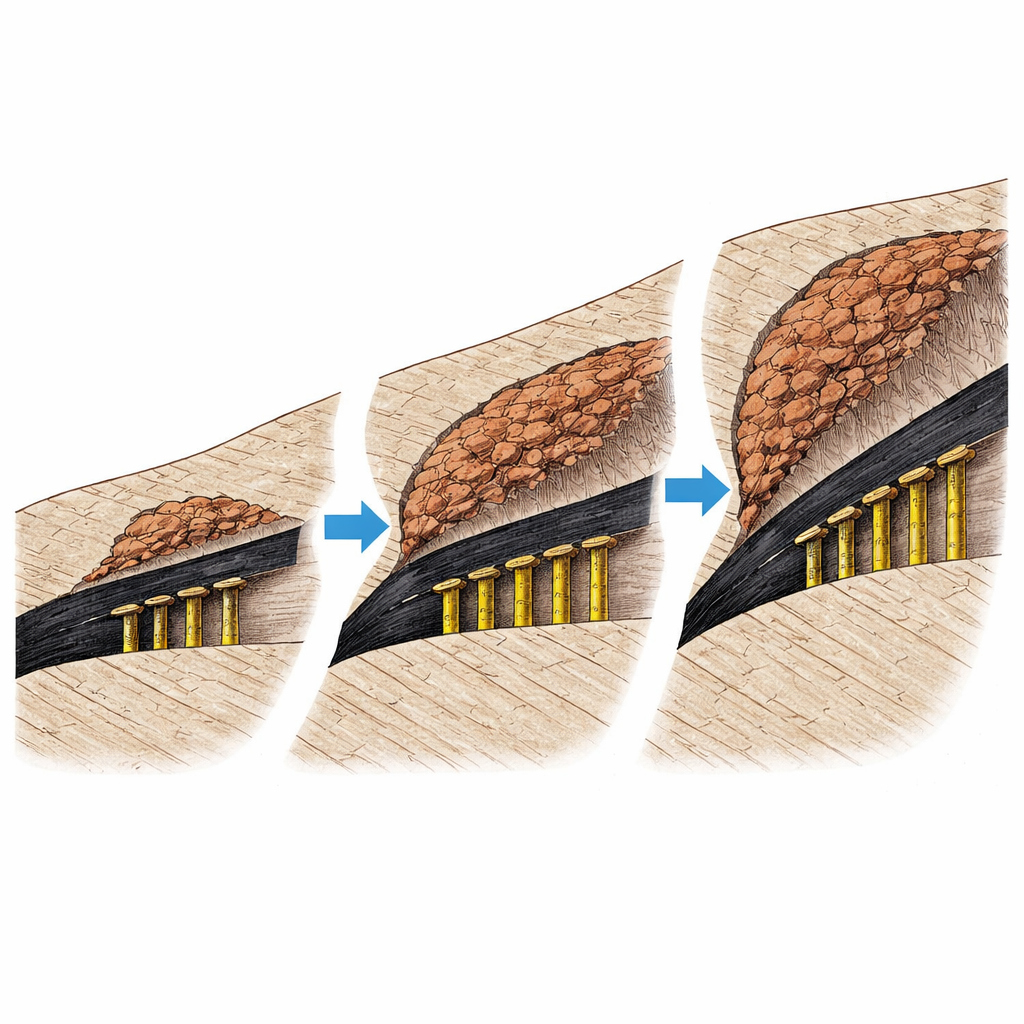
To explore the “dip effect,” the researchers repeated their simulations for steeper seams at 45 and 55 degrees. As the seam steepens, both the maximum and minimum principal stresses in the top coal decline, but their distribution becomes more uneven: the most intense zones shift toward the lower side of the face, and the stress pattern grows more asymmetric. The limit-equilibrium shell forms sooner and its extent grows larger, with the deepest failure reaching about 4.5 meters for the gentler case and up to 7.5 meters for the steepest. The curved shell’s high point moves upward along the seam, reflecting a stronger tendency for the upper part of the top coal to break, slide, and fragment.
Linking coal breakage to support stability
The team then connected this hidden geometry to what miners actually observe. Using a simple mechanical model, they showed that when the coal above a support is highly fragmented, it transmits less load and offers less friction on the support canopy, making the support more prone to slip and topple downslope. Field measurements at the Changshanzi face confirmed the numerical picture: where the lower boundary of the limit-equilibrium zone lay farther from the mining face, top-coal leakage events were more frequent and the measured support resistance was lower. Where the boundary lay closer, coal stayed more intact, leakage was rare, and supports carried higher, more stable loads.
What this means for safer, smarter mining
In simple terms, the study shows that as a steep coal seam gets steeper, the zone of almost-broken top coal above the face grows larger, more lopsided, and more dangerous for the supports holding up the roof. By mapping how this invisible shell forms and shifts, mine engineers gain a tool for anticipating where coal will fragment most severely and where supports are most likely to lose stability. That insight can guide support design, face layout, and operating strategies to keep miners safer while improving coal recovery in some of the world’s most technically challenging deposits.
Citation: Wu, X., Chi, X., Lang, D. et al. Evolution and dip effect of boundary spatial morphology of top-coal limit equilibrium zone in steeply dipping coal seam. Sci Rep 16, 12268 (2026). https://doi.org/10.1038/s41598-026-43091-w
Keywords: steeply dipping coal seam, top coal caving, rock mass stress, roof support stability, numerical mine modeling