Clear Sky Science · en
Thermofluid and exergy characteristics of MoS2/water nanofluid flow in a flat‑plate solar collector under high‑irradiance conditions
Hot Water from Sunshine Made Smarter
For many households, especially in sunny regions, heating water quietly consumes a large share of energy bills and fuels climate-warming emissions. This study explores a way to make common rooftop solar water heaters significantly more effective by tweaking what flows inside them. Instead of plain water, the researchers tested a water-based liquid containing tiny particles of molybdenum disulfide (MoS₂), aiming to capture more of the Sun’s energy, cut costs over a system’s lifetime, and reduce pollution—all without changing the familiar flat-plate solar panels themselves.
Why Tiny Particles Can Make a Big Difference
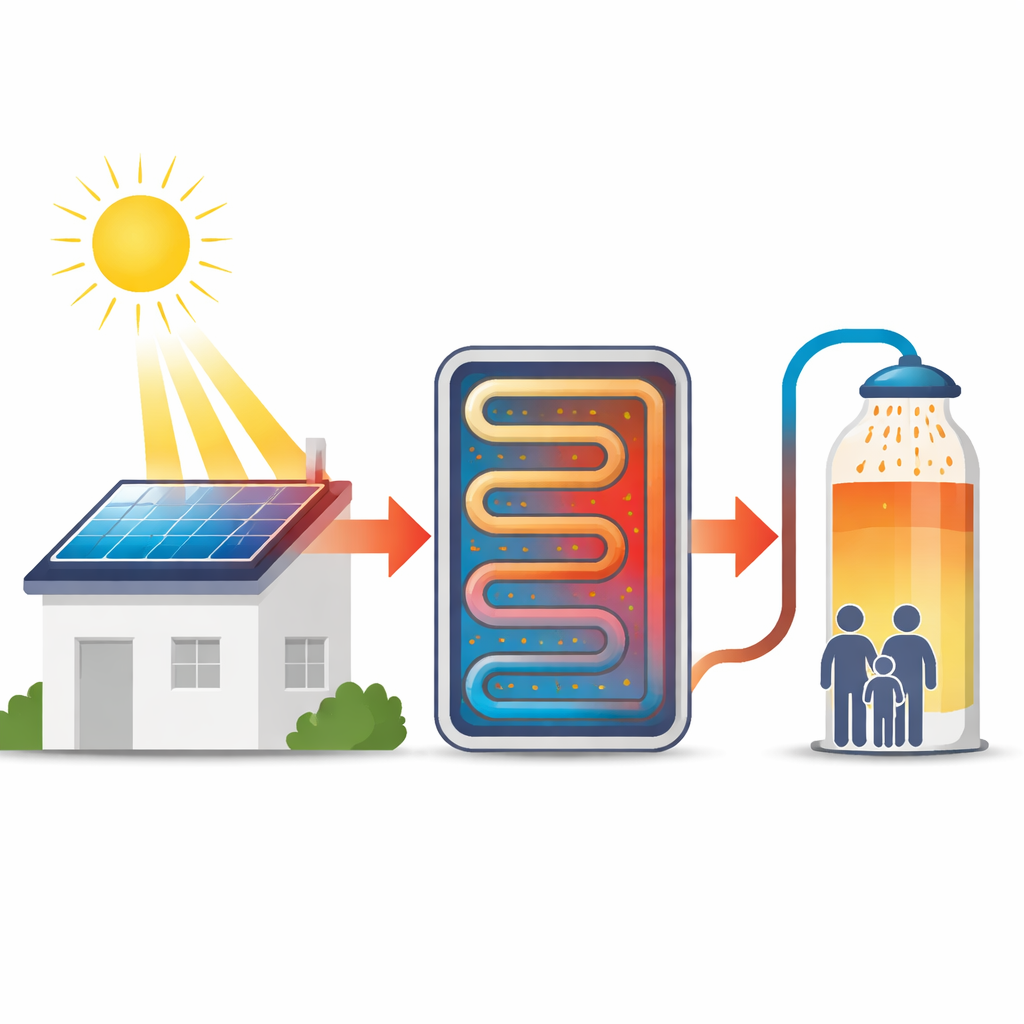
Standard flat-plate solar collectors, widely used for domestic hot water, work like a black metal panel that warms up in the Sun while water carries the heat away. The catch is that water is not an especially good heat conductor, so some of the captured solar energy is lost before it reaches the storage tank. The authors tackled this by dispersing extremely small MoS₂ particles into the water, creating a so-called nanofluid. These particles, known for their layered, heat-conducting structure and strong absorption of sunlight, help the fluid soak up and transport heat more efficiently. The system they studied matches a typical single-family home in Iran, with a rooftop collector, a pump circulating the fluid, and a vertical hot-water tank, all modeled in year-round computer simulations.
How the System Was Tested Over a Whole Year
To move beyond short laboratory trials, the team built a detailed digital model using TRNSYS, a widely used tool for simulating energy systems, and then checked it against real measurements from an outdoor test rig in Ahvaz, a very sunny city in Iran. They compared the model’s predictions of useful heat output with data from an actual collector under both clear and cloudy conditions. The match was close—errors were only a few percent—giving confidence that the virtual system could be trusted to explore performance over an entire year. The simulations examined three fluid options: plain water, water with 0.5% MoS₂ by volume, and water with 1% MoS₂, while also including a specially designed hot-water tank enhanced with a wax-based storage material containing aluminum oxide particles to smooth temperature swings.
More Heat, Better Use of Sunlight, and Lower Costs
Across all seasons, the nanofluid with 1% MoS₂ came out on top. In colder months, when gaining a few extra degrees matters most, the temperature at the collector’s outlet rose by about 20% compared with plain water, and the average useful heat gained by the system increased by up to 13%. The panel’s overall efficiency—how much of the incoming sunlight turned into usable heat—also climbed several percentage points, especially in spring and autumn. A more advanced measure called “exergy,” which tracks how much of the captured energy can actually perform useful work, improved even more: the 1% nanofluid boosted exergy output and exergy efficiency by roughly 20–22% while slightly reducing internal losses. In practical terms, the system put a larger share of the available sunlight to good use rather than wasting it as low-grade heat.
Money Saved and Emissions Avoided
Because the improved collector delivers more hot water from the same sun, the cost per unit of useful heat drops despite the added price of nanoparticles. The study calculated a metric called the Levelized Cost of Heat, which spreads all investment, maintenance, and material costs over the system’s lifetime. Under the brightest summer conditions, the 1% MoS₂ fluid achieved a minimum heat cost of about 0.77 dollars per kilowatt-hour of useful heat, and over the year it reduced the cost tied to high-quality (exergy) output by around 3–5% compared with plain water. Environmentally, the better-performing system displaces more electricity or fuel that would otherwise be burned for water heating, avoiding up to 44 kilograms of carbon dioxide emissions per month in peak periods. Indices that combine environmental and economic perspectives also improved, showing more pollution avoided for each dollar invested.

What This Means for Everyday Solar Hot Water
For non-specialists, the bottom line is that simply changing the working liquid inside a standard flat-plate solar water heater can unlock major gains without redesigning the hardware. In this study’s high-sun setting, a modest 1% dose of MoS₂ nanoparticles made the collector turn more sunlight into hot water, lowered long-term heating costs, and cut greenhouse-gas emissions, all while improving how steadily the system used available solar energy over the year. While future work must still confirm long-term stability and real-world maintenance needs, the results suggest that nanofluid-based collectors are a promising next step for cleaner, more efficient household hot-water systems in sunny regions.
Citation: Chammam, A., Widatalla, S., AlMohamadi, H. et al. Thermofluid and exergy characteristics of MoS2/water nanofluid flow in a flat‑plate solar collector under high‑irradiance conditions. Sci Rep 16, 11628 (2026). https://doi.org/10.1038/s41598-026-43090-x
Keywords: solar water heating, nanofluids, flat plate collectors, energy efficiency, renewable heating