Clear Sky Science · en
Continuous variable QKD inspired analog encryption for classical PAM links
Hiding Messages in Plain Sight
Modern fiber-optic networks move staggering amounts of data, from banking records to health files. Protecting that data usually relies on digital encryption running on top of the physical link. This paper explores a different idea: using the analog behavior of the light signal itself to hide information, borrowing inspiration from quantum key distribution but staying entirely in the classical, telecom-friendly world.
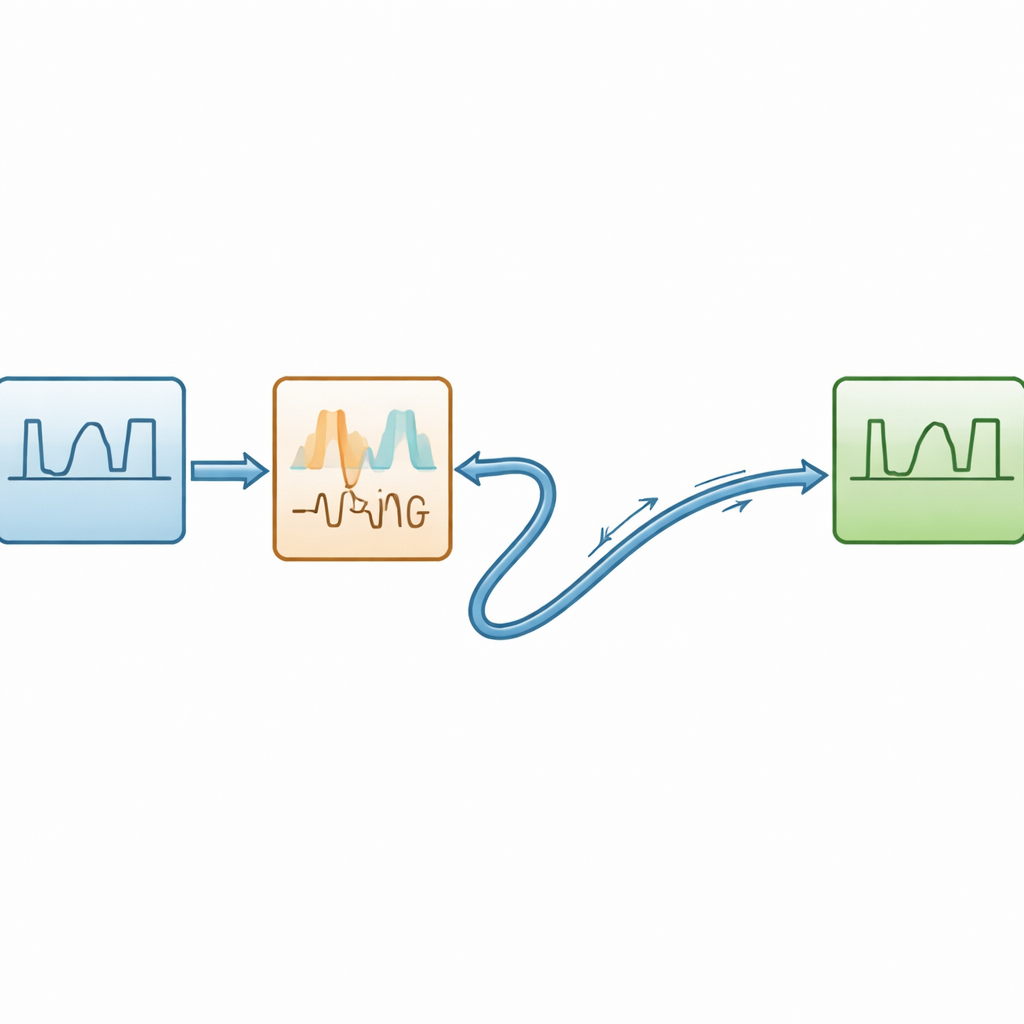
A New Way to Mask Light Signals
The authors study a scheme in which every symbol in a standard fiber link is deliberately "shaken" by a secret, random-looking analog pattern before it is sent. In technical terms, they add a Gaussian dither—a carefully controlled noise signal—generated from a shared secret seed and parameters. The transmitter adds this noise directly to the electrical waveform that drives the laser, and the intended receiver, which knows the same seed and noise settings, regenerates and subtracts it before deciding which symbol was sent. Because this masking happens on the same bright optical channel as ordinary data, it works with familiar intensity-modulation/direct-detection links and can coexist with optical amplifiers, unlike many quantum-key-distribution systems that need very weak light and special channels.
Keeping Things Simple for Real Networks
Instead of aiming for full quantum security, the proposal focuses on practical protection at the physical layer. The only extra ingredients are a high-quality pseudorandom number generator, a shared seed, and two numerical settings that control the added noise. No exotic detectors, no extra quantum fibers, and no heavy-duty coherent receivers are required. In a basic theoretical model where the only disturbance is ordinary Gaussian noise, the team shows that if the transmitter and receiver are perfectly synchronized, subtracting the secret dither restores performance to that of a standard 4-level pulse-amplitude-modulation link. The measured bit-error rate as a function of signal strength is essentially indistinguishable from a conventional system with no masking at all, confirming that the protection layer does not punish legitimate users when everything is properly aligned.
What Eavesdroppers and Misaligned Receivers See
The story changes as soon as the seed or noise settings are wrong. If an eavesdropper does not know the seed, or if a receiver uses the wrong noise amplitude, it cannot accurately regenerate the dither and therefore cannot fully cancel it. To that receiver, the masked signal looks as if extra, uncontrollable noise has been added. The authors find that this mismatch produces either a fixed error floor that does not improve when the signal gets stronger, or a substantial penalty in the signal level required to reach a given error rate. In other words, boosting power does not help an unauthorized listener recover the data: the masking behaves like a stubborn interference source that only the holder of the correct seed and parameters can remove.
Turning Quantization into a Security Feature
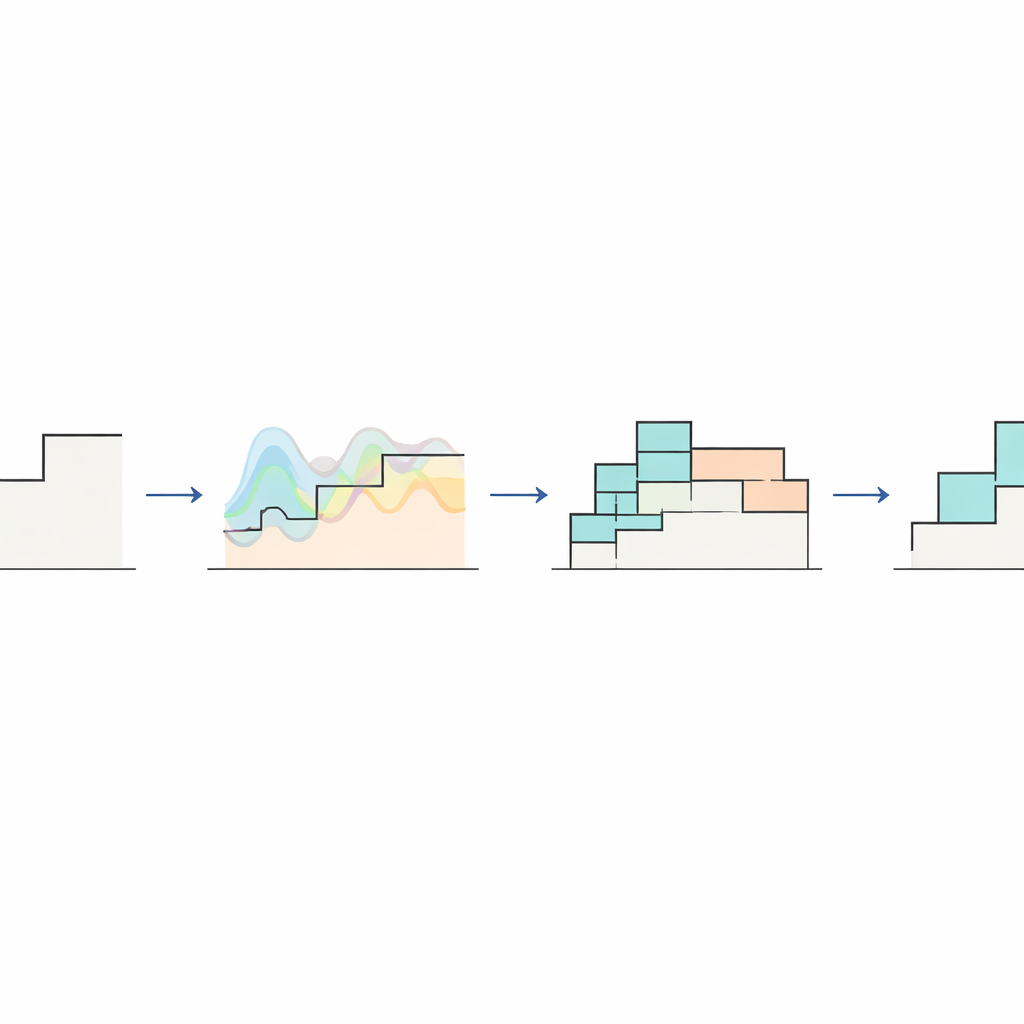
The researchers then intentionally introduce an extra twist that exploits the way electronics digitize analog signals. They route the dithered 4-level symbols through an 8-level quantizer at the transmitter and a 4-level quantizer at the receiver, creating a pseudo-constellation whose amplitudes follow a bell-shaped profile reminiscent of probabilistic shaping. Because these two quantizers do not perfectly undo each other, a small but unavoidable chance of symbol error appears even when the physical channel is otherwise clean. This creates an intrinsic bit-error floor that can be adjusted by changing the strength of the dither and the quantizer design. Crucially, the team shows that by selecting forward-error-correction codes whose decoding threshold sits near this floor, the link can be run in a deliberately fragile regime: tiny extra disturbances, such as a slightly wrong noise setting or seed, push the error rate beyond what the code can handle, causing decoding to fail and effectively scrambling the payload for unauthorized observers.
Why This Matters for Future Secure Links
Overall, the work demonstrates that ideas from continuous-variable quantum communication can be repurposed as a purely classical, hardware-friendly masking layer for existing optical links. The scheme adds only modest complexity to standard intensity-modulation systems while sharply distinguishing between receivers that know the secret analog pattern and those that do not. Instead of promising absolute, physics-backed secrecy, it offers a tunable, "edge-of-correction" operating point where legitimate users communicate normally but small mistakes or missing keys quickly render the data unusable. This makes the approach an attractive building block for future secure metro and access networks, potentially combined with conventional encryption or even a separate quantum key distribution channel that supplies the shared seed.
Citation: Atieh, A., Raytchev, A., Raytchev, M. et al. Continuous variable QKD inspired analog encryption for classical PAM links. Sci Rep 16, 13478 (2026). https://doi.org/10.1038/s41598-026-43061-2
Keywords: optical communication security, physical layer encryption, Gaussian dither masking, pulse amplitude modulation, quantum inspired cryptography