Clear Sky Science · en
Integrated experimental, machine learning, and life-cycle assessment of fly ash–silica fume based self-compacting geopolymer concrete
Why this new concrete matters
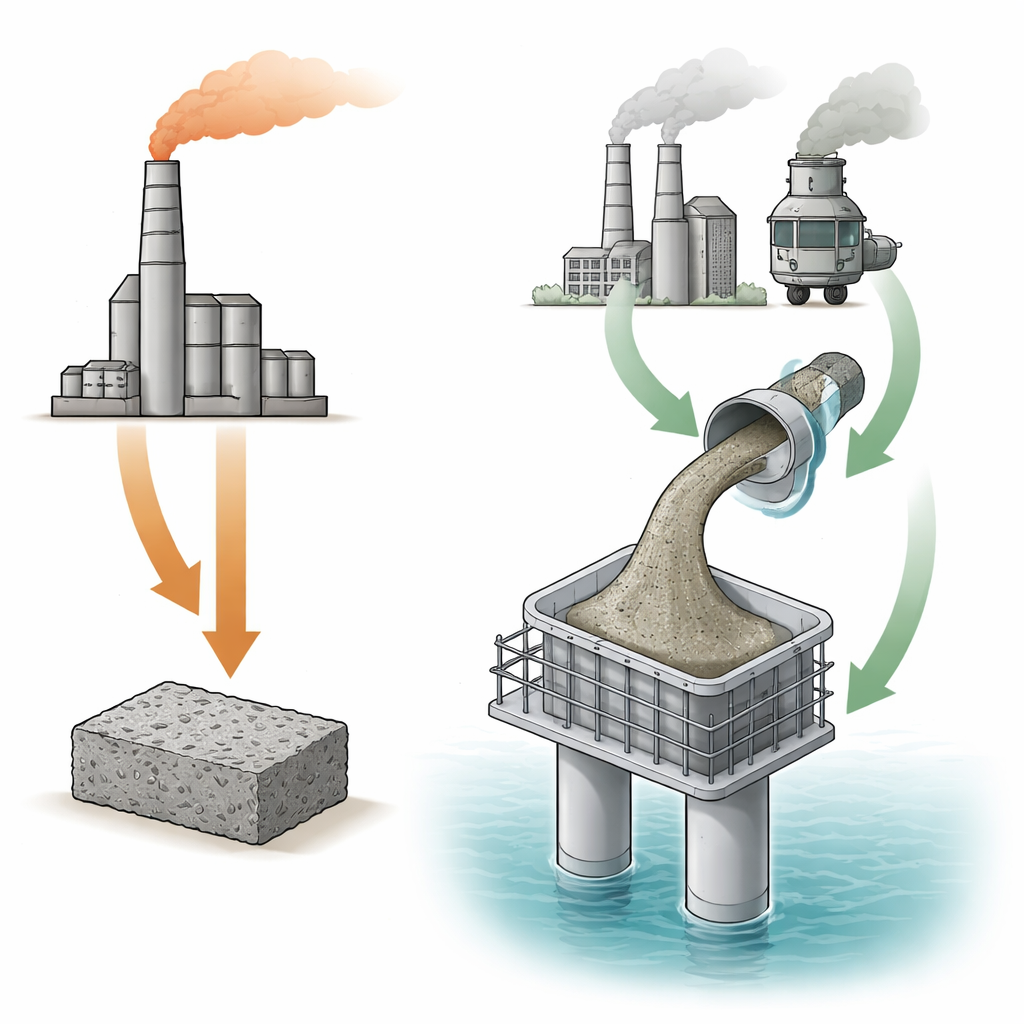
Concrete is everywhere—roads, bridges, buildings—and making it releases huge amounts of carbon dioxide. This study explores a new type of concrete that aims to be strong, long‑lasting, easy to place on construction sites, and much kinder to the climate. Instead of relying on traditional cement, it turns industrial by‑products into a high‑performance material that flows into place under its own weight, potentially cutting both emissions and maintenance costs.
Turning industrial leftovers into building blocks
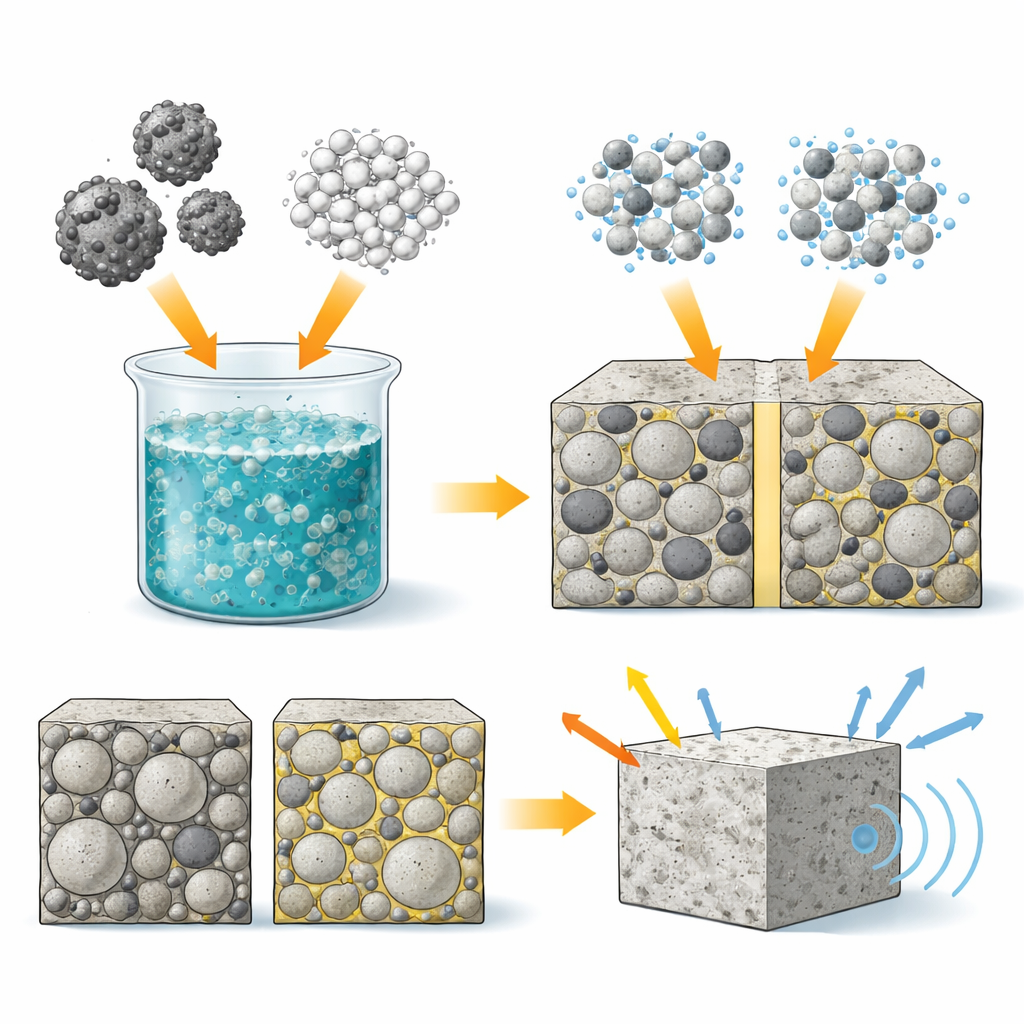
The researchers focused on a material called self‑compacting geopolymer concrete. Unlike regular concrete, which depends on Portland cement, this mix uses fly ash from coal power plants and silica fume from metal production as its main binding ingredients. When these powders react with an alkaline solution, they form a hardened network that can rival or even surpass conventional concrete. The team made four versions of this geopolymer, replacing part of the fly ash with silica fume at 0, 5, 10, and 15 percent, plus a fifth mix made with ordinary cement as a real‑world benchmark.
Testing how it flows, hardens, and holds up
Because self‑compacting concrete must flow easily through dense steel reinforcement without vibration, the researchers first measured how each mix behaved when fresh using standard slump, funnel, and box tests. They then followed the concrete for six months, tracking compressive, tensile, and bending strength, as well as how quickly water was drawn into it, how easily chloride ions could pass through, and how sound waves traveled inside. Microscopy images revealed what was happening at the tiny scale of pores and gel networks, while a detailed life‑cycle assessment compared energy use and climate impact with the cement‑based control.
Finding the sweet spot for strength and durability
A clear winner emerged: the mix with 10 percent silica fume. It flowed more readily into tight spaces than the version without silica fume and even outperformed the ordinary cement concrete in key measures of self‑compacting ability. Over time, its strength kept climbing, reaching about one‑fifth higher compressive strength than the fly‑ash‑only geopolymer and comfortably beating the cement‑based mix after 180 days. It also resisted cracking better, as shown by higher tensile and bending strength. Durability tests told a similar story. Water was drawn into this concrete more slowly, and the electrical charge passed in a standard chloride test fell below the threshold often described as “very low” permeability. Faster travel of ultrasonic pulses through the material pointed to a denser, more uniform interior. Electron microscope images confirmed that the 10‑percent mix had fewer unreacted particles and voids, with a tighter, more continuous binding structure than the version without silica fume.
Using data science to predict performance
To move beyond trial‑and‑error in the lab, the team trained several machine‑learning models on their test results. These models took in details such as mix proportions, fresh‑flow properties, and curing time, and then predicted strength and durability. Among the approaches tested, an ensemble method called random forest gave the most accurate forecasts, closely matching measured values with relatively small errors. The model highlighted curing time and silica fume content as the most influential factors, mirroring the experimental findings and offering a practical tool for guiding future mix designs without exhaustive testing.
Cutting the carbon cost of construction
The environmental analysis compared each geopolymer mix to the cement‑based concrete from raw material production through concrete batching. Because it replaces energy‑intensive clinker with industrial by‑products, the geopolymer cut climate‑warming emissions by roughly 30 to 45 percent and lowered energy use by about 20 to 25 percent per cubic meter. Again, the 10‑percent silica fume mix came out best, delivering the lowest overall impact while still offering top‑tier mechanical and durability performance. Even when accounting for the environmental cost of the alkaline activators and silica fume processing, the geopolymer mixes consistently outperformed traditional cement concrete.
What this means for future structures
For a general reader, the takeaway is that it is possible to build strong, durable structures with far less environmental damage by smartly reusing industrial waste and fine‑tuning mix design. This study shows that a carefully balanced blend of fly ash and silica fume can yield a concrete that pours itself into complex forms, grows stronger over time, resists water and salt attack, and substantially reduces carbon emissions. With supportive design tools from machine learning and credible environmental accounting, such geopolymer concretes could help shift everyday infrastructure—from bridges to marine works—toward a more sustainable future.
Citation: Padavala, S.S.A.B., Avudaiappan, S., Prathipati, S.R.R.T. et al. Integrated experimental, machine learning, and life-cycle assessment of fly ash–silica fume based self-compacting geopolymer concrete. Sci Rep 16, 12845 (2026). https://doi.org/10.1038/s41598-026-43052-3
Keywords: geopolymer concrete, fly ash, silica fume, low carbon construction, self compacting concrete